Showing posts with label Franciscan friars. Show all posts

Thursday, April 30, 2009

Flu, Finances, Foreclosures, Fanatics, Farenheit -- Franciscans?

We certainly are living in "interesting times", as the fabled ancient Chinese curse puts it. Just read today that a huge section of the Anarctic ice shelf is breaking off leaving the glaciers more exposed to the ocean, which can increase their melting speed. As of today almost 170 people have died in Mexico due to the so-called "swine flu." The economic stimulus seems sluggish and US auto makers are in a very bad way. And Somali pirates in the Indian Ocean and Taliban militants in Pakistan and Afghanistan are upping the violence, plus the sectarian inter-Muslim violence spree in Baghdad, Iraq has taken scores of lives.


Swine flu news from Excelsior newspaper from Mexico City yesterday, Wednesday, 29 April 2009.

What, exactly, is happening in our world? On the one hand, probably nothing new as the Book of Ecclesiastes reminds us. Still, it seems to be a "new" reminder that we live in a very real and fragile world fraught with insecurities. Bailouts, viruses, car bombs, unemployment, homelessness -- all these have become harsh realities for so many people. Plus the horrific street gang violence in many of our cities and the brutal and "efficient" massacres of police and others over narcotrafficking along the USA -- Mexico border.


Somali pirates in the Indian Ocean this past April 2009

Even Arlen Spectre's change from the Republican Party to the Democratic Party the other day seemed to herald doom and gloom from the jilted party!

Being Gospel men, "instruments of peace" as Franciscan friars, even as Christians, can seem terribly deluded and naive, don't you think?

And yet, historically, this seems to be the climate in which Christians shine. I'm not suggesting that financial crises, droughts and famines, wars and plagues are something good! Rather, what I am pointing out is that it would seem that these become "blessed opportunities" as the Epistle of St. James teaches. Not that God sends these things -- I certainly don't abide that line of thinking. What seems to be the case is that these situations provide the proverbial "rubber meeting the road" times. Exactly how Christian am I?

I remember back in high school, my best friend who is now deceased, an evangelical Christian, talked to me about his faith often and provoked my Catholic faith by quoting the great American Baptist Evangelist, Rev. Billy Graham (whether this quote originated with him, I don't know): "If you were arrested for being a Christian, would there be enough evidence to convict you?"


Great quote, don't you think? So, how do we respond to situations rather than react? We can fall into panic and suspicion and even direct or indirect violence against others. Will we reach out to those in need -- those whose business have succumbed to the economic collapse, those whose houses are in foreclosure, those who are afflicted with swine flu, those who are victimized by violence -- especially the poor? Or will we try and protect ourselves in our "bunkers" of propriety and self-respect?


Currency of the USA "In God we Trust?"


This is a question that every Christian, I think, needs to ponder. Certainly it is one that we Franciscans must address! And address it we are -- Franciscan men and women, young and old, throughout the world. For instance, just this past year (2008), the Franciscan friars began a mission outreach among refugees in Darfur, that part of Sudan (eastern Africa) which has witnessed untold violence and repression. Franciscans -- men and women -- are advocating for deliberate and profound positive responses, often "green" responses, to the growing global warming concerns (e.g. Antarctic ice shelf melting).


Perhaps what we as Christians, and as Franciscans in particular, can offer is hope. It is certainly what we are proclaiming this Easter Season with our cry of "Christ is Risen! Indeed he is Risen!"


Maybe this really is our opportunity to shine. The candles we lit during the Easter Vigil, all lit from the Paschal Candle, the candles that the newly baptized held, the newly confirmed clung to -- isn't this all about hope? Not a "hope" that any political leader can elicit or proclaim. It is the singular hope of those who believe -- who have encountered -- Jesus is risen from the dead!

How about choosing hope, the kind that led St. Francis of Assisi way back 800 years ago or so to ask the Lord Jesus in prayer, "Lord, what do you want me to do?"

Monday, April 20, 2009

It's Easter -- again!


Christ is risen! Indeed he is risen!


Jersualem: interior of the Holy Sepulchre, the site which the ancient Christian Churches claim to be the location of both the Crucifixion of the Lord and the Tomb from which he resurrected. This is the ornately decorated Tomb.


Among the ancient Churches which have a place in the Holy Sepulchre -- Greek Orthodox, Armenian Orthodox, Roman Catholic (Franciscans), Coptic Orthodox and Ethiopian Orthodox


This past Saturday, 18 April, the Eastern Orthodox Christians throughout the world celebrated the Great Fire and the Matins of the Resurrection. Sunday, 19 April, is their celebration of Easter Sunday, or Pascha, and this is Bright Week.


The Greek Orthodox Patriarch of Jerusalem, Theofil, entered into the Tomb (to the right) with some of his clergy on Saturday night and emerged with the Sacred Fire, announcing the Resurrection of the Lord Jesus! This fire is then quickly passed among the crowds of believer both inside and outside the basilica in Jerusalem and beyond, and may even be taken by plane to Greece! (how they do this with security, I don't know!)


The Franciscan friars who serve in the Holy Land (they were part of the Good Friday collection two weeks ago on 10 April) celebrate Easter according to the Gregorian calendar. The major difference between the two reckonings of Easter is this -- the Western, or Gregorian, calendar follows this principle -- Easter is the first Sunday following the full moon after the vernal equinox (i.e. 21 March). The Eastern Orthodox reckoning states that Easter must follow the Jewish Passover, and so is the first Sunday after Passover (Jesus having fulfilled the Old Covenant with Moses).


The Franciscan friars in the Holy Land abide by what is called the Status Quo, which is an agreement among the various Christian Churches to strictly follow guidelines in order to maintain peace -- among Christians! Sadly, and to the scandal of both Christian and non-Christian, there are times when the monks from the different Churches scuffle among themselves to "safeguard" territory. Personally speaking, I think it's rather crazy, but then again, I don't live there.


As Franciscans we strive to work toward Christian unity and mutual respect. What that will look like and how the Lord will realize this ancient prayer of the Church we have no idea. Nevertheless, the Lord Jesus himself prayed for this in the Gospel of John chapter 17, that all may be one. This prayer became an abiding motto for Bd. John XXIII when he called the Second Vatican Council way back in the early 1960s. And it continues to be our prayer as Church.


But, back to Easter. We join with our Eastern Orthodox Christian brothers and sisters in the joyful cry, "Christos aneste! Alithos aneste!" (Greek) "Al-Masiah Qam! Haqan Qam!" (Arabic) "Christos voskrese! Vojistinu voskrese!" (Slavonic) -- all of which are identical: Christ is risen! Indeed he is risen!"
Icon of the Myrrh-bearing women on the Day of Resurrection begin greeted by angel at the Tomb of the Lord

Saturday, April 11, 2009

The Harrowing of Hell

This icon depicts what an early Christian homily for Holy Saturday describes in text-- Jesus Christ enters into the regions of the dead (Hades in Greek, technically not "hell" as a place of punishment). There the Lord Jesus, having been crucified and buried for all humanity enters into death, having tasted death for us all, and releases the captives held in the grip of death. Jesus has conquered and we can see him grasping our first parents, Adam and Eve, by their hands and lifting them from their tombs.


Byzantine icon of the Resurrecton of the Lord Jesus Christ


In the Roman Rite's Easter Vigil there is a solemn proclamation of the Lord's resurrection at the beginning of the Liturgy called the Exsultet. It uses biblical imagery from the Old Testament to describe the fulfillment of the Exodus of Israel from Egypt and the Passover in the life, passion, death, burial and resurrection of the Lord Jesus on the Third Day. It also delcares that Christ is risen and victorious.


The same early Christian homily referred to above notes that Jesus brings into the regions of the dead the weapon of victory, his own life-giving Cross. While this particular icon does not show the Cross, it does colorfully demonstrate that Jesus stands upon the crossed tombstones of our first parents as he raises them and all the emblems of death are at his feet. Moreover, other figures from the Old Testament, Saints, are shown gathering around this scene of victory -- King David, John the Baptist, the Patriarchs and Matriarchs, the Prophets. All who from the very beginning of time have perished without conscious hope of resurrection are now participating in the Lord's resurrection!


And this is our hope, the hope of all who have lossed loved ones, who wonder aloud to God about the realities we face in this world of violence, of disease, of hunger, of terror; all who long for an end to suffering and death; all who are preparing for the embrace of what St. Francis of Assisi called "our Sister Death."


As we Christians of all the Rites of the Catholic Church, along with our Protestant brothers and sisters, prepare to celebrate the Lord's glorious resurrection (Eastern Orthodox Easter falls on next Sunday, 19 April 2009), let us remember that Jesus has conquered death; he is the victor over sin. There is nothing, absolutely nothing, that is impossible for God! Sacred Scripture declares is, our liturgies celebrate it; the newly baptized profess it and we renew that profession this Easter.


Christ is risen! Indeed he is risen! We Franciscan friars join in extending to you our prayer that you and your lovedones have a very happy and even life-changing Easter.

Friday, April 10, 2009

We adore you, O Christ, and we praise you because by your holy cross you have redeemed the world!

These words echo throughout the Church today on Good Friday. For those accustomed to praying the Stations of the Cross this is how each Station begins.


From the movie, "The Passion of the Christ" by Mel Gibson -- the Fifth Station -- Simon of Cyrene is pressed into service to help Jesus carry his cross to Calvary.


We proclaim that Jesus dies on the cross on Golgatha for the salvation of the whole human race. It is "Good" Friday because of the great good that God accomplished through Jesus' obedience even unto death, death on a cross (cf. Phil. 2:5-11). It is not in spite of the cross but actually through the cross that we have salvation.


St. Paul writes in 1 Corinthians chapter 1 that "for the Jewish people the cross is a scandal and for the Greeks (Gentiles) the cross is foolishness, but to those on the way of salvation -- Jew and Gentile alike -- Christ the power and wisdom of God!"


For St. Francis of Assisi, and for successive Franciscan friars, Sisters, nuns and lay people, the Cross of the Lord has always been an invitation to repentance and to joyful (yes, joyful) penance by seeking the Lord in all things and encountering him in every circumstance of life.


From the Crucifix of San Damiano when Francis was a young man, to the design of what would become the habit in the shape of the cross, to the sign of the Tau (T) at Lateran Council IV (1215) as a mark of renewal to the great episode on Monte LaVerna toward the end of his life when he received the sacred stigmata, the cross of the Lord Jesus always impressed upon St. Francis the great condescension of God toward humanity. Such great love of such a great God!


Undeserving sinners that we are, God has never given up on us nor has God turned his back on us. St. Paul reminds us of this in Romans chapter 5 where he writes, "While we were still in our sins Christ died for us."

As we contemplate the Lord Jesus' Passion, death and burial today -- whether Roman Rite, Byzantine Rite or another Eastern Rite of the Catholic Church -- let us consider this great love of God toward us today.

It transformed the lives of the Mother of God, the Apostles and disciples of the Lord, it transformed Francis' and Clare's lives and the lives of countless saints before us.

May this Good Friday be a powerful blessing for you and may your prayer today lead you ever closer to the Lord Jesus who gave his life for us that we might have life, and have it abundantly (Jn. 10:10).

That is our Christian vocation, after all. And this is the Franciscan vocation as well. We bless you, Lord Jesus for by your very cross you have redeemed the world. We believe this, Lord, we believe. Amen.

Thursday, April 9, 2009

Lord, do you intend to wash my feet, too?

This question posed by St. Peter at the Last Supper according to the Gospel of John (chapter 13) really can be a focus for us, especially in the West.


Icon of Jesus washing the discples' feet at the Last Supper

Will we allow the Lord Jesus to wash our feet? According to Middle Eastern tradition it was the role of the slave or servant to undertake this seemingly distasteful task. Jesus the Master become Jesus the Servant. And then later on in the Last Supper discourse (chapter 14) he tells his disciples that he considers them to be his friends and no longer slaves.

We have become familiar with the symbolic use of feet in the Middle East, especially since the US military involvement in Iraq. Perhaps this takes on even a more profound meaning for us. Whether it was beating the fallen statue of Sadaam Hussein with the soles of shoes, or the angry Iraqi people insulting US soldiers by showing the bottoms of their feet or the reporter throwing both of his shoes at former President Bush in Baghdad, the Middle Eastern attitude toward displaying feet is understood as a negative act.

Jesus willingly takes on a distateful ritual reserved to the lowest members of the household in preparation for undergoing the ignominious "ritual" of Roman crucifixion. And he teaches his disciples to do the same!


Tonight at the Roman Rite Mass of the Lord's Supper the priest will wash the feet of members of the congregation. It seems that whenever folks are asked to have their feet washed in this solemn ceremony they are quite reluctant to do so. There is an unease, an embarrassment about this public display of humility and even affection.


Franciscan priest kissing a parishioner's foot after having washed it


And perhaps that is exactly where we need to be -- just a bit uncomfortable! Peter was aghast that his Lord and Master would literally stoop to this act. It was, quite frankly, shocking. And then to be instructed that this is how the disciples are to relate to one another -- washing one another's feet! Not just as a ritual act but as a symbol of loving one another as Jesus has himself loved us.


As Franciscan friars we see this as our life, our vocation. It is not only in imitation of the Lord Jesus. Even more so, it is allowing Jesus Christ, risen from the dead, to animate us to live, act and behave in his name. From the time of St. Francis of Assisi's remarkable humilty in caring for lepers and also for his brothers, the Franciscans have attempted to undertake this task in cheerful love, especially among the poor, the forgotten, the isolated and the marginalized.


The Mass of the Lord's Supper, which concludes with the solemn transfer of the Holy Eucharist to the Altar of Repose, leads us to prepare for the Lord's Passion. I would like to encourage any who read this blog to take the time, whether at your parish church or at home, and continue the Gospel of John from the conclusion of the this evening's Gospel (John 13:1-15), beginning with verse 16 and continuing slowly through the following chapters of the Gospel -- 14, 15, 16 and 17 -- often called the Last Supper Discourse (that is, teaching) of Jesus.


Powerful messages for us as we enter into this Sacred Triduum -- loving one another as Jesus loves us, the promise of the outpouring of the Holy Spirit, the encouragement for perseverence under trial and the famous prayer of Jesus for the unity of his disciples. And more, of course.


The Agony of the Lord Jesus in the Garden of Gesthemani


Jesus washing the discples' feet leads to his own feet being crucified on Good Friday. He does this for you and for me, indeed, for the whole world.


His washing eventually transforms his disciples. If you will, it is a kind of "baptism" in which they are changed by their Master. It leads us to have the attitude of Jesus (cf. Phil. 2:1-11). The same love and compassion, the same strength and grace, the same trust in his Abba, Father (see Rom. 8:14-17).


He wants to wash your feet. Today. Now. Will you let him?


Come, Lord, and wash my feet, too. Deliver me from sin and from my own selfishness. Change my heart that I may trust you with all things in every circumstance in my life. Bring salvation, Lord Jesus, as you wash my feet even now. Lead me through these holy days of the Triduum into the victory (yes, victory!) of your Cross and Resurrection. Lord, by your Cross and Resurrection you have set me free -- you have set us free -- you are the Savior of the world. Thank you. Amen.

Monday, March 30, 2009

How's Your Lent?

A lot of times folks who are serious about engaging Lent find themselves in a real struggle. If they thought that the works of prayer, fasting and almsgiving would be easy, or, if they thought that it might be a good opportunity to practice some kind of pious "diet", I find they are often very mistaken!


Judean wilderness, between Jerusalem and Jericho, near where the Gospels (Matthew & Luke) report Jesus fasting and praying for forty days and having been tempted by the devil.

Lent is a REAL struggle! And it is supposed to be! That's the blessing, though. Not that we are fasting more or praying more or even more generous in our almsgiving. No, rather, that we are allowing the Spirit of God to move through us and to change us more and more into the glorioius image of Jesus Christ!


That is why, on the first Sunday of Lent, in each of the cycles of readings (A, B and C), we find Jesus, just after having had the exhilirating experience of his Baptism in the River Jordan, going up into the desert to pray and to fast, and to struggle.


We know that the desert is the primoridal image in the Old Testament. The Book of Exodus tells us stories of the Israelites fleeing the Egyptians which then leads them into the Sinai Desert where they wander for forty years. It is where God gives Israel the Torah at the hands of Moses the Lawgiver. The Prophet Hosea depicts God affectionately recalling the desert for the People of God as the holy place of their formation as a people belonging uniquely to God!

Like the desert of the first covenant, the desert of our Lent is a crucible in which we are re-formed as God's holy People. We prayerfully accompany those who are preparing for the Sacraments of Christian Initiation (Baptism, Confirmation and Holy Eucharist). We stand together in solidarity with all penitents as we celebrate the Sacrament of Reconicilation, especially favorable during Lent.

The Prophet Moses bringing the Tablets of the Commandments to the Children of Israel from Mount Sinai.
As Franciscan friars, we have donned the "habit of penance", as our holy founder, St. Francis of Assisi, called it. We do so not out of a sense of guilt but rather in the spirit of confident assurance of God's Word which extends mercy "for ever" and "to the thousandth generation to those who fear the LORD."
Our vocation, first as Christians and lived out as friars minor ("lesser brothers") is one of trust in the Lord Jesus. We seek to be in the fire of the crucible of the Lent to be transformed by the hot fire of God's grace into the image of his glorious Son (cf. 2 Corinthians 3:18).
Perhaps the challenges of Lent 2009 have involved famiily disputes, or loss of employment or some other significant financial loss, or the loss of a friendship, or the visit of death to a loved ones. All these can be such difficult situations for us and for those whom we love and care.
Maybe it's time, then, to take stock of our Lent. Have we been looking at our Lenten penance superficially or more deeply as growing into Jesus. Maybe standing in prayer with and for those who are struggling -- in Darfur, in the Middle East, in central Africa, in our own cities and towns -- and who are suffering -- maybe this is the kind of penance (or, better, conversion!) the Lord is calling us to as our Lenten journey is drawing to a close next week. Maybe we can review the First Reading from the Friday after Ash Wednesday, Isaiah 58:1-9 and do a "check-in" with the Lord as to how we are responding to this "great season of grace" (Preface II of Lent).

Tuesday, February 24, 2009

Beyond Mardi Gras -- Entering Lent 2009

Here we go again! We enter into the Great Fast (so the Eastern Churches) or Lent this new year of 2009.

As Catholics, along with many Orthodox and even several Protestants, we are commemorating the 2000th anniversary of the birth of St. Paul the Apostle (Saul of Tarsus).


What do these two have to do with one another? It's about conversion. In his epistles the Apostle periodically refers to his own conversion, although obliquely so. He does mention that he was a persecutor of the Church until the Lord Jesus himself definitively affected his life.


I remember in high school when my best friend, an evangelical Protestant, asked me a question that both shook me and piqued my curiosity, "Joachim, do you know Jesus Christ?" I answered him, "Well, I go to church on Sundays," to which he replied, "That's now what I asked."


So, I asked myself that question. I think that is one of the aspects of St. Francis of Assisi that really attracted me, and still does. He knew Jesus; not just knew about Jesus! It was later on that I began to appreciate that I, too, could know Jesus Christ. But knowing the Lord is not just about saying the right prayer or practicing some kind of ritual.


No, rather, it's about growing in a relationship with him. And that is ongoing conversion, something that all of us Christians are called by the Lord to do. As Church we have this wonderful opportunity to do this through the ancient biblical practices of prayer, fasting and almsgiving (giving to the poor).


As Franciscan friars, we were originally called the "Penitents of Assisi." Not as self-punishment, but rather, following the inspiration of both St. Francis and St. Clare of Assisi, to seek the Lord as our highest good and to pursue him before all others. Having Jesus first in our lives, that's what penance, repentance and conversion is all about.
Being focused on God's Word -- allowing that Word who became Incarnate for us and for our salvation -- is the "center of gravity" of Christian conversion, knowing the Lord.


For Byzantine Rite Catholics who began the Great Fast this past Sunday night at Forgiveness Vespers or Roman Rite Catholics -- and other Western Christians -- who will begin Lent tomorrow with Ash Wednesday, maybe it is time for us to prayerfully consider if we know the Lord. Do our words show it? Do our actions demonstrate it?


For those being marked with ashes tomorrow on our foreheads, and for those who have already begun the Great Fast, perhaps we can enter into this great season of conversion together toward Easter with renewed purpose and vigor to seek the Lord and come through this holy season knowing Jesus more fully. Just like St. Paul the Apostle and St. Francis of Assisi!

Thursday, February 12, 2009

We've Got to do Something! But What?

Seems like old times, doesn't it? Democrats and Republicans wrangling (again!) about the economy. So much for "change;" at least so far.

Sen. Nancy Pelosi (D-CA) and Rep. Harry Reid (D-NV) at a press conference advocating the Decomcrats' nearly $800,000,000,000.00 (that's approaching $1 trillion!) Stimulus Package.


Democrats are touting this as necessary, although imperfect, to get the economy going again. Republicans tend to disparage it as inconsequential and a huge waste of government funds.


One very practical question, of course, is where is the money coming from? Our government is already in deep debt to China. And the rest of this economic business becomes foggier and foggier to figure out. We rely on "experts" of economy, who don't necessarily agree with one another. Depends to which Party one subscribes and promotes, I suppose.


Nevertheless, any Stimulus Package, any antidote to a toxic economy that is malfunctioning must always take into consideration the effects on human lives. In a very real way, at least for people of an ethical conscience, be they believers or others, the economy is meant to serve humanity, not humanity at the service of the economy.


Regardless of one's economic theory(ies) or school(s) of thought, it must never be forgotten nor forsaken that so many human beings' lives have been adversely affected -- loss of employment, loss of livelihood, loss of homes, loss of credit, loss of savings, loss of retirement, loss of businesses -- all these add up to people, especially those who are older and therefore more vulnerable, suffering through the ignominy and grief of loss.


As Franciscan friars, we stand in solidarity with all those who are struggling and who are suffering the weight of grief. Our charism, a gift of the Holy Spirit to the Church, and to the world, mediated through the person of St. Francis of Assisi, is to accompany those who are being cast aside through this economic downturn of the last half year or so.


Beginning with property speculations and the bubble that burst and all its subsidiary effects, we have seen the reality of human greed. It's seamy and it's ugly. Greed has no concern for the other, for human life. It respects no one; it is completely self-centered.


Generosity, on the other hand, is life-giving, as its root suggests. St. Francis, inspired by the Gospel of Jesus Christ, wanted to be generative and so became generous. He wanted to live completely for the Lord Jesus.
Greed seduces us into the lull of self satisfaction. Generosity leads us beyond ourselves, away from the pit of self preoccupation into communion. This is what the late Pope John Paul II wrote and again what the current Holy Father, Pope Benedict XVI teaches.

Bro. Andy Brophy, OFM at St. Francis of Assisi Parish, Greenwood, MS with parishioners.
Simply put, it's Gospel! And that is life. Perhaps coming through the murkiness of this current economic situation we can learn to be generous and to advocate those values for the economy that are virtuous; those values which respect human life and the goodness of being human. remembering that the economy serves humanity, not the other way around.

Thursday, January 29, 2009

Momentous Days and Heady Events in January 2009

Within two days in January 2009 two spectacular and outstanding events occurred in Washington, DC. The first African-American president of the United States of America was sworn into office and the thirty-sixth anniversary of Roe v. Wade was commemorated.

Each event gathered thousands upon thousands to our nation's capital to bear witness.

The first, on Tuesday 20 January, to see a man who rose from relative obscurity in Illinois and who became a US Senator from that State to run for and achieve the highest elected office in the land.

The second, on Thursday 22 January, was to demonstrate on behalf of the inalienable right to life of the unborn and to commemorate the millions of unborn children who have perished in this nation over the last thirty-six years.

However, a bit of a conflict emerges. The first Black US president in our nation's history is also avidly pro-choice! He has both spoken and acted on behalf of a woman's "right to choose" to have an abortion.

The US Catholic bishops have found themselves in a bit of a quandary. While it is a time for celebration for the historic event of the first it is also a sobering reminder of the need for work for the second.

As Franciscan friars, we try to see all events as opportunities for God's grace. The waves of boistrous applause and cheers on the National Mall that frigid Tuesday displayed a unity of peoples of all races, ethnic backgrounds and socio-economic realities. The March for Life two days later expressed a profound frustration at the current reality of both the US government's change of policy to liberalize abortions and a hope. The hope is born, really, of the Gospel of Jesus.

That is what we Franciscans proclaim -- the Gospel of Jesus Christ! While we can celebrate on the one hand with peoples of various religious and historical backgrounds we also can speak the truth of the invioable right to life for every human being.

With the US Catholic bishops we can call for an ongoing dialog so that, according to our newly inaugurated president, "abortions become rare." We certainly hope that this is not empty rhetoric. We also pray for a change of heart -- from an apparent obstinancy toward the right to life "in utero" to embracing these unborn fetuses as human persons, given life by their Creator.

This, of course, calls everyone in the Right to Life movement, Catholics and other Christians and those of other faith traditions or no faith tradition, to take stock of what can be done to promote human life throughout so that, indeed, abortions not only become rarer, they become non-existent.

Pre-natal help for expectant mothers; care for children who are born to mothers who are addicted to drugs and/or alcohol; care for mothers who are incapable, for whatever reason, to care for their own children; increasing responsiblility among all people in the USA toward sexual behavior, regardless of one's religious affiliation; a civil debate about women's concerns regarding their bodies and human reproduction; the reality of the devastating effects of medically induced abortions on the human fetus, the mother and other family members; and so much more.

Perhaps we can take President Obama's inaugural address to heart "to pick ourselves up and dust ourselves off" and begin again. St. Francis of Assisi is quoted as saying something similar toward the end of his life. "Brothers, let us begin, for up till now we have done very little."

Tuesday, January 13, 2009

Franciscan Friars Gather to Prepare for the Order's 800th Anniversary


The Franciscan family around the world is gearing up to celebrate the 800th anniversary of the Rule of St. Francis of Assisi this coming 16 April 2009. That's the traditional date given for the vows of our holy founder in 1209 before Pope Innocent III at the St. John Lateran Cathedral in Rome.


San Damiano outside the walls of the city of Assisi where St. Francis heard the Lord Jesus call him to repair his home.


Members of the various American provinces of the Order of Friars Minor have gathered in Las Cruces, NM at Holy Cross Retreat Center for a week-long retreat being given by Fr. Michael Blastic, OFM of Holy Name Province in New York City.


The US provinces represented are Our Lady of Guadalupe (Albuquerque, NM), the hosting province, Sacred Heart (St. Louis, MO), Holy Name Province (as above), the Commissariat of the Holy Land (Washington, DC), St. John the Baptist Province (Cincinnati, OH), St. Barbara Province (Oakland, CA) and my province of the Assumption of the Blessed Virgin Mary (Franklin, WI). There's also a friar from the St. Mary of the Angels Province in Krakow, Poland who is studying in Washington, DC!


It's a good refresher for all of us Franciscan friars, both young and old, veterans and newly professed friars to consider their respective vocations as friars minor ("lesser brothers"). Fr. Michael Blastic recommended and provided gratis for the friars a relatively small book called, A Study of the Rule of 1223: History, Exegesis and Reflection. It is published by the Holy Name Province of Franciscan Friars.


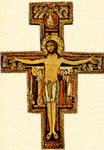
The San Damiano Cross (now housed in the Basilica of Santa Chiara within the City of Assisi), about six feet tall, which spoke to St. Francis of Assisi calling him to repair his house.

It's been a good reflection, as I stated above, to consider our vocation -- our call from the Lord to be lesser brothers in a viiolent world fraught with greed. Fr. Michael has been juxtaposing the reality of 13th century Assisi with our own reality of early 21st century USA. Lots of similarities! Human life deals with the same or at least similar realities and challenges.

Tuesday, December 16, 2008

Advent Swiftly Passing -- What's My Attitude?

Some musings of a Franciscan friar in a Midwestern winter:


Here in southeastern Wisconsin we are getting both frigid weather and new snow fall. Last week when we were preparing to celebrate the Feast of Our Lady of Guadalupe it was quite cold! This past weekend the temps went up into the 40s F, and then they plunged into the single digits. Wow! What a contrast.


For me in the northern part of the Midwest it seems to take more time to adjust to the fluctuations of weather. When it's cold and stays cold I seem to be fine; when it's warmer and stays warmer I'm OK, too. But when it goes up and down my body seems to get rather confused!


Maybe that's just how our lives are -- adjusting to the fluctuations that happen beyond our control. Economic downturn, violence both near and far, insecurity at work, a loved one's illness. I don't think it means we're "powerless", at least not completely so.


As Advent is quickly moving toward the great celebration of Christmas next week, it might be an opportunity for us to consider how we respond to the changes in our lives, the changes about which we have very little, if any, say.


Yes, there are many things in life that we do have control over -- what we put into our bodies, what we watch on TV and in the movies, the people we call friends and with whom we associate outside of work and school.


But, taking a look at this past Sunday's Second Reading (1 Thess. 5:16-24) from the Roman Rite, it speaks a lot about our attitude in life. "Rejoice always;" "pray without ceasing;" "give thanks in all circumstances, for this is the will of God for you in Christ Jesus."


We might be tempted to think this is sweet religiosity or pious prattle until we confront that our life in conversion really is becoming more and more like Jesus Christ! As we yield to the operation of the Holy Spirit in our lives we begin to notice a change. We are becoming more like the Lord in our attitudes. Just take a look at what St. Paul writes about the fruit of the Holy Spirit (BTW, it's singular "fruit") in his Letter to the Galatians 5:22-23.


That's our attitude in the face of uncontrollable events. Not a sense of desperation. Not cynicism. Not even resentment. But an atttiude that God is greater than whatever happens, though for now, at least, it might seem overwhelming. The Christian vocation sees God at the center, at the periphery and throughout the experience.


Advent swiftly passes; tempus fugit as the Latin proverb states (i.e. "time flies"). Still, what's my attitude this Third Week of Advent?

Monday, December 8, 2008

Holy Russia and the Franciscan Friars


With the passing of Patriarch Alexiy II of Moscow and All Russia I thought it opportune to mention the relationship between Orthodox Russia and the Franciscan Friars.


The relationship between the Orthodox East and the Catholic (and Protestant) West has been contentious for many centuries. After the fall of Constantinople to the Ottoman Turks in 1453, Moscow's metroplitanate declared itself the "Third Rome", to the consternation of the first Rome -- in Italy -- which was in the throes of its own crisis, the Great Schism among competing men bearing the title "pope" of Rome.


Russian Orthodox clergy bid farewell in Moscow to the late Patriarch Alexiy II


Also, due to various Western incursions, such as the Teutonic Knights in the Middle Ages, Napoleon's invasion of Russia in the early 1800s and, most recently, Nazi Germany's invasion of Russia and Soviet-controlled lands (e.g. Ukraine, Lithuania) at the time during World War II-- have made Russia historically sensitive to and suspicious of Western advances (i.e. Western Europe and North America).


So, when the Soviet Union collapsed in the early 1990s and the glasnost and perestroika policies of Mikhail Gorbachev and his successor, Boris Yeltsin, opened the former USSR to expressions of democracy -- including freedom of religion -- the Franciscan Friars (OFM) saw this as an opprtunity of God's grace and providence and so decided to reach out to Roman Catholics in the former Soviet Union who were not previously able to freely express themselves or practice their faith.


This included persons who were ethnically Poles, Germans, Slovaks, and Lithuanians who were, at least, nominally Catholic before their parents' and grandparents' forced migration to the regions of Siberia.


This, however, was met with suspicion by the resurgent Russian Orthodox Church which accused the Roman Catholics of proselytism (i.e. the practice of seeking converts). Our General Minister at the time, Fr. Herman Schaluk, OFM and members of his General Council visited the late patriarch in Moscow to assure him that the only intention of the friars minor was to minister to those who were already Roman Catholics and not to actively seek new converts to the Catholic Church.

Bro. Mario Nagy, OFM (right) of our province receiving the renewal of temporary vows of a young friar in Ussurysk, Siberia, Russia in 2006

The Franciscan friars went to the former Soviet Union and, in various countries, have done a significant outreach and ministry among those Roman Catholic descendants of Europeans displaced during the regime of Joseph Stalin.

Bp. Henry Howaniec, OFM (born of Polish parents in Chicago, IL), a member of our province who served at our General Curia in Rome for many years volunteered to serve in Kazakhstan and was named by the late Pope John Paul II to be bishop of the Catholic diocese in Almaty. (Having reached his 75th birthday, Bp. Henry submitted the mandatory request to the Holy See for retirement.)

Bro. Mario Nagy, OFM (pictured above), also from our province -- who had served for many years in our former missions in the Philippines -- likewise volunteered and lived and served in far eastern Siberia (not too far from the border with North Korea)! Due to increased restrictions on foreigners by the Russian government, Bro. Mario has come back Stateside to help here in the US.


Fr. Blase Karas, OFM, born in Poland before World War II and, as a child, was a refugee under Stalin's USSR in Siberia (Poland was divided between Nazi Germany and the Soviet Union during World War II). He returned to Russia, this time to serve in central Russia in the western Siberian city of Novosibirsk. He has returned to the States and is working among Eastern European immigrant men recovering from alcohol addiction in Chicago, IL.


As instruments of peace, the Franciscan friars -- following the example of our holy founder, St. Francis of Assisi -- seek to respect the integrity of the Orthodox Church of Russia and to serve among those people who are Roman Catholic as well as those -- even indigenous Russians -- who choose on their own (not through proselytism!) to be received into the Catholic Church.

Russian Orthodox faithful in Moscow mourn the passing of Patriarch Alexiy II of Moscow and All Russia

And so, we mourn with our Russian Orthodox brothers and sisters, both in Russia and abroad, the death of their Patriarch Alexiy II of Moscow and All Russia. May God grant his servant blessed repose and eternal memory. And may there be increased trust and charity between the Orthodox Churches and the Catholic Church, in the name of our one Lord Jesus Christ. Amen.

Saturday, November 29, 2008

Happy New Year! Advent 2008

Tomorrow, 30 November 2008, begins the New Church Year in the Roman Rite of the Catholic Church. Tomorrow is the First Sunday of Advent.

The Byzantine Rite began Christmas preparations already on 15 November, the Feast of St. Philip the Apostle according to their calendar. Hence, the Christmas preparation is called "Philip Fast". It is a time of penitential preparation to celebrate the Nativity of the Lord Jesus Christ.


In the Western Church -- the Roman Catholic and those of the Protestant Reform which keep the Season of Advent (e.g. Episcopalians, Lutherans and Methodists), we begin this evening with First Vespers of the First Sunday of Advent.


As Franciscan friars, we eagerly anticipate this joyful Season of Advent -- and Philip Fast -- to celebrate Christmas Day. The celebration of the Incarnation of the Son of God in human history was so dear to St. Francis of Assisi's heart! And to ours, as well. And so we learn to wait, like Mary, the Mother of God, awaited after the Annunciation for nine months to give birth to the Lord Jesus. We learn to listen, as the Children of Israel of old listened with attentiveness to the prophetic utterances of the coming of Messiah. We learn to hope, in a darkened world where sin holds sway -- we claim that he who came in the manger is indeed the conqueror of sin and death!

Our Lady of the Sign (cf. Isa. 7:14, Mt. 1:23), "Behold a virgin shall give birth to a son and shall call him 'Immanuel' [a name which means 'God is with us'!]"

Wednesday, November 26, 2008

Thanksgiving Day is more than "Turkey Day"! Give Thanks to the LORD for He is Good!


Rejoice always. Pray without ceasing. Give thanks in all circumstances, for this is the will of God for you in Christ Jesus." 1 Thessalonians 5:16-18


The word "thanks" in New Testament Greek is the basis for the word we have for "eucharist". During the Mass or the Divine Liturgy at the Preface Dialog beginning the Eucharistic Prayer/Anaphora, the priest says, "Let us give thanks to the Lord our God", and we respond, "It is right to give him thanks and praise", or, "It is just and right." In effect the priest is addressing us as congregation and saying, "Let us do the eucharist!"

Thanksgiving is deeply ingrained in the entire Scriptures, both Old and New Testaments. It is simply what we as Christians do! We give thanks to God.


Fr.Joachim Studwell, OFM at the Great Entrance of the Divine Liturgy


Fr. Patrick Gawrylewski, OFM (right) and Fr. Brendan Wroblewski, OFM during the Eucharistic Prayer at the chapel of Assumption BVM Parish


Thanksgiving Day is far more than its nickname, "Turkey Day!" It is about an attitude of life. Giving thanks and forgiving someone are both might antidotes to bitterness in human life. Not just the proverbial "counting the blessings", as good as that might be. Just giving thanks!


It takes our attention off ourselves and focuses us on Another, in this case God. Hopefully we have been reared to be grateful -- grateful for presents, sending thank-you cards, showing appreciation to people in our family, at work or in school.


Giving thanks just makes plain sense -- and it's good for mental health, besides. Grateful people are happy people. They notice small things about people and take notice of them in a positive way. People of thanksgiving notice the details of life and express gratitude. As the 12 Step Program calls it cultivating the Attitude of Gratitude!


And so it is with the Lord. Maybe we can look at the New Testament reading (above) again, where St. Paul the Apostle deliberately writes that we are to give thanks in ALL circumstances (please note, not for all circumstances, but in all circumstances)! That means we acknowledge God is supreme and greater than any and all circumstances in which we find ourselves.


I'm grateful for Him, first of all! And for my Franciscan brothers, my family and my friends, for the many who have trusted me and allowed me into their lives through ministry, for all the good things that the Lord has lavished upon me. And I am grateful for my vocation as a Franciscan friar and priest.


What are YOU grateful to the Lord for this Thanksgiving Day?

Monday, November 24, 2008

Enough is enough!

A couple weekends ago I attended a youth event that was led by a group of Brothers and Sisters. There was lively music and high energy and, overall, a rather positive spirit among the presenters and participants.

This was shortly after our national elections on 5 November 2008.

Later in the afternoon, a priest gave a talk on Christian morality and was preparing the young people and their chaperons for the Sacrament of Reconciliation. Two things he said astonished me -- he obviously supported John McCain as his choice for president of the USA (by stating that the wrong man had been elected) and he inferred that there was a similarity between the rise of Adolph Hitler in 1930s Germany and the election of Barack Obama.

His choice of candidate is fine; it is his business and has no correlation to a public announcement at a Catholic youth event sponsored by the Church. His connection seemed to be focused solely on Mr. Obama's consistent pro-choice stance and support of the 1973 Supreme Court decision of Roe v. Wade.

Since then I have become aware of others making this rather odd and, quite frankly, frightening association. Some have been Catholic (on blogs like this, apparently) and others have been political. Already at the end of the political campaign there seemed to be fear-mongering about Obama as a "socialist" and other such epithets directed at him.

BTW, is anyone familiar with the political campaigns when Franklin Delano Roosevelt was running for president? As I recall, he was also dubbed a socialist!

I find it alarming that people -- especially people of faith and public Catholic leaders like I had met -- would insinuate a connection between Hitler and Obama. Hitler was a thug! He wanted to eliminate the Jews from Europe (and beyond, if possible!), as well as the Roma (Gypsies), homosexuals, Communists and Free Masons. He made it to office through thuggery and manipulaton. He precipitated World War II in 1939 by setting up a bombing in Germany and falsely accusing the Poles of committing the violence, and subsequently invaded Poland for the sake of the "honor" of the German fatherland. BTW, he committed this heinous injustice with the collaboration of Joseph Stalin and the now-defunct Soviet Union. Hitler explicitly promoted violence and Germany as the "superpower" and the Aryan people as the "super race" in his book, Mein Kampf (My Complaint).

As a Catholic Christian, a Franciscan friar and a priest I certainly disagree with Mr. Obama's stated position on abortion and the so-called pro-choice stance, as well as his apparent and unequivocal support for the "Freedom of Choice Act" (FOCA), which our US Catholic bishops have rightly and resoundingly opposed.

At the same time, I oppose any insinuation of connection between Obama and Hitler! Enough is enough. Someone who is "unhinged" may take this inference and seek to protect the nation from "another Hitler". God forbid! We as Catholic Christians, as clergy and religious, must advocate for life and oppose violence of any kind. Especially as Franciscans, for as St. Francis of Assisi stated to his friars early on, "If you are going to proclaim peace with your lips, make sure you have it first in your heart!"

Thursday, November 20, 2008

Cafeteria Catholics


Recently there was a video posted about Maria Shriver, the first lady of California (wife of Governor Arnold Schwarzenegger). She described herself rather matter-of-factly as a "cafeteria Catholic." No apologies; no regrets.

Now, Ms. Shriver is a very articulate, attractive and vivacious speaker. She is clear and deliberate in her speech, which is evidence of a very good education and professional training.

She stated that as far as matters of faith were concerned she clearly identified herself as Roman Catholic -- liturgy, creed, etc. But as far as practice of faith and the Catholic Church's position on various issues -- e.g. women's roles in the Church, the right to choose an abortion, gay marriage and the like she clearly stated that she disagreed with the Catholic Church's positions.

She said that she did agree with the "social" content of Catholic teaching -- justice and peace, outreach among the poor, and she noted that she identified with Jesus' compassion and mercy, especially among the poor and the downtrodden.

As a Franiscan friar and priest I find this attitude curious and disturbing. For one thing, Ms. Shriver is a member of my generation, the so-called Baby Boomer Generation. She is a member of the Kennedy clan (first cousin, for example, of Caroline and the late John, Jr., the famed children of the late President John F. and Jacqueline Kennedy).
I think that Maria speaks for many of my/our generation and our generation's treatment of the practice of faith. One unabashedly picks and chooses as one wants. This certainly fosters a sense of individual identity, even a sense of individualism. Problem is -- and this certainly is problematic -- it flies in the face of the notion of the New Testament's image of the Church as Body of Christ. We are members of one another, as the Apostle teaches in 1 Corinthians 12 and 14. We are not as individuals the Body of Christ!

St. Paul, in his various writings, and those attributed to him, certainly warns the various Christian communities against "novelty" in faith and strongly admonishes the members of the communities to be faithful to their Tradition -- i.e. what has been handed to them by Paul and other Apostles. We are an apostolic Church, after all, as we readily profess in our Creed Sunday after Sunday.

The one thing that was even more curious to me -- maybe you've seen the interview? -- was how Maria described teaching her daughters about a woman's right to choose an abortion. She said that she differentiates between being "pro-choice" and being "pro-abortion." At the very least, it is an interesting split. To be pro-abortion means, according to what she seems to have described, to advocate the termination of a pregnancy whereas being pro-choice means that it is the woman's right to choose whether or not to terminate the pregnancy.
This seems to me, at least, to be a definite disconnect between faith and practice. I am not advocating a so-called black-and-white approach; life is not that simple -- most of us have had to confront situations in our life where the answers were not easy. But the "cafeteria Catholic" approach to faith is, at best, disingenuous if not actually dishonest. Perhaps not deliberately so, but certainly the result leads to a rather loud dissonance of faith. Especially understanding faith as communion -- communion with one another, with our Bishops, with the Pope of Rome.
As Franciscans, we have traditionally been at the vanguard of mission and outreach. Since the time of St. Francis of Assisi and the early friars, we have been in the proverbial "trenches" where others did not want to go or were simply not aware.


It seems to me that confronting the "cafeteria" approach to Catholicism is one such "trench" to which we are called. Not as judgemental or arrogant, of course! But approaching folks with the reality of the lack of consistency -- and as an opportunity to evangelize (without being "preachy").

Friday, November 14, 2008

The Wearin' of the Brown!

When Galen Osby, from Howards Grove, WI decided to embark upon the journey of becoming a Franciscan friar, he probably didn't guess the various challenges that lay ahead. He had an unusual postulancy program (the first year when a candidates begins to explore, or "postulate", becoming a friar minor), mostly because he was the only one!

Galen Osby as a postulant to the Franciscan Friars (OFM) of the Assumption BVM Province.

After his varied experiences and ventures -- from Milwaukee, WI to McAllen, TX to Greenwood, MS and then to our senior friar residence of Queen of Peace Friary in Burlington, WI, Galen "took up his cross daily" to follow the Lord Jesus and encountered several surprises along the way.


Last May 2008 Galen applied to and was accepted to be received into the novitiate, when a man entering our brotherhood becomes a novice, or "new man". It is what St. Francis of Assisi calls in our Rule, the "year of probation", or a time of testing. The novice is tested by life in the fraternity to help in the discernment if this is the right life for him; the novice tests the community to ascertain if this is the correct community or way of life for him. That information can be found in a previous blog.


This past 26 September 2008 Galen and his classmates were invested in the "habit of penance", the brown habit of the Franciscan Friars of the Order of Friars Minor (OFM). It consists of a long tunic, a brown habit, or "capuche" and a woolen cord. Novices have no knots in their cords -- that is reserved for their first profession when they make temporary vows of poverty, chastity and obedience.


Bro. Galen Osby, OFM, novice and newly invested with the habit of penance, the Franciscan habit, at San Damiano Friary, Cedar Lake, IN


The novitiate is located in Cedar Lake, IN, south of Hammond and about one hour or so southeast of Chicago, IL. The Assumption BVM Province hosts the novitiate and shares its leadership and membership with two other provinces, Sacred Heart Province (headquartered in St. Louis, MO) and St. John the Baptist Province (headquartered in Cincinnati, OH).


The team for the novitiate is Fr. John Stein, OFM (SJB Province), Fr. Larry Nickels, OFM (SH Province) and Fr. Camillus Janas, OFM (ABVM Province). Fr. John is the Novice Director, Fr. Larry is assistant and Fr. Camillus is the Guardian (local superior).

You might ask, "Why 26 September?" In the calendar of the Catholic Church of the Roman Rite, 26 September is the memorial of the holy brother and doctor martyrs, SS. Cosmas and Damian. It was at the chapel in honor of St. Damian (in Italian, San Damiano) that Francis of Assisi heard the Lord's call to him, "Francis, go repair my Church, which you see is falling into ruins!" And, the house of the novitiate is called San Damiano Friary. So, it's their friary's patron saint's day!

Fr. Camillus Janas, OFM, Guardian of San Damiano Friary (Novitiate) and Bro. Galen Osby, OFM, newly investied novice

Saturday, October 18, 2008

Br. Jason Welle, OFM Runs 2008 Chicago Marathon

Beginning of Chicago Marathon 2008 on Sunday, 12 October in Grant Park

by Bro. Jason Welle, OFM
Bro. Jason recently professed solemn vows as a friar minor on the Solemnity of the Assumption, 15 August, in the parish church of Pulaski, WI, Assumption BVM. He is current ly a student at Catholic Theological Union (CTU) in Chicago


On October 12th, I joined 33,000 other athletes for the 2008 Chicago Marathon, the fourth marathon I have run as a Franciscan friar. Doing a marathon a year is quickly becoming a tradition for my younger brother Scott and I; we have run four together, shoulder to shoulder, start to finish. This year, we completed the 26.2 mile course through twenty-nine Chicago neighborhoods in 3:45.
Chicago Marathoners running through the streets of the City of Chicago, Sunday 12 October 2008
The unusually hot weather slowed down the field on this flat, fast course which starts and ends in Grant Park. Runners weave through the downtown Loop three times total, after jaunts as far north as Lincoln Park and as far south as U.S. Cellular field.


Great crowds in areas like Pilsen and Chinatown lift the runners’ energy, as do playful signs encouraging us that “Oprah did it, you can too!” and to “find your inner Kenyan.” Running for charity also gave me a boost. For the second time, I ran on behalf of St. Coletta’s of Illinois Foundation, an organization founded by Franciscan Sisters to work with developmentally-disabled children and adults.

I think I’m a little different than many of last Sunday’s fitness gurus. I own neither an i-pod nor an mp3 player. When I train, I usually don’t even wear a watch. I just go out and run, to breathe fresh air and immerse myself in the world around me. I’m often struck by how many people ceaselessly try to escape from their surroundings, hiding behind a cell phone, headphones, a newspaper, or any other means they can find to insulate themselves from the world. I find the true value of aerobic exercise in re-connecting with the world, attentively looking at the trees, listening to the birds, and becoming more conscious of how I interact with it all, through my steps, my heartbeat, my breathing, etc.


Our house of studies is just two blocks from Lake Michigan, so I do most of my training out on the lakefront running/cycling trail, where many Chicagoans come for a bit of peace. Getting out into this world for a time clears my head and refreshes me for our other daily tasks: prayer, housework, ministry at different sites around Chicago, and the perennial tasks of reading and paper-writing that mark a house of studies. In time, I have come to see running as a form of prayer, because it renews me, leaves me in better touch with who I am, and better able to face the challenges of each day.

Of course, running a marathon is a quite different from a daily jog by the lake…and I wouldn’t continue to do it if these rather painful days hadn’t taught me an additional, different lesson about myself. People often tell me that they’re impressed with the determination it takes to complete a marathon, that they don’t think they could do it themselves.


It obviously does require discipline, building up one’s mileage over the course of months to prepare oneself for race day. But honestly, running three marathons in Chicago and one in Austin, Texas, has taught me more about relaxing my discipline than how to build it up.


Many people, especially endurance athletes, seek out new and bigger challenges for the sake of having a new challenge, and can’t live with themselves if they fail to complete these challenges, to meet their self-imposed goals. I hear many runners say with pride that they couldn’t imagine not finishing the race. No matter what happens, they have to finish. Marathoning has taught me that my goals for myself are not God’s goals for me. If I miss my goal time or drop out, God still loves me. That might seem obvious, but the way we often fixate on our goals in school, in work, in athletics, in our finances, or other things demonstrates that many people don’t internalize it.


I entered Sunday’s race intending to finish but knowing that if I failed to, God and my ego could accept it. This gave me the freedom to run hard, to do the best I could, and enjoy the race for the graced moment that it was. Even though we ran our best (I’m still rather stiff and sore…), this was the first race when Scott and I missed our goal time, and that was fine on a very hot Sunday morning.


Right: An obviously relieved and rejoicing Bro. Jason after having completed the 2008 Chicago Marathon -- "thumbs up!"


Left: Bro. Jason (R) with his brother, Scott, after having ocmpleted the 2008 Chicago Marathon!


We did what was ours to do, we ran the good race, and we did it together. And God willing, we’ll probably do it again somewhere next year!


Dear Jason Welle, Congratulations from Bank of America for finishing the2008 Bank of AmericaChicago Marathon! Your recorded finish time was3:45:43 and you placed 3925out of 31,401 finishers.

Tuesday, October 14, 2008

Synod of Bishops in Rome Focus on the Word of God


Many bishops from around the world have gathered with His Holiness, Pope Benedict XVI in Rome to prayerfully study how to respond to the situations in the world and the Catholic Christian response according to the Word of God. You can find the latest updates on the Vatican Web site, http://www.vatican.va/, including the working document and responses.


The Holy Bible has always been at the heart of the life of the Church since its beginning. The Lord Jesus, the Word of God made flesh (cf. John 1:14) is often depicted in the Gospels as quoting from the Scritpures [Old Testament] -- in combatting the devil (cf. Mt. 4:4; see Dt. 8:3), in addressing the people at his hometown synagogue in Nazareth (cf. Lk. 4:18-19; see Isa. 61:1-2a), and even when hanging upon the Cross, Jesus invokes the Scriptures (cf. Mk. 15:34; see Ps. 22:1).

Pope Benedict XVI, 2008

The Apostles and Evangelists quoted freely from the Sacred Books of the First Covenant of the Jewish people, citing from the ancient texts to indicate that Jesus is the Messiah of Israel and the Savior of the nations. Therefore, he is the fulfillment of the Jewish Bible (Hebrew and Greek texts).

The proclamation of the biblical texts has always been part of our liturgical tradition. Direct Scriptural quotes are found throughout the Roman Mass and other sacramental celebrations. Indirectly, there are multiple allusioins to the Bible. Two examples are the "Holy, Holy, Holy" [Sanctus], which quotes from the Book of the Prophet Isaiah 6:3 and Psalm 118:26b, and the "Lamb of God" [Agnus Dei], which combines the invocation to Christ as the Lamb of God (cf. John 1:36 and Rev. 5:12) with the plea for mercy (cf. Mt. 9:27).

As Franciscan friars we rejoice that Pope Benedict and the bishops from around the world have gathered in the Twelfth Synod to focus on the Word of God. The Bible, being at the heart of the Church, is always at the heart of our Order and our Franciscan tradition.

St. Francis and St. Clare were both inspired to renounce everything for the sake of the Gospel of Jesus Christ, and as our respective Rules state (i.e. that of St. Francis for the Friars Minor and that of St. Clare for the Poor Clare nuns), ". . . to live the Holy Gospel of our Lord Jesus Christ in obedience, without anything of our own and in chastity."

Monday, October 13, 2008

“Brother, Can You Spare a Dime?”

When I was growing up back in the late 1960s I remember older folks commenting about the “Great Depression.” Both of my parents were teenagers during the Depression and recounted experiences of struggle, want and family togetherness. Maybe you remember your parents or grandparents (great-grandparents?!) telling the stories?

Strikers protest for just pay and form unions

And every so often I would hear survivors of the Great Depression remark that they thought such a harrowing experience in the present time might bring people together again in a fractured society like it was back then. That, and it might get them back to church!


To be honest, I don’t know what it was like back in the 1930s. The Great Depression, begun when the stock market crashed in 1929, was not my experience. I only know what I read and what people recounted as they remembered. Problem is, nostalgia can also omit facts. And it probably could resurfac songs of the period that depicted the plight of the poor and unemployed in shantytowns such as the title of this article.


Dust Bowl in the 1930s in Oklahoma


What people frequently recount, though, is the sense of community they remember. People helping people; people, if you will, in solidarity with one another.

Of course, it was also a time of great political turmoil – the Ku Klux Klan had reached its zenith of racial, ethnic and religious intimidation in the 1920s and continued in the 1930s (in the North as well as the South), Jim Crow laws were enforced in the segregated South since after the Civil War and mills and mines in the North were the sites of some rather violent strikes.


Economic refugees from the Great Dust Bowl in Oklahoma were not particularly welcomed to sunny California, as well recounted in John Steinbeck’s famous novel, The Grapes of Wrath. So, not all was “togetherness” or “community”.


To be sure, houses of worship were probably more frequented than in the Roaring Twenties. When disaster strikes, off to God we go!


Train station in South Carolina in the 1930s shows effects of "Jim Crow" segregation laws

In the midst of the current financial downturn, and reality for many of job loses or the threat of job less, we can be faced with the temptation to despair. Many did in the Great Depression. Just as preachers warned their flocks in the past so we are being warned today to not put our faith in the “almighty” dollar, but in God Almighty!


Scripture warns us that the love of money is the root of evil (by the way, not money itself) – see 1 Timothy 6:10, and it follows, “. . . and some people in their desire for it have strayed from the faith and have pierced themselves with many pains.” (NAB Rev).


St. Francis of Assisi and St. Clare of Assisi each renounced fortune and the comforts that their respective parents’ afforded. Not because money in itself was evil, but because they wanted to live for Jesus Christ and him alone. And to love money and seek after it would have defied the Word of God and separated them from the Lord. They each renounced greed, and probably had to renounce it daily in their lives, for there are many forms of greed! They found their hope and their source of strength in the Lord, not in their families’ wealth or social status. And in this they found great freedom.


St. Francis of Assisi as a youth encountering the leper outside of Assisi.
In this meeting Francis found Jesus Christ, which helped lead him to radically change his life.

While the economic forecasters and experts are struggling with what to do next for hope of an economic upturn, all seem to agree that we are not headed for something similar to the Great Depression of the 1930s. Let’s hope so!


At the same time, this may be a graced opportunity to get our focus right and our proverbial “store in order” as we consider our lives and our futures. Yes, we want what is good for us and for those whom we love – affordable health care, just and living wage, honest work for honest pay. These are important. But our faith in what is eternal is even MORE important.


Like St. Francis and St. Clare, it would seem to behoove us to guard against the temptation to greed. As Franciscan Friars it is our sincere hope that we can offer this insecure world the hope of God’s security!