Showing posts with label Christmas. Show all posts

Wednesday, December 24, 2008

Merry Christmas 2008!

From wherever you are reading this, we in southeastern Wisconsin are having a very white Christmas. It could change, of course! The snow is sloppy wet and the temps seem to be going up. But, then again, we're expecting another 3 inches or so today. Glory to God!

We Franciscans are preparing to celebrate along with the rest of the Christian world (which follows the Gregorian calendar), the birthday of the Lord Jesus Christ, the great celebration of the Incarnation of the Word of God.

It really is a glorious celebration, which St. Francis rated very high. One of our friars, Fr. Roch Niemier, OFM was recently taped about the first Franciscan celebration of the Lord's Nativity in Grecchio, Italy in 1223. You can find it on YouTube and at our Web site, http://www.franciscan-friars.org/.

However you and your loved ones celebrate this holy day and feast of feasts, may the Lord Immanuel bless you greatly as you commemorate the Word made Flesh in human history. How wonderful is our God!

Merry and blessed Christmas!

!Feliz Navidad! Buon Natale! Froeliche Weinnachten! Joyeaux Noel! Wesolych Swiat Bozego Narodzenia! Sretan Bozic! Vesele vianoce! Nollaig Shona Duit! Mele Kelikimaka! Linksmu Kaledu! Christos Rozdajetsja! Slavite jeho!

(Spanish, Italian, German, French, Polish, Croatian, Slovak, Irish, Hawai'ian, Lithuanian, Church Slavonic)

Saturday, November 29, 2008

Happy New Year! Advent 2008

Tomorrow, 30 November 2008, begins the New Church Year in the Roman Rite of the Catholic Church. Tomorrow is the First Sunday of Advent.

The Byzantine Rite began Christmas preparations already on 15 November, the Feast of St. Philip the Apostle according to their calendar. Hence, the Christmas preparation is called "Philip Fast". It is a time of penitential preparation to celebrate the Nativity of the Lord Jesus Christ.


In the Western Church -- the Roman Catholic and those of the Protestant Reform which keep the Season of Advent (e.g. Episcopalians, Lutherans and Methodists), we begin this evening with First Vespers of the First Sunday of Advent.


As Franciscan friars, we eagerly anticipate this joyful Season of Advent -- and Philip Fast -- to celebrate Christmas Day. The celebration of the Incarnation of the Son of God in human history was so dear to St. Francis of Assisi's heart! And to ours, as well. And so we learn to wait, like Mary, the Mother of God, awaited after the Annunciation for nine months to give birth to the Lord Jesus. We learn to listen, as the Children of Israel of old listened with attentiveness to the prophetic utterances of the coming of Messiah. We learn to hope, in a darkened world where sin holds sway -- we claim that he who came in the manger is indeed the conqueror of sin and death!

Our Lady of the Sign (cf. Isa. 7:14, Mt. 1:23), "Behold a virgin shall give birth to a son and shall call him 'Immanuel' [a name which means 'God is with us'!]"

Sunday, December 23, 2007

Christmas Countdown, Part 4 – and Final: Merry Christmas!


Well, are you ready for Christmas? Cards sent, presents purchased and wrapped, travel plans made, cookies and baked goods prepared? Little children excited about the arrival of You-Know-Who on Christmas Eve?

Even more important, though – are YOU ready? How has Advent been for you? Were you able to participate in your parish’s Penance Service and celebrate the Sacrament of Reconciliation? Have you noticed a positive change in your life since the first candle of the Advent Wreath was lit more than three weeks ago? Have you become aware of where the Lord is calling you to change?

Icon of the Nativity of our Lord, God and Savior Jesus Christ

Since the last entry to this blog, we have celebrated the Winter Solstice (21 December), the shortest day of the year in the Northern Hemisphere. On that day the “O” antiphon was “O Radiant Dawn” (sometimes also called “O Dayspring”). Then on Saturday it was “O King of the Nations” and Sunday, “O Emmanuel”.

The countdown for Christmas comes to a close today, Christmas Eve.
With all kinds of “holiday” music at shopping malls and on the radio and TV shows (“A Christmas Story”, “How the Grinch Stole Christmas” and, of course, “It’s a Wonderful Life’), we can forget that we really are preparing to celebrate the Messiah’s birthday.

With this last day before Christmas Day, the Eve of the Nativity of the Lord Jesus, what is the gift that you need from the Lord?

Do you need an open heart? An open spiritual ear? A willing spirit to respond to his Word, like the Blessed Virgin Mary or John the Baptist?

What might you still need to surrender to God’s redemptive grace before you can adequately celebrate Christmas? Perhaps today, even in the midst of last minute preparations, you can spend some quiet time with the Lord and ask him what it is you need from him. He might surprise you! (I think he usually does!)

God bless you this Christmas, and all your loved ones. God bless your travels with peace and grace; God bless your gatherings with joy and friendship; God grant your worship with new power and keen awareness; God grant your Christmas with profound awe and wonder of his love and salvation.

Wesołych Świąt Bożego Narodzenia! ¡Feliz Navidad! Fröliche Wiehnachten! Mele Kelikimaka! Vesely Vianoce! Buon Natale! Christos Rozdajutse!/Slavite Jeho! Linksmu Kaledu! Nollaig Shona Dhuit! Sretan Bozić! Maligayamg Pasko! Chung Mung Giang Sinh! Mo’adim Lesimkha! Niibaa' anami'egiizhigad! ºKrismas Njema! I'D Miilad Said! Joyeux Noël!

In whatever language – Merry Christmas!
Christ is born! Glorify him!

O Rising Dawn, radiance of light eternal and Sun of Justice; come, and enlighten those hwo sit in darkness and in the shadow of death!

O King of the Nations and the Desired of all, you are the cornerstone that binds two into one. Come, and save poor humanity whom you fashioned out of clay!

O Emmanuel, our King and Lawgiver, the Expected of the nations and their Savior: Come, and save us O LORD our God!
(Languages used above: Polish, Spanish, German, Hawai'ian, Slovak, Italian, Carpatho-Rusyn, Lithuanian, Irish, Croatian, Tagalog [Philippines], Vietnamese, Hebrew, Ojibway, Ki-Swahili, Arabic, French)

Tuesday, December 18, 2007

Christmas Countdown, Part 2

Today’s “O” Antiphon is “O Lord of Might”, from the Hebrew, Adonai (the respectful name for the LORD in Hebrew).

This is the title that the LORD gave to Moses (cf. Exodus 3) when he called him from shepherding his father-in-law’s flocks in the land of Midian to be the deliverer – and lawgiver – of the Children of Israel.

Two things need to be kept in mind as we continue our Christmas Countdown.

The first is remembering our sacred heritage. Just yesterday at Mass we heard the genealogy of Jesus according to the flesh (so Romans 1:3) from the Gospel of Matthew (1:1-17). And we remember our own sacred heritage -- the one that the Lord has given to us through our family and through his Church (we call this Tradition).

The second is how we respond to God’s call in our own lives, that is, our vocation. This week, in particular, the Gospels refer to a number of calls – Zechariah, Joseph (the Annunciation in Matthew) and Mary, the Blessed Mother of God (the Annunciation in Luke). Look at how each responded to his or her vocation.

They each were perplexed and uncertain. Each chose to believe the message given, even if (with Zechariah) there was some doubt at first. They chose to believe that the God of Israel, who promised and fulfilled the promises from one generation to the next would again fulfill the promise – this time of sending the long-awaited Messiah!


Franciscans prepare for Christmas with particular relish as we set up our Christmas cribs after the example of St. Francis of Assisi at Grecchio way back in the early 1220s. We joyfully celebrate the Incarnation of the Word of God in human history, believing in God’s great love for us and all creation (the whole world) for having sent us his only-begotten Son (see John 3:16).

As Christians we believe that the Law of Moses and the ancient Covenants God established (beginning with Noah, then Abraham, then Moses and again David, concluding with the prophetic hope of a new and eternal covenant [cf. Jeremiah 31]) are fulfilled in the coming of the Lord of Might, Adonai, the one we call Jesus Christ!

He who revealed himself to Moses in the Burning Bush and gave the Law (Torah) to Moses at Mt. Sinai is the same who became incarnate for us and for our salvation.

How do you sense the Lord of Might (Adonai) calling you? How do you respond? Let's re-read the Gospel stories of Joseph’s dream (Matthew 1:18-23), Zechariah’s call (Luke 1:5-25; 57-79) and Mary’s call (Luke 1:26-38). And let's ponder how God is speaking to us as Advent is drawing to a close and Christmas is quickly approaching!

“O Adonai and Ruler of the House of Israel,
you appeared to Moses in the fire of the burning bush
and on Mount Sinai gave him your Law.
Come, and with an outstretched arm redeem us!”

Monday, December 17, 2007

Christmas Countdown

T:he Lord Jesus Christ, the Wisdom of God -- "O Sapientia!"


We are quickly approaching Christmas Day! Liturgically, we “count down” to Christmas from 17-23 December each year. We use the “O” Antiphons.


Perhaps the hymn that is most associated with Advent is “O Come, O Come, Emmanuel”. It is based on a 9th century Gregorian chant. It was used by Benedictine monks originally and was initially intended only for the final days of Advent. However, as it became more popularly used in the modern era, it also became extended throughout the Advent Season.


Today is the first of the “O” Antiphons – O, Wisdom! O Sapientia! These antiphons are used as the opening and closing antiphon for the Gospel canticle for Evening Prayer (Vespers), called the Canticle of Mary, or by its Latin name, Magnificat.


In considering one’s vocation in life, it is always important to seek the Lord’s wisdom. The Book of Wisdom from the Old Testament acclaims God’s wisdom. Like the Book of Proverbs, Wisdom is personified. The early Church saw Jesus Christ as the Wisdom of God and used this book as a reference to the Lord Jesus (esp. Wis. 2:12-21). In the Scriptures, wisdom is a hallmark of the person devoted to God; it is a gift from on high (see Isa. 11:2; 1 Cor. 12:8 and Jas. 1:5). And the person who chooses the path of the Lord chooses wisdom; God's Word is wisdom (see Psalm 119) and they who seek it, follow it and live it are wise! Jesus uses this motif when preaching (cf. Matt. 7:24-27).


The quality of wisdom is opposed to folly; that is, wisdom vs. foolishness. Seeking a vocation is basically seeking God’s wisdom in life. “Lord, what do you want me to do?” as opposed to, “Lord, help me do what I want to do!” Such a prayer is by no means passive. Rather, it is an act of trust in the day-to-day happenings of our lives.


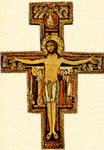
As Franciscan friars we seek God’s wisdom for our decisions. But even at a deeper level, like St. Francis of Assisi before the Cross of San Damiano, “Lord, what you have me do?” In his famous Prayer Before the Crucifix, St. Francis asked the Lord for the grace needed (". . . true faith, certain hope and perfect charity, sense and knowledge . . .") to lead a wise life in following the Lord and living for him alone.


We all need to seek God’s wisdom in order to truly live the Gospel of Jesus Christ in a manner that is pleasing to the Father and relying on the power and gifts of the Holy Spirit.


“O Wisdom, you came from the mouth of the Most High,


and reaching from beginning to end,


you ordered all things mightily and sweetly.


Come, and teach us the way of prudence!"

Wednesday, December 12, 2007

Our Lady of Guadalupe

Image of the Blessed Virgin Mary, Our Lady of Guadalupe, on Juan Diego's tilma ,in the Basilica in Mexico City

La Virgen Morena is the famous celebration of the indigenous peoples of the Americas. She appeared to Juan Diego at Tepeyac, near the former Aztec capital and holy sites, over a series of days in December 1531, about 10 years after Hernán Cortéz and the Spanish conquistadores vanquished the once-proud Aztec people and several the other native peoples of México.

She spoke to Cuauhtlatoatzin, his Nahuatl (Aztec language: “one who speaks like an eagle”) name, in his native tongue, not in Spanish. Similarly, she appeared to him as one of his own, not as a European. She was swarthy, la Virgen morena (the dark-skinned Virgin).

The image of Our Lady of Guadalupe is very rich in symbols. Hers is an “icon”, if you will, not made by hands. Her image was miraculously imprinted on Juan Diego’s tunic, the tilma (a piece of clothing fashioned from the fibers of the maguey plant).

Unbeknownst to Juan Diego, when he displayed his tilma with the freshly picked roses, Bishop Juan Zumárraga, OFM (1st bishop of Mexico and a Franciscan friar and priest) was astonished, as were his friars!

The wonderful result of this heavenly visit was a powerful wave of evangelization. Millions of indigenous peoples, Aztec and beyond, professed faith in Jesus Christ and embraced the Catholic faith through the proclamation of the Gospel and were baptized. The story of the Blessed Mother’s arrival to their land and her message swept the land around Mexico.

Here was someone with whom the native peoples could identify. And still do to this day! When I am among Mexican Catholics, in their homes, businesses and even cars, I see Mary’s image, la Guadalupana! The story and her image are deeply ingrained in the consciousness of Mexican Catholics. And, December 12th is a national holiday in all of Mexico! Ser mexicano es ser guadalupano (to be Mexican is to be a devotee of Guadalupe!).

As we celebrate her feast day today, let us recall that Mary, the Mother of God, continues to intercede for us (as the position of her hands displays) and especially considers the poor and the downtrodden to be her special children. She is the pregnant Mother (the black sash around her waist) who came to a conquered people, the Aztecs. It was to them, not their conquerors, that she gave her message; to a peasant, not to an aristocrat or friar or bishop; in Nahuatl not Spanish.

To me, at least, it becomes another example of “minority” – the quality which was so dear to St. Francis of Assisi and which he tried to inculcate among his brothers, to whom he gave the name “minors” (friars minor – lesser brothers). The fruit of minority is solidarity. And this is our vocation as Franciscans!

We are preparing to celebrate the great festival of the Incarnation -- Christmas -- when the Word of God takes on human flesh, in solidarity with us. So great is God's love (see John 3:16).
God in Jesus Christ identifies with us! He becomes flesh of our flesh, bone of our bone, blood of our blood. Is this not true of what we celebrate sacramentally in the Eucharist, when we partake of the Body and Blood of Christ Jesus? The Lord himself feeds us with himself.


We ourselves might be quite surprised how the Lord desires to enter into our lives, to be in solidarity with us. Through the intercession of the Blessed Virgin Mary, our Lady of Guadalupe, may we all come to know the power of God’s grace in our very real human experience.

Tuesday, December 4, 2007

Lights in the Darkness

Advent Wreath

I think it’s curious that December becomes a month of increasing darkness and at the same time a series of light festivals. Both religious and secular communities celebrate the growing darkness, eagerly awaiting the return of the sunlight and springtime! At least up here in the northern hemisphere! (in the southern hemisphere they’re in spring and getting ready for summer).


Tonight the Jewish community begins the ancient festival of Hanukkah which is the commemoration of the rededication of the Temple (see 2 Maccabees 10;1-8) Western Christians mark the four Sundays preceding Christmas with the lighting of the successive candles of the Advent wreath. And for eight days following Christmas many African-Americans celebrate traditional family and tribal values with Kwanzaa, again, lighting a series of candles.
Hanukkah lights

St. Francis of Assisi took significant time in prayer and preparation for the great festival of the Incarnation, Christmas. He knew the darkness that could penetrate one’s heart, and he knew that Jesus Christ, the Light of the World alone could enlighten him. He prayed before the San Damiano Cross, “. . . enlighten the darkness of my heart.”

We who are baptized have been enlightened by Christ. That is why we are given the baptismal candle, which is lit from the Easter Candle at each baptism. We have been delivered from the ancient curse of evil and sin, the Powers of Darkness. We have been brought into the Kingdom of Jesus, God’s incomparable Light (cf. Colossians 1:12-14).

Friday, November 30, 2007

Come, Lord Jesus!

The ancient cry of Israel, our elder brothers (and sisters), as the late Pope John Paul II called the Jewish community, has been for the fulfillment of the Holy Covenant.


We Christians believe that the fulfillment of the Law of Moses and the Prophets is in the coming and person of Jesus of Nazareth whom we call Messiah (anointed) and Lord.

And yet, not in all its fullness!
An Orthodox Jewish man praying at the Western Wall in the Old City of Jerusalem

We await the Lord's return in glory. And, so, how do we do this?

This Advent is an opportunity to grow deeper in our relationship with the Lord -- by focusing on the Scrptures of the Old Covenant that we hear proclaimed daily at Mass, and particularly at the Sunday Eucharst.


During Advent we join as members of the entire Church of God and cry, "Come, Lord Jesus!" The ancient cry of the Church, even from apostolic times in the Aramaic of the Apostles and early disciples of Jesus, is Marana tha! (Come, Lord!).


St. Francis of Assisi taught his friars that we should prepare for the coming of the Lord at Christmas, the great festival of the Incarnation, by fasting from All Saints' Day (1 November) all the way through Christmas Eve. It's in our Rule of 1223 how the friars are to prepare. While we Franciscan friars are not required to maintain a strict fast, we are encouraged to prayerfully and physically prepare for the celebration of the Messiah's birthday.


Like our elder brothers and sisters in the faith, the Jewish people, we pray the psalms and listen attentively to the Word of God, those ancient prophecies from so long ago, believing that this very Word of God is active and living. Unlike our Jewish kin, though, we eagerly anticipate the return of the Messiah!


Icon of Our Lady of the Sign (cf. Isaiah 7:14; Matthew 1:23)


The way that St. Francis called us friars minor, and all in the Franciscan family, to celebrate this Season of Advent is rather countercultural. When so much of our culture wants more and sees the "holiday season" as more and more about profit, sales, being financially solvent (e.g. "Black Friday") -- and advertisements (especially aimed at children) are about more and more toys, electronic gadgets and the like, St. Francis calls his brothers to fast!


Granted, Advent in the Roman Church is not penitential like Lent is. Still, it is an opportunity laden with all kinds of ways to grow in our relationship with the Lord. It is an opportunity . . . if we take it!


So, how about sitting down with the Bible, refrain from TV, computer games, text messaging and the like, and carefully listen and read the prophecies of ancient Israel. You can find their references in your parish's Missalette; sometimes even in your parish bulletin. That the Scritpurre passages are fulfilled in Jesus Christ is certain; still, we await his return in glory, when his Word will be completely fulfilled.


As the priest says after we pray the Lord's Prayer at Mass, ". . . as we wait in joyful hope for the coming of our Savior, Jesus Christ!" Amen. Come, Lord Jesus (cf. Revelation 22: 20b). Marana tha! (cf. 1 Corinthians 16:22b)