Showing posts with label Jesus Christ. Show all posts

Saturday, April 11, 2009

The Harrowing of Hell

This icon depicts what an early Christian homily for Holy Saturday describes in text-- Jesus Christ enters into the regions of the dead (Hades in Greek, technically not "hell" as a place of punishment). There the Lord Jesus, having been crucified and buried for all humanity enters into death, having tasted death for us all, and releases the captives held in the grip of death. Jesus has conquered and we can see him grasping our first parents, Adam and Eve, by their hands and lifting them from their tombs.


Byzantine icon of the Resurrecton of the Lord Jesus Christ


In the Roman Rite's Easter Vigil there is a solemn proclamation of the Lord's resurrection at the beginning of the Liturgy called the Exsultet. It uses biblical imagery from the Old Testament to describe the fulfillment of the Exodus of Israel from Egypt and the Passover in the life, passion, death, burial and resurrection of the Lord Jesus on the Third Day. It also delcares that Christ is risen and victorious.


The same early Christian homily referred to above notes that Jesus brings into the regions of the dead the weapon of victory, his own life-giving Cross. While this particular icon does not show the Cross, it does colorfully demonstrate that Jesus stands upon the crossed tombstones of our first parents as he raises them and all the emblems of death are at his feet. Moreover, other figures from the Old Testament, Saints, are shown gathering around this scene of victory -- King David, John the Baptist, the Patriarchs and Matriarchs, the Prophets. All who from the very beginning of time have perished without conscious hope of resurrection are now participating in the Lord's resurrection!


And this is our hope, the hope of all who have lossed loved ones, who wonder aloud to God about the realities we face in this world of violence, of disease, of hunger, of terror; all who long for an end to suffering and death; all who are preparing for the embrace of what St. Francis of Assisi called "our Sister Death."


As we Christians of all the Rites of the Catholic Church, along with our Protestant brothers and sisters, prepare to celebrate the Lord's glorious resurrection (Eastern Orthodox Easter falls on next Sunday, 19 April 2009), let us remember that Jesus has conquered death; he is the victor over sin. There is nothing, absolutely nothing, that is impossible for God! Sacred Scripture declares is, our liturgies celebrate it; the newly baptized profess it and we renew that profession this Easter.


Christ is risen! Indeed he is risen! We Franciscan friars join in extending to you our prayer that you and your lovedones have a very happy and even life-changing Easter.

Thursday, April 9, 2009

Lord, do you intend to wash my feet, too?

This question posed by St. Peter at the Last Supper according to the Gospel of John (chapter 13) really can be a focus for us, especially in the West.


Icon of Jesus washing the discples' feet at the Last Supper

Will we allow the Lord Jesus to wash our feet? According to Middle Eastern tradition it was the role of the slave or servant to undertake this seemingly distasteful task. Jesus the Master become Jesus the Servant. And then later on in the Last Supper discourse (chapter 14) he tells his disciples that he considers them to be his friends and no longer slaves.

We have become familiar with the symbolic use of feet in the Middle East, especially since the US military involvement in Iraq. Perhaps this takes on even a more profound meaning for us. Whether it was beating the fallen statue of Sadaam Hussein with the soles of shoes, or the angry Iraqi people insulting US soldiers by showing the bottoms of their feet or the reporter throwing both of his shoes at former President Bush in Baghdad, the Middle Eastern attitude toward displaying feet is understood as a negative act.

Jesus willingly takes on a distateful ritual reserved to the lowest members of the household in preparation for undergoing the ignominious "ritual" of Roman crucifixion. And he teaches his disciples to do the same!


Tonight at the Roman Rite Mass of the Lord's Supper the priest will wash the feet of members of the congregation. It seems that whenever folks are asked to have their feet washed in this solemn ceremony they are quite reluctant to do so. There is an unease, an embarrassment about this public display of humility and even affection.


Franciscan priest kissing a parishioner's foot after having washed it


And perhaps that is exactly where we need to be -- just a bit uncomfortable! Peter was aghast that his Lord and Master would literally stoop to this act. It was, quite frankly, shocking. And then to be instructed that this is how the disciples are to relate to one another -- washing one another's feet! Not just as a ritual act but as a symbol of loving one another as Jesus has himself loved us.


As Franciscan friars we see this as our life, our vocation. It is not only in imitation of the Lord Jesus. Even more so, it is allowing Jesus Christ, risen from the dead, to animate us to live, act and behave in his name. From the time of St. Francis of Assisi's remarkable humilty in caring for lepers and also for his brothers, the Franciscans have attempted to undertake this task in cheerful love, especially among the poor, the forgotten, the isolated and the marginalized.


The Mass of the Lord's Supper, which concludes with the solemn transfer of the Holy Eucharist to the Altar of Repose, leads us to prepare for the Lord's Passion. I would like to encourage any who read this blog to take the time, whether at your parish church or at home, and continue the Gospel of John from the conclusion of the this evening's Gospel (John 13:1-15), beginning with verse 16 and continuing slowly through the following chapters of the Gospel -- 14, 15, 16 and 17 -- often called the Last Supper Discourse (that is, teaching) of Jesus.


Powerful messages for us as we enter into this Sacred Triduum -- loving one another as Jesus loves us, the promise of the outpouring of the Holy Spirit, the encouragement for perseverence under trial and the famous prayer of Jesus for the unity of his disciples. And more, of course.


The Agony of the Lord Jesus in the Garden of Gesthemani


Jesus washing the discples' feet leads to his own feet being crucified on Good Friday. He does this for you and for me, indeed, for the whole world.


His washing eventually transforms his disciples. If you will, it is a kind of "baptism" in which they are changed by their Master. It leads us to have the attitude of Jesus (cf. Phil. 2:1-11). The same love and compassion, the same strength and grace, the same trust in his Abba, Father (see Rom. 8:14-17).


He wants to wash your feet. Today. Now. Will you let him?


Come, Lord, and wash my feet, too. Deliver me from sin and from my own selfishness. Change my heart that I may trust you with all things in every circumstance in my life. Bring salvation, Lord Jesus, as you wash my feet even now. Lead me through these holy days of the Triduum into the victory (yes, victory!) of your Cross and Resurrection. Lord, by your Cross and Resurrection you have set me free -- you have set us free -- you are the Savior of the world. Thank you. Amen.

Monday, January 21, 2008

35 Years of Roe v. Wade, 22 January 1973 -- 22 January 2008 Part II

While we must continue the struggle to defend the rights of the unborn, we must also engage the so-called “pro-choice” side with their issues. And several of these issues are not unreasonable – health care for pregnant mothers, child care for neglected, abandoned and abused children, protection for pregnant mothers who are in abusive relationships and the like. The strident call for privacy and freedom of “choice” to have an abortion really does miss the mark. But so does the violence of unchecked speech and attitude toward these people.

And, as the late Pope John Paul II and our current Holy Father, Benedict XVI, as well as the US Bishops have stated, we must cultivate a “Culture of Life” – in its entire spectrum. As Catholic Christians we must do so consistently lest we lose whatever credibility we may have.

These issues of life include the abolition of the death penalty, an end to military and government sanctioned torture of prisoners of war, peace-making in foreign affairs (please recall that the late Pope John Paul II condemned the US-led invasion of Iraq in 2003 and the US Bishops called upon our nation's Administration for military restraint), just and living wages for workers, justice for the elderly, adequate medical care for all people, and concern for the immigrant, whether legal or undocumented.

These are all part of what the late Joseph Cardinal Bernardin of Chicago called the “seamless garment” of pro-life issues. He was referring to the Lord Jesus’ garment mentioned in the Gospels that was gambled for at his crucifixion. First of all, the “seamless garment” is entirely consistent with the New Testament ethic we find in the Sermon on the Mount (Matthew 5 & 6). It is also very much a Franciscan approach – to announce and bring the Good News of God’s reconciling love in Jesus Christ. To announce God's infinite mercy. By the way, Cardinal Bernardin was an honorary Franciscan friar.

I think that it is befitting on this anniversary to recall that a few years ago "Ms. Roe" underwent a powerful conversion experience to the Lord Jesus and subsequently became a fully initated and reconciled Catholic Christian woman in her home State of Texas.

So, after 35 years, we have work to do. While there is politicking on both sides of the issue, the real issue, it seems to me, is human life. In all its stages. Beginning in the womb.

Thursday, January 3, 2008

Reverencing the Name

Most Holy Name of Jesus! That's the memorial for today, 3 January 2008.


Many Catholic churches and Catholic schools bear this name. For instance, the Cathedral Church in the Archdiocese of Chicago is named after the Holy Name of Jesus. There is even a Catholic organization of laymen called the Holy Name Society.

Unfortunately, as I am sure we all know, the Name of the Lord Jesus is not always (ahem!) invoked reverently. Frequently it is invoked (loudly) when there is a great disappointment, frustration or other anger-inducing incident (shall we say, hitting one's thumb with a hammer?).

Back in the later Middle Ages, St. Bernardine of Siena, a reformer of the Franciscan friars and renowned preacher in 15th century Italy sought to call people to invoke the Holy Name of Jesus as a way of countering not only vulgarity, but interfamily warfare.
At that time many influential families in Italy were at odds with one another (remember Shakespeare's Romeo and Juliet [Capulets v. Montagues]?). They used logos with their respective family crests to "rally the troops". In many ways it was like gang warfare.

St. Bernardine, taking the Gospel of Jesus seriously and being a man of his times, was inspired to become a peacemaker. He used the logo of "IHS", from the Greek word "IHCOUC" (Iesous = Jesus) in the midst of a sunburst to proclaim the Holy Name of Jesus Christ. He had some success at this, calling families and their armies to put down their arms and to reconcile.
Unfortunately, the Franciscan preacher had his detractors. This resulted in Bernardine being called before the Roman Inquisition on charges of heresy! (Some suggested that the use of the logo was tantamount to idolatry.) He was acquitted, but also chastened.


St. Bernardine never gave up, though, on preaching the Gospel of Jesus Christ, peace and reconciliation in the name of the Savior, and reverence for the Holy Name. He took it quite seriously when the New Testament states that there is no other name by which human beings can be saved (Acts 4:12).

St. Bernardine of Siena, OFM, by El Greco


He received permission eventually to use the logo he and the Franciscan friars had designed. Eventually others also embraced this movement and subsequently, (well after St. Bernardine) in the early 1700s, the Feast of the Holy Name of Jesus was added to the Roman Calendar. The Franciscans have celebrated this on January 3rd.

(When the Roman Calendar was revised in 1969 the Memorial of the Holy Name of Jesus was removed as a universal feast of the Church [although the Franciscans continued to celebrate it]; it was restored by the late Pope John Paul II in the early 2000s, again on January 3rd).

In fact, the name Jesus comes from the Hebrew (Yehoshua; or Yeshua) and is also rendered "Joshua". It means "salvation", as in, "Yahweh saves his people". Like the peoples of ancient times and today's peoples of traditional cultures, one's name refers to what one is destined to be or do. In the Gospels which we heard and read prior to Christmas Day, we learned that Jesus is "to save his people from their sins" (Matthew 1:21). His name reflects who he is and what his life was all about.

Scripture also promises that "all who call upon the Name of the Lord shall be saved!" (Acts 2:21; Joel 3:5a).

What about your name? What does it mean? Were you named after a relative or significant person in your family's life? Why did your parents (or other person) choose that name for YOU? Do you live up to it? Is your life fulfilling what your name means?

If you don't know what your name means, I encourage you to look it up (you can do so, of course, on the Internet). It is something you can take to the Lord in your own prayer today.

Saturday, December 29, 2007

Witness in the Cathedral during the Christmas Octave!

As you probably know we are in the Octave of Christmas (eight days of Christmas Day). So great is the festival of the Incarnation of the Eternal Word of God that we celebrate the single event for eight days.


During these eight days of Christmas we have celebrated St. Stephen the Proto-Martyr and Deacon ("first born" into heaven after the Resurrection through martyrdom), St. John the Apostle and Evangelist ("beloved disciple" of the Lord, according to the Gospel of John), the Holy Innocents ("first witnesses" who unwittingly shed their blood for the Lord during his life) and today, a commemoration, in honor of St. Thomas Becket, martyred Archbishop of Canterbury), 1118-1170.


I would like to comment on St. Thomas Becket. There was a film made in the early 1960s called "Becket" starring the late Richard Burton in the title role and Peter O'Toole as his nemesis, King Henry II. It's a good film, but rather condensed as far as history is concerned. There are many sites on the Internet you can look up for historical details.

For the purpose of this Blog, I would like to reflect on Thomas' own conversion from being a rather arrogant man to learning humility and courage by his willingness to take on the yoke of archiepiscopal office.

St. Thomas Becket, 1182-1170
Martyred Archbishop of Canterbury

Please note that he was killed before the birth of St. Francis of Assisi (1182), and so this has nothing immediately to do with the Franciscan movement. Rather, it seems that Thomas was more influenced by the Benedictine tradition of monasticism, although he never professed religious vows.

Thomas underwent an ongoing conversion. First, he reluctantly accepted the archiepiscopal office and see from his friend King Henry. Apparently the election was "irregular", which Thomas later would confess to Pope Alexander.

Initially Henry thought he could control his new primate of England, but as matters between Church and State, and Thomas and Henry, became increasingly sticky and hostile, the king regretted having made his one-time friend and former Chancellor of England to be Archbishop or Canterbury.

When Thomas did meet with the pope in Rome to appeal his case and confessed the apparent irregularity, he thereupon resigned his office as archbishop. At first the pope accepted his resignation, but later on changed his mind and reinstated Thomas by returning him his bishop's ring and telling him that he was to do God's work back in England.

After a lengthy interval, Thomas and Henry made some peace and Thomas received permission to return to England to serve as archbishop. While Henry was in France, though, his advisers informed him that he would have no peace and only rivalry for authority as long as Thomas was left alive. Then the king made his infamously historical statement, which his barons took as both rebuke and directive, "Will no one rid me of this meddlesome priest?"

The barons understood this as a royal edict and proceeded to murder Thomas in Our Lady's transept of Canterbury Cathedral as Vespers were underway and darkness covered the land. He was canonized two years later, and Henry also did penance for his implication in the archbishop's death.

Contemporary depticion of the Martyrdom of St. Thomas Becket


Our Christian vocation, which we receive from baptism, is to give witness to our faith in our daily lives, whether convenient or inconvenient.

Our vocation is to live and proclaim the truth in love (cf. Eph. 4:15), and that truth is a person, Jesus Christ!


Even during Christmastime, this requires a conversion on our part, doesn't it? From what to what?

More than a preparation for new year's resolutions, it seems to be an opportunity to call upon the Lord, like Thomas Becket did, and ask the Lord where he wants us to change! Christian life is ongoing conversion; our common Christian vocation is ongoing conversion.

Thomas allowed God's Word, the Holy Scritpures, to take root in his heart and to change his life, his attitude, his perspective and his very lifestyle!

I encourage us to take this to the Lord in prayer and let him show us. Do we need more courage in the face possible unpopularity? Do we need more compassion in the face of poverty or other people's disabilities? Do we need to work through forgiveness of someone who has betrayed us?

Let's ask the Lord for the courage of St. Thomas Becket, to let the Incarnate Son of God change us so that our lives may more fully reflect his life in us!

Sunday, December 23, 2007

Christmas Countdown, Part 4 – and Final: Merry Christmas!


Well, are you ready for Christmas? Cards sent, presents purchased and wrapped, travel plans made, cookies and baked goods prepared? Little children excited about the arrival of You-Know-Who on Christmas Eve?

Even more important, though – are YOU ready? How has Advent been for you? Were you able to participate in your parish’s Penance Service and celebrate the Sacrament of Reconciliation? Have you noticed a positive change in your life since the first candle of the Advent Wreath was lit more than three weeks ago? Have you become aware of where the Lord is calling you to change?

Icon of the Nativity of our Lord, God and Savior Jesus Christ

Since the last entry to this blog, we have celebrated the Winter Solstice (21 December), the shortest day of the year in the Northern Hemisphere. On that day the “O” antiphon was “O Radiant Dawn” (sometimes also called “O Dayspring”). Then on Saturday it was “O King of the Nations” and Sunday, “O Emmanuel”.

The countdown for Christmas comes to a close today, Christmas Eve.
With all kinds of “holiday” music at shopping malls and on the radio and TV shows (“A Christmas Story”, “How the Grinch Stole Christmas” and, of course, “It’s a Wonderful Life’), we can forget that we really are preparing to celebrate the Messiah’s birthday.

With this last day before Christmas Day, the Eve of the Nativity of the Lord Jesus, what is the gift that you need from the Lord?

Do you need an open heart? An open spiritual ear? A willing spirit to respond to his Word, like the Blessed Virgin Mary or John the Baptist?

What might you still need to surrender to God’s redemptive grace before you can adequately celebrate Christmas? Perhaps today, even in the midst of last minute preparations, you can spend some quiet time with the Lord and ask him what it is you need from him. He might surprise you! (I think he usually does!)

God bless you this Christmas, and all your loved ones. God bless your travels with peace and grace; God bless your gatherings with joy and friendship; God grant your worship with new power and keen awareness; God grant your Christmas with profound awe and wonder of his love and salvation.

Wesołych Świąt Bożego Narodzenia! ¡Feliz Navidad! Fröliche Wiehnachten! Mele Kelikimaka! Vesely Vianoce! Buon Natale! Christos Rozdajutse!/Slavite Jeho! Linksmu Kaledu! Nollaig Shona Dhuit! Sretan Bozić! Maligayamg Pasko! Chung Mung Giang Sinh! Mo’adim Lesimkha! Niibaa' anami'egiizhigad! ºKrismas Njema! I'D Miilad Said! Joyeux Noël!

In whatever language – Merry Christmas!
Christ is born! Glorify him!

O Rising Dawn, radiance of light eternal and Sun of Justice; come, and enlighten those hwo sit in darkness and in the shadow of death!

O King of the Nations and the Desired of all, you are the cornerstone that binds two into one. Come, and save poor humanity whom you fashioned out of clay!

O Emmanuel, our King and Lawgiver, the Expected of the nations and their Savior: Come, and save us O LORD our God!
(Languages used above: Polish, Spanish, German, Hawai'ian, Slovak, Italian, Carpatho-Rusyn, Lithuanian, Irish, Croatian, Tagalog [Philippines], Vietnamese, Hebrew, Ojibway, Ki-Swahili, Arabic, French)

Wednesday, December 12, 2007

Our Lady of Guadalupe

Image of the Blessed Virgin Mary, Our Lady of Guadalupe, on Juan Diego's tilma ,in the Basilica in Mexico City

La Virgen Morena is the famous celebration of the indigenous peoples of the Americas. She appeared to Juan Diego at Tepeyac, near the former Aztec capital and holy sites, over a series of days in December 1531, about 10 years after Hernán Cortéz and the Spanish conquistadores vanquished the once-proud Aztec people and several the other native peoples of México.

She spoke to Cuauhtlatoatzin, his Nahuatl (Aztec language: “one who speaks like an eagle”) name, in his native tongue, not in Spanish. Similarly, she appeared to him as one of his own, not as a European. She was swarthy, la Virgen morena (the dark-skinned Virgin).

The image of Our Lady of Guadalupe is very rich in symbols. Hers is an “icon”, if you will, not made by hands. Her image was miraculously imprinted on Juan Diego’s tunic, the tilma (a piece of clothing fashioned from the fibers of the maguey plant).

Unbeknownst to Juan Diego, when he displayed his tilma with the freshly picked roses, Bishop Juan Zumárraga, OFM (1st bishop of Mexico and a Franciscan friar and priest) was astonished, as were his friars!

The wonderful result of this heavenly visit was a powerful wave of evangelization. Millions of indigenous peoples, Aztec and beyond, professed faith in Jesus Christ and embraced the Catholic faith through the proclamation of the Gospel and were baptized. The story of the Blessed Mother’s arrival to their land and her message swept the land around Mexico.

Here was someone with whom the native peoples could identify. And still do to this day! When I am among Mexican Catholics, in their homes, businesses and even cars, I see Mary’s image, la Guadalupana! The story and her image are deeply ingrained in the consciousness of Mexican Catholics. And, December 12th is a national holiday in all of Mexico! Ser mexicano es ser guadalupano (to be Mexican is to be a devotee of Guadalupe!).

As we celebrate her feast day today, let us recall that Mary, the Mother of God, continues to intercede for us (as the position of her hands displays) and especially considers the poor and the downtrodden to be her special children. She is the pregnant Mother (the black sash around her waist) who came to a conquered people, the Aztecs. It was to them, not their conquerors, that she gave her message; to a peasant, not to an aristocrat or friar or bishop; in Nahuatl not Spanish.

To me, at least, it becomes another example of “minority” – the quality which was so dear to St. Francis of Assisi and which he tried to inculcate among his brothers, to whom he gave the name “minors” (friars minor – lesser brothers). The fruit of minority is solidarity. And this is our vocation as Franciscans!

We are preparing to celebrate the great festival of the Incarnation -- Christmas -- when the Word of God takes on human flesh, in solidarity with us. So great is God's love (see John 3:16).
God in Jesus Christ identifies with us! He becomes flesh of our flesh, bone of our bone, blood of our blood. Is this not true of what we celebrate sacramentally in the Eucharist, when we partake of the Body and Blood of Christ Jesus? The Lord himself feeds us with himself.


We ourselves might be quite surprised how the Lord desires to enter into our lives, to be in solidarity with us. Through the intercession of the Blessed Virgin Mary, our Lady of Guadalupe, may we all come to know the power of God’s grace in our very real human experience.

Tuesday, December 11, 2007

What’s With All the Killing?

Prayer Service after shooting incident in Omaha, NE


An Amish school near Lancaster, PA in 2006, Virginia Tech this past spring, and now just recently a shopping mall in Omaha, NE and a church and missionary school in Colorado Springs, CO. It seems too frequent now – deliberate shootings at innocent people. It seems there have been increasing numbers of shootings most often random.


What is happening?


Wounded victim being removed from the mall in Omaha, NE


I don’t presume to have an answer, but I’d like offer some thoughts on the matter.


First, it seems that all the assailants are, at the very least, psychologically disturbed. From the evidence I have read, they tend to be loners and disconnected from human interaction.


They seem to have found some kind of weird “connection” with people by killing them!


Perhaps the “connection” is really about power.


The individuals involved in these violent acts also seem to have no concept of how these acts hurt not only their victims, but the families of the victims and their own families!


There doesn’t seem to be any sense of conscience; hence, no remorse.


It seems to be a question of power – power over others whom they perceive at least represent those who have wronged them, excluded them, betrayed them or otherwise ignored them. It appears to be a rage that turns into a vicarious vengeance.


And it also seems to be nihilistic. There seems to be no apparent thought (who can interview someone who has committed suicide after the killings, or who has been slain?) about their future, either temporal or eternal.


There is apparently nothing for them – no hope, no apparent relationships to hold them, no reason to go on. And where, if it exists at all, does faith come into the picture?


The young man who opened fire on the horrified shoppers in Omaha and then killed himself apparently left a suicide note which concluded, “Now I’ll be famous.”


A very touching scene for me, at least, was an image of the prayer service at a local Catholic Church in which people lit candles in memory of the slain, and someone included the assailant’s name among the deceased.


Young people among horrified shoppers at mall in Omaha, NE


In this Season of Advent we read and hear the marvelous Scripture passages, especially from the Prophet Isaiah, which foretell the reign of Messiah, when there will be an end to violence and peace will flourish. But we continue to see the evils of violence all around us!


Name of assailant is included among the names of the nine deceased persons at Prayer Service, Omaha, NE


What is this all about?


We Christians affirm that Jesus of Nazareth is the Messiah and the Lord. We also claim to believe, as we profess in the Lord’s Prayer (Our Father), “thy kingdom come, thy will be done on earth as it is in heaven.”


What we claim is mighty bold – we claim that we believe, in prayer and our celebration of the Sacraments, that God is establishing his kingdom among us, even in the midst of warfare, terror and violence.


We Franciscan friars say to a mad world that seems more and more nihilistic and sees no purpose for existence that life is a gift from God and precious to God, even the life of someone who commits unspeakable violence and affronts common human sensibilities with senseless rage. We struggle to focus on Jesus Christ, even when tempted to surrender to the insanity of violence or the stunning silence of apathy.


Like our founder St. Francis of Assisi, who loved Jesus as the Center of his very life, we believe and proclaim that real power comes not from doing violence against another, whether a vendetta against another or others. Yes, one may have power to take another person’s life. But for what? Death? Then what?


Instead, real power comes from God who is the Author of Life. And this power is to give life, to forgive, to renounce grudges, to seek out those who are oftentimes abandoned by society, who are “benignly neglected” because they are different or odd or just don’t “fit in” to our notions of belonging. Maybe even those who reject society because of mental illness or other affliction.
Would someone’s outreach to these loners have possibly stopped a massacre? I don’t presume to know an answer to that. And I don’t think trying to assign guilt is helpful.


Rather, it seems to me, the Christian vocation – and as a Franciscan friar and priest of the Catholic Church I particularly feel this – our life in Christ is to allow God’s grace, already within us from our baptism and confirmation, and from our reception of the Holy Eucharist, to become visible in our society.


That can readily become healing in our world. To take the Lord at his Word and believe those powerful texts of Sacred Scripture, like St. Francis and St. Clare did, and to believe that God is, indeed, effecting them in our lives – that is the hopeful message of Advent.


How can we respond as Christians to such evil? How do you think God is calling you to respond? How do you think you can bring God's hope into this world?

Friday, November 30, 2007

Come, Lord Jesus!

The ancient cry of Israel, our elder brothers (and sisters), as the late Pope John Paul II called the Jewish community, has been for the fulfillment of the Holy Covenant.


We Christians believe that the fulfillment of the Law of Moses and the Prophets is in the coming and person of Jesus of Nazareth whom we call Messiah (anointed) and Lord.

And yet, not in all its fullness!
An Orthodox Jewish man praying at the Western Wall in the Old City of Jerusalem

We await the Lord's return in glory. And, so, how do we do this?

This Advent is an opportunity to grow deeper in our relationship with the Lord -- by focusing on the Scrptures of the Old Covenant that we hear proclaimed daily at Mass, and particularly at the Sunday Eucharst.


During Advent we join as members of the entire Church of God and cry, "Come, Lord Jesus!" The ancient cry of the Church, even from apostolic times in the Aramaic of the Apostles and early disciples of Jesus, is Marana tha! (Come, Lord!).


St. Francis of Assisi taught his friars that we should prepare for the coming of the Lord at Christmas, the great festival of the Incarnation, by fasting from All Saints' Day (1 November) all the way through Christmas Eve. It's in our Rule of 1223 how the friars are to prepare. While we Franciscan friars are not required to maintain a strict fast, we are encouraged to prayerfully and physically prepare for the celebration of the Messiah's birthday.


Like our elder brothers and sisters in the faith, the Jewish people, we pray the psalms and listen attentively to the Word of God, those ancient prophecies from so long ago, believing that this very Word of God is active and living. Unlike our Jewish kin, though, we eagerly anticipate the return of the Messiah!


Icon of Our Lady of the Sign (cf. Isaiah 7:14; Matthew 1:23)


The way that St. Francis called us friars minor, and all in the Franciscan family, to celebrate this Season of Advent is rather countercultural. When so much of our culture wants more and sees the "holiday season" as more and more about profit, sales, being financially solvent (e.g. "Black Friday") -- and advertisements (especially aimed at children) are about more and more toys, electronic gadgets and the like, St. Francis calls his brothers to fast!


Granted, Advent in the Roman Church is not penitential like Lent is. Still, it is an opportunity laden with all kinds of ways to grow in our relationship with the Lord. It is an opportunity . . . if we take it!


So, how about sitting down with the Bible, refrain from TV, computer games, text messaging and the like, and carefully listen and read the prophecies of ancient Israel. You can find their references in your parish's Missalette; sometimes even in your parish bulletin. That the Scritpurre passages are fulfilled in Jesus Christ is certain; still, we await his return in glory, when his Word will be completely fulfilled.


As the priest says after we pray the Lord's Prayer at Mass, ". . . as we wait in joyful hope for the coming of our Savior, Jesus Christ!" Amen. Come, Lord Jesus (cf. Revelation 22: 20b). Marana tha! (cf. 1 Corinthians 16:22b)

Tuesday, October 23, 2007

Franciscan and Jesuit Witness Against US-Sanctioned Torture

As followers of Jesus Christ, the Gospels impel us to speak and act on behalf of truth. Some of these are as simple as writing emails, letters to the editor or other outreaches protesting a breach of justice or promoting what is good and true. Sometimes the actions are more prophetic, such as we see among the holy prophets of the Old Testament who boldly spoke on behalf of God's truth and against falsehood and injustice (e.g. Jeremiah and Amos).


Our country has embarked upon a dangerous practice, call it what you will, of sanctioned torture, since 11 September 2001. In the name of security and anti-terror, we have seen its fallout in such hideous images from the Abu Graib prison outside of Baghdad, the complaints arising from Guantanamo Bay, Cuba and other issues of "rendition" of prisoners ostensibly captured regarding terror. While we do not deny the reality of terror and those who commit those awful anti-human and anti-life actions, we also stand against the denial of human dignity of prisoners as well. Hence, the need to actively do something!


One such example is the article below -- Fr. Louis Vitale, OFM, is a Franciscan friar and former provincial minister of St. Barbara Province, headquartered in Oakland, CA. His compatriot is a Jesuit priest, Fr. Steve Kelly, SJ. They protested together at the military compound at Fr. Huachuca, AZ, outside of Tucson, last November 2006.


We Franciscans of the Assumption BVM Province support them as they suffer the predictable consequences of imprisonment for their prophetic action on behalf of justice and peace, their action of protest considered a crime against the US government.


SUPPORT FR. STEVE KELLY AND FR. LOUIE VITALE


On October 17, 2007, the first anniversary of the signing of the Military Commissions Act, Fr. Steve Kelly and Fr. Louie Vitale were sentenced to 5 months in prison for their nonviolent witness against torture at Ft. Huachuca, Arizona in November of 2006. They were taken into custody immediately. (More information at http://tortureontrial.org/)


Please support them - Write a note of support to: (Make sure you include the #)

Stephen Kelly #00816111CCA
P. O. Box 6300
Florence, AZ 85232


Louis Vitale #25803048CCA
P. O. Box 6300
Florence, AZ 85232


They were taken to a privately run detention center in Florence, Arizona the day of their sentencing. It is not known if, when or where they may be transferred. If the priests are moved, your letters addressed to Florence will be returned to you. You may then send letters to them c/o The Nuclear Resister, PO Box 43383, Tucson, AZ 85733 and their mail will be forwarded to them.


If you are mailing something to them at this prison, please know:- All books and magazines must be sent by the publisher or directly from a book store.- Non-copyrighted documents in manila envelopes are fine, but to expedite it, print on the manila envelope "paperwork enclosed."*


Fr. Kelly and Fr. Vitale ask that every woman and man of conscience do all that they can to protest the injustice of torture and to end U.S. policy that sanctions torture.


They encourage people to participate in the protests at Ft. Benning, Georgia and Ft. Huachuca, Arizona on November 17 and 18, or consider having a protest in your community. visit http://www.soaw.org/ (protest at Ft. Benning) and http://southwestwitness.org/ (protest at Ft. Huachuca)- Visit http://torturelaw.org/ and sign the petition to repeal the Military Commissions Act and use the handy form to customize a letter that will be emailed to your Senators.* Their commissary needs are taken care of but contributions for prison support expenses are welcome.


Checks can be made payable to the Nuclear Resister (please put Torture on Trial on the memo line) and mailed to the Nuclear Resister, PO Box 43383, Tucson, AZ 85733. Donations can also be made securely online at the Torture On Trial website at http://tortureontrial.org/donate.html*


Prison visits are being coordinated by Br. David Buer. Visiting hours at the detention center in Florence are limited, and occur very early in the morning. It is very important to contact David if you are interested in visiting either of the men, so he can make sure that no one travels all that way only to be turned away because there is already a visitor there. You can contact David at <buer@intermind.net> or call (314)803-6735.


Wednesday, October 17, 2007
Statement of the Franciscan Friars, Province of Saint Barbara regarding the sentencing of Father Louis Vitale OFM:


On November 19, 2006, Father Louie was among others protesting military "interrogation training" at Fort Huachuca, Arizona. It is our understanding that Father Louie was arrested at Fort Huachuca when he attempted to speak with enlisted personnel and deliver a letter to the commander denouncing the immoral teaching of torture there, and that he has now been sentenced for a total term of five months.


Father Louie's religious superior, Father Melvin Jurisich OFM, Provincial Minister of the Province of Saint Barbara, commented on the sentencing:


"Father Louie's Franciscan brothers fully support his actions at Fort Huachuca because we know they are consistent with his life-long dedication to work for good and oppose evil. He does so in the spirit of prayer and nonviolence. He is doing what he believes Saint Francis of Assisi would do if he were at Fort Huachuca. We stand by Father Louie during his time of incarceration, and we know that even in jail he will continue to work and pray for peace."

Wednesday, October 10, 2007

The Poison of Violence and Its Antidote


We all know we live in a violent world. We can just watch "Animal Planet" and see how animals can be violent to one another, whether hunting or among their own kind (contrary to popular opinion, by the way) battling for mates, hierarchy or food.

(Photos from Cleveland Plain Dealer, 10 October 07)


And then we see how we human beings can treat one another. And not just in warfare, but people commit violent acts even in our cities, our places of business and our homes.


Just today we learned of another school shooting -- this time in the inner city of Cleveland,
Ohio. The alleged assailant attacked several people with his gun and then apparently turned the weapon on himself commiting suicide. How terrible for the students, the faculty, the staff, the young man himself -- and his family. It is a poison which infects our speech, our behavior and our attitudes to one another.


What can we possibly do about this? I don't presume to have any easy answer. As Christians we claim that Jesus Christ is the Prince of Peace. We read God's promises in the Bible, such as, ". . . they shall beat their swords into plowshares . . . one nation shall not raise the sword against another, nor shall they train for war again." (Isa. 2:4b,c).

We see in St. Francis of Assisi (1182-1226), the founder of our Franciscan Order, a model of peacemaking based on the Gospels, especially the Beatitudes of Matthew, "Blessed are the peacemakers, for they shall be called the children of God." (Mt. 5:9).


There was an episode, for example, toward the end of St. Francis' life, when the bishop and the mayor were at odds in a bitter feud. Francis had recently composed the Canticle of the Creatures, and added a verse specifically for this occasion, which he had a couple friars sing in the public square, "Praised be You, my Lord, through those who give pardon for Your love and bear infirmity and tribulation." This simple gesture from the Poverllo apparently quelled the violent hearts of the leaders of both parties so that, in tears, they reconciled on the spot!


It seems that the antidote to the poison of violence begins when we recognize that we are capable of doing violent acts. Anyone can hurt another (we probably are all guilty of that!), and in so doing, whether in cold silence in our hearts or in inflammatory speech, we have committed violence.


The next step is to realize we have choices -- we can retaliate when a wrong is done to us, or respond as Jesus teaches in the Gospels (e.g. "Love your enemy!"). In prayer, we ask the Lord to change our hearts. This doesn't mean our anger or indignation will magically evaporate; rather, we learn to work with the anger.

We have an opportunity to forgive! We pray it in the Lord's Prayer, ". . . forgive us our trespasses as we forgive those who trespass against us."

So, simply put, I cannot deal with the violence out there if I don't deal with the violence in my own heart! St. Francis himself advised his brothers who preached God's Word, "Be sure you have peace in your own heart before you preach it to others." Peacemaking is our Christian vocation, and as Franciscan friars, it is at the heart of our vocation to proclaim the Gospel of Jesus.

Thursday, October 4, 2007

The Poverello of Assisi: St. Francis and his feastday, 4 October 2007


Most High, glorious God,

bring light to the darkness of my heart

and give me true faith, certain hope and perfect charity,

sense and knowledge, Lord,

that I might carry out your holy and true command.

Amen.


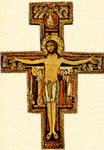
St. Francis composed this simple prayer apparently early on in conversion experience. He would pray this before the Crucifix of San Damiano on the hill outside of the city of Assisi. San Damiano was a hostel for pilgrims en route to Rome, but had fallen into disrepair from neglect. It was before this Crucifix that Francis heard the Lord Jesus speak to him and say, "Francis, go repair my Church which you see is falling into ruins!"

Francis initiated his church-rebuilding campaign shortly afterward, thinking originally that it was to this chapel and a couple others that he was called to physically renew and repair. However, it wasn't till later on, as he reviewed his life, that he realized that the Lord had called him to a renewal of the People of God, not just stone and mortar!

Above I used the word "conversion" -- what was that all about? Francis (Giovanni Baptista Bernardone) was reared in a Catholic household, the elder son of the Bernardone family. He was known to be generous to the poor; he was also known to be lavishly generous to his friends for parties! So, you can imagine that he was popular.

But after his excursion into warfare (Assisi v. Perugia -- Perugia won), he became a prisoner of war in the dungeons of Perugia, where he apparently contracted a form of tuberculosis and nearly died. After being ransomed from the prison by his father, Pietro, Francis returned to Assisi a changed man. He tried another venture in warfare, but turned back after a disturbing dream. He began to reconsider the direction of his life. That is when we began going to San Damiano to pray before the Crucifix, alone in a lonely place -- to confront his inner self and to meet the Lord. Such is the stuff of discernment.

It was out of this interior struggle and encounter that eventually led Francis to renounce the world and to become the poor man, the poverello of Assisi, a "fool for Christ", who wanted to live for Jesus alone. And so he embarked on the greatest adventure a human being can do -- to live the Gospel of Jesus Christ!

Crucifix of San Damiano

"Francis, go repair my Church which you see is falling into ruins."

Thursday, September 27, 2007

Franciscan Vocation Directors Meet in Florida

Franciscan friars serving as vocation directors throughout the United States, and also England and Ireland, and who represent the different branches of the Order, gathered for three days from September 17-21, 2007 at Franciscan Center in Tampa, FL. Don't worry, we didn't get a lot of sun! The weather was comfortably warm, but cloudy and damp.

The friars, pictured above, came from the Observant movement (the Friars Minor -- OFM), the Conventuals (OFM Conv), the Capuchins (OFM Cap) as well as the Third Order Regular (TOR) Franciscans and the Society of the Atonement (SA), also called the "Graymoor" Franciscans.

(In the photo above, I am on the far left.)

The Conventuals wear the grey habit, the Capuchins wear the brown habit with attached hood (capuche), the TORs wear the black habit and the Observants (OFM) -- that's our group! -- have the brown habit (light and dark) with the detachable hood. The Graymoor friar has a brown-grey habit.

Fr. Dominic Monti, OFM, a Franciscan historian from New York, gave some great input regarding the vocation ministry. St. Francis called the Holy Spirit the "General Minister" of the Order -- the entire brotherhood depended and still depends on the operation of the Holy Spirit.

St. Francis, in his Testament (written very shortly before his death), reflected on his life and how the Lord guided him throughout his life. He relied completely on the Lord's inspiration and the guidance of the Holy Spirit.

Francis sought to live the Gospel of Jesus Christ. Contemporary Franciscans also seek to live the Gospel of the Lord -- but in the 21st century, not the 13th. So, we too must rely on the Holy Spirit and the Word of God, to inspire us today and to guide us today in living the Gospel of the Lord Jesus.

The friars were great encouragement for one another, deepening our spiritual bonds through prayer, fellowship, good laughter and stimulating fresh ideas to energize us to joyfully promote our way of life as Franciscan men.

Thursday, June 7, 2007

"How Did You Know, Father?"

Every so often, when they are away from their peers or potential eavesdroppers, young men will ask the question, "Father, how did you know that you wanted to be a Franciscan friar or a priest?" I must admit, it's not an easy question to answer. I suppose it's like a parent trying to answer the question, "How did you know that Mom/Dad was the right one for you?" It seems easy enough, I suppose, but really isn't.

It's not because I don't know exactly -- it's more like, how do you explain a mystery? And a vocation is a mystery! For me, at least, there was no "magic moment" of Aha! It was more gradual. I am very visual, and I think part of my childhood attraction was the Franciscan habit. But the story of St. Francis of Assisi caught my imagination and heart even moreso!


I was fascinated by St. Francis' relationship with the Lord Jesus -- with his deep attraction to prayer, his holy boldness in preaching the Gospel, and his willingness to joyfully love his opponents who, quite frankly, thought he was nuts. I wanted to be like the "Poverello" (little poor man in Italian). I wanted to live for Jesus Christ!


When I was a teenager (way back in the 1970s!) I became involved in an area-wide youth group in metropolitan Pittsburgh, PA. It was led by one of our friars, Fr. Augustin ("Gus") Milon, OFM. And it was through him that I ended up becoming a Franciscan friar myself. I was drawn to prayer, to preaching and eventually to work among the poor.


I guess I just connected with the Franciscan charism (gift of the Holy Spirit), but before I even knew that there was a Franciscan charism! Maybe it grabbed me? See what I mean? It's difficult to explain. It really is a mystery.


But through prayerful discernment with other Franciscans over time it became increasingly obvious to me that this was where I belonged. God works with what attracts us. The Gospel of Jesus, the whole Bible, the Mass and Sacraments of the Church, the life and writings of St. Francis of Assisi, the habit, prayer, preaching -- all these attracted me to the Order of Friars Minor. It was something consistent and persistent in my life.


How about you? What attracts you? What does the Lord use to attract you to himself? To his Church? To ministry?


(In the above photo from August 2006, Bro. Jaime Hernandez, OFM from Guadalajara, Mexico and I are at "The Fest", a vocation event held annually in the Cleveland, OH area.)