Showing posts with label Catholic. Show all posts

Thursday, February 26, 2009

Inner Conversion -- Outer Works


St. Paul emphatically teaches that one is saved not by observance of the Law of Moses but by faith in Jesus Christ (cf. Gal. 2:16). Still, the Gospel of Matthew has Jesus teaching the crowds that not only has he come to fulfill the Law and the Prophets, not to abolish them (cf. Mt. 5:17), but also warns his followers that it is not enough to call him "Lord, Lord", but also do the will of the heavenly Father (cf. Mt. 7:21). And First John exhorts us that if we claim to love God whom we cannot see and fail to love the brother (or sister) whom we can, then we are liars! (cf. 1 Jn. 4:20).


In various places in the New Testament, both in the Gospels and in some of the Epistles, we are advised that the fulfillment of the Old Testament is to loved our neighbor as ourself (cf. Lv. 19:18b).

Conversion, or metanoia from the Greek meaning a "change of mind" (so, Mk. 1:15; Mt. 3:2 [John the Baptist] and 4:17 [Jesus]), is the universal call to think and do differently. Yesterday, for those Catholics of the Roman Rite, we heard the injunction to either "Turn from sin and believe the Gospel" or the reminder echoing the Book of Genesis, "You are dust and unto dust you shall return." (cf. Gen. 3:19c).


St. Paul reminds us we who are baptized must have a change of mind (cf. Rom. 12:2) and that, in fact, we have the mind [psyche] of Christ (cf. 1 Cor. 2:16b). And yesterday we were also reminded that "today is the acceptable time" (cf. 2 Cor. 6:2-3).


So, being a Christian -- as we all know -- is more than saying words; it is a lifetime of practice and working. We yield to God's Holy Spirit and allow the Spirit of the Living God to transform us -- our ways of thinking, our attitudes, our bad habits, our speech, our behaviors, our actions -- so that they more readily and clearly reflect the image [ikon] of Jesus Christ (cf. 2 Cor. 3:18).


Our Christian vocation is ongoing converstion into Jesus Christ. For us members of the Franciscan family, friars, Sisters, nuns and laypeople alike -- our life is one of penance in joyful response to the Lord's call. Not only to follow Jesus Christ, but to live in him and him live in us, thus following the lead from our holy founder, St. Francis of Assisi.

St. Francis of Assisi embracing the leper, through whom he encountered the Lord Jesus Christ.

Monday, November 24, 2008

Enough is enough!

A couple weekends ago I attended a youth event that was led by a group of Brothers and Sisters. There was lively music and high energy and, overall, a rather positive spirit among the presenters and participants.

This was shortly after our national elections on 5 November 2008.

Later in the afternoon, a priest gave a talk on Christian morality and was preparing the young people and their chaperons for the Sacrament of Reconciliation. Two things he said astonished me -- he obviously supported John McCain as his choice for president of the USA (by stating that the wrong man had been elected) and he inferred that there was a similarity between the rise of Adolph Hitler in 1930s Germany and the election of Barack Obama.

His choice of candidate is fine; it is his business and has no correlation to a public announcement at a Catholic youth event sponsored by the Church. His connection seemed to be focused solely on Mr. Obama's consistent pro-choice stance and support of the 1973 Supreme Court decision of Roe v. Wade.

Since then I have become aware of others making this rather odd and, quite frankly, frightening association. Some have been Catholic (on blogs like this, apparently) and others have been political. Already at the end of the political campaign there seemed to be fear-mongering about Obama as a "socialist" and other such epithets directed at him.

BTW, is anyone familiar with the political campaigns when Franklin Delano Roosevelt was running for president? As I recall, he was also dubbed a socialist!

I find it alarming that people -- especially people of faith and public Catholic leaders like I had met -- would insinuate a connection between Hitler and Obama. Hitler was a thug! He wanted to eliminate the Jews from Europe (and beyond, if possible!), as well as the Roma (Gypsies), homosexuals, Communists and Free Masons. He made it to office through thuggery and manipulaton. He precipitated World War II in 1939 by setting up a bombing in Germany and falsely accusing the Poles of committing the violence, and subsequently invaded Poland for the sake of the "honor" of the German fatherland. BTW, he committed this heinous injustice with the collaboration of Joseph Stalin and the now-defunct Soviet Union. Hitler explicitly promoted violence and Germany as the "superpower" and the Aryan people as the "super race" in his book, Mein Kampf (My Complaint).

As a Catholic Christian, a Franciscan friar and a priest I certainly disagree with Mr. Obama's stated position on abortion and the so-called pro-choice stance, as well as his apparent and unequivocal support for the "Freedom of Choice Act" (FOCA), which our US Catholic bishops have rightly and resoundingly opposed.

At the same time, I oppose any insinuation of connection between Obama and Hitler! Enough is enough. Someone who is "unhinged" may take this inference and seek to protect the nation from "another Hitler". God forbid! We as Catholic Christians, as clergy and religious, must advocate for life and oppose violence of any kind. Especially as Franciscans, for as St. Francis of Assisi stated to his friars early on, "If you are going to proclaim peace with your lips, make sure you have it first in your heart!"

Thursday, November 20, 2008

Cafeteria Catholics


Recently there was a video posted about Maria Shriver, the first lady of California (wife of Governor Arnold Schwarzenegger). She described herself rather matter-of-factly as a "cafeteria Catholic." No apologies; no regrets.

Now, Ms. Shriver is a very articulate, attractive and vivacious speaker. She is clear and deliberate in her speech, which is evidence of a very good education and professional training.

She stated that as far as matters of faith were concerned she clearly identified herself as Roman Catholic -- liturgy, creed, etc. But as far as practice of faith and the Catholic Church's position on various issues -- e.g. women's roles in the Church, the right to choose an abortion, gay marriage and the like she clearly stated that she disagreed with the Catholic Church's positions.

She said that she did agree with the "social" content of Catholic teaching -- justice and peace, outreach among the poor, and she noted that she identified with Jesus' compassion and mercy, especially among the poor and the downtrodden.

As a Franiscan friar and priest I find this attitude curious and disturbing. For one thing, Ms. Shriver is a member of my generation, the so-called Baby Boomer Generation. She is a member of the Kennedy clan (first cousin, for example, of Caroline and the late John, Jr., the famed children of the late President John F. and Jacqueline Kennedy).
I think that Maria speaks for many of my/our generation and our generation's treatment of the practice of faith. One unabashedly picks and chooses as one wants. This certainly fosters a sense of individual identity, even a sense of individualism. Problem is -- and this certainly is problematic -- it flies in the face of the notion of the New Testament's image of the Church as Body of Christ. We are members of one another, as the Apostle teaches in 1 Corinthians 12 and 14. We are not as individuals the Body of Christ!

St. Paul, in his various writings, and those attributed to him, certainly warns the various Christian communities against "novelty" in faith and strongly admonishes the members of the communities to be faithful to their Tradition -- i.e. what has been handed to them by Paul and other Apostles. We are an apostolic Church, after all, as we readily profess in our Creed Sunday after Sunday.

The one thing that was even more curious to me -- maybe you've seen the interview? -- was how Maria described teaching her daughters about a woman's right to choose an abortion. She said that she differentiates between being "pro-choice" and being "pro-abortion." At the very least, it is an interesting split. To be pro-abortion means, according to what she seems to have described, to advocate the termination of a pregnancy whereas being pro-choice means that it is the woman's right to choose whether or not to terminate the pregnancy.
This seems to me, at least, to be a definite disconnect between faith and practice. I am not advocating a so-called black-and-white approach; life is not that simple -- most of us have had to confront situations in our life where the answers were not easy. But the "cafeteria Catholic" approach to faith is, at best, disingenuous if not actually dishonest. Perhaps not deliberately so, but certainly the result leads to a rather loud dissonance of faith. Especially understanding faith as communion -- communion with one another, with our Bishops, with the Pope of Rome.
As Franciscans, we have traditionally been at the vanguard of mission and outreach. Since the time of St. Francis of Assisi and the early friars, we have been in the proverbial "trenches" where others did not want to go or were simply not aware.


It seems to me that confronting the "cafeteria" approach to Catholicism is one such "trench" to which we are called. Not as judgemental or arrogant, of course! But approaching folks with the reality of the lack of consistency -- and as an opportunity to evangelize (without being "preachy").
Tuesday, July 22, 2008

WYD SYD 08!


World Youth Day in Sydney, Australia! July 15-20, 2008. Thousands of Catholic youth from all over the globe converged Down Under to gather with Pope Benedict XVI for prayer, fellowship and learning.

What a marvelous event to see on-line or via TV, thanks to EWTN's coverage. Did you have a chance to see it? If not, you can download the various events under "World Youth Day 2008". Lots of video to view. Apparently this was the first time that WYD had live feed on-line. How great that technology can serve us so well to proclaim the Good News of the Lord Jesus and help build up the Body of Christ!


As a "virtual" participant, it was thrilling to see so many young adults gathered to worship God within our Catholic traditions. Cardinal Pell of Sydney welcomed all the pilgrims and the Holy Father to Australia, and the Prime Minister of that country welcomed the youth of the world on their pilgrimage of peace. He had noted that many -- all too many -- times such a physical movement of young people from one location to another was associated with warfare. (Curiously, while he mentioned the words "faith", "Christian" and "Catholic" he omitted the word "God"! It seems to speak of the obvious reality of Australia's secular culture.)

At the end of World Youth Day, when addressing both Pope Benedict and all the participants at the Sunday Mass, Cardinal Pell noted that WYD has now become part of the Catholic reality and is an eagerly anticipated event in the life of the Church world-wide.

Pope Benedict XVI, continuing the tradition of the Servant of God, Pope John Paul II
in promoting and participating in World Youth Day 2008, at Sydney, Australia (15-20 July 2008)

Friday, April 18, 2008

Benedict’s Visit Reflects Changing Church

An article by Bro. Jason Welle, OFM, during his year in the province at Sacred Heart Parish in McAllen, TX


Pope Benedict XVI won’t be visiting Texas (this time!), but the Franciscan friars in the Rio Grande Valley, have still been eagerly awaiting his arrival. Personally, I’ve felt a close affinity to this pope ever since his election. My family heritage is Germanic and I had the chance to help another Franciscan friar lead a group of high school students to see the Holy Father at World Youth Day in Cologne, Germany, in 2005. Seeing Benedict speak German in his home country was a wonderful thrill, but following this visit through the news with our parishioners has been a great blessing as well.

Our parish’s religious education programs have found different ways to draw attention to the Holy Father’s message. In my fourth grade CCD class, the kids acted out a play about Shepherd One landing at Andrews Air Force base—although the Texan kids clamored more for the roles of President Bush and the First Family than for the papal entourage! My 12th grade class read and discussed some commentary on the pope’s trip, and my adult education Bible study integrated conversation about Benedict’s style of leadership with that of St. Paul, as we continued our reflections on 2 Corinthians. In the wake of Good Shepherd Sunday, we asked ourselves what kind of shepherd Jesus was, what kind of shepherd Paul was, and what kind of (German) shepherd Benedict is.

These discussions are exciting because here in deep South Texas, just a few miles from the Mexican border, we live in a unique cultural mix. Many commentators have observed the growing presence of Hispanics in the Catholic Church throughout the United States, and Benedict’s recent creation of Texas’ first cardinal, Archbishop Daniel DiNardo of Galveston-Houston, seems to acknowledge the significance of this for the future of the American Church. In many places throughout the country, different cultural groups live side-by-side in the same parish or neighborhood but yet remain distinct and separate. We feel blessed here in McAllen to minister in a poor, downtown parish where Spanish and English speakers mix freely, working together for the future of this community. The friars of the Assumption Province came to this parish two years ago and were warmly welcomed, as we continued the long Franciscan tradition of reaching out to those on the margins. Our friars occasionally run into problems communicating, but Catholics here appreciate the sincerity of the effort; we pray that American Catholics will extend the same openness to the Holy Father’s words as he calls us all to hold up the richest parts of our tradition and preach Christ our Hope!

Bro. Jason Welle, OFM, kneeling, renews his religious profession in the hands of our Provincial Minister, Fr. Leslie Hoppe, OFM

Monday, March 31, 2008

Welcome, Pope Benedict XVI! What will he find in the USA?


Our Holy Father, Pope Benedict XVI is expected to make his first papal visit to the United States of America next week, 15 April 2008. With open arms the Catholic Church, young and old, welcomes the Successor to St. Peter and Vicar of Christ to our nation!


Yet, what will he find when he arrives? He is an ardent student of current events and is not ignorant of the reality we face as Catholic Christians here in the USA. You may be aware of the recently released survey from the Pew Forum on Religion and Public Life, called the U.S. Religious Landscape Survey (you can find the results on-line), "The porportion of the U.S. population that identifies itself as Catholic has remained relatively stable in recent decades, but this apparent stability obscures the major changes that are taking place within American Catholicism."
The article continues, "No other major faith in the U.S. has experienced greater net losses over the last few decades as a result of changes in religious affliciation than the Catholic Church. Nearly one-third (31.4%) of U.S. adults say they were raised Catholic. Today, however, only 23.9% of adults say they are affiliated with the Catholic Church, a net loss of 7.5 percentage points. Overall, roughly one-third of those who were raised Catholic have left the church, and approximately one-in-ten American adults are former Catholics."
The survey acknowledges the tide of those who convert to Catholicism -- witness the numbers of adults who are received either as catechumens or as baptized candidates at each year's Easter Vigil. It notes that "The Landscape Survey finds that 2.6% of U.S. adults have switched their affiliation to Catholicism after bein raised in other faiths or in no faith at all."
However, it also notes that ". . . former Catholics outnumber converts to Catholicism by roughly four-to-one . . ." The survey points to the relative steady number of people who identify themselves as Catholics to immigrants -- particularly those from Mexico and other parts of Latin America. Again, "The Landscape Survey finds that nearly half of all immigrants coming to the U.S. (46%) are Catholic, compared with just 21% of the native-born population."
Finally, "The vast majority (82%) of Catholic immigrants to the U.S. were born in Latin America, and most Catholic immigrants from Latin America (52% of all Catholic immigrants to the U.S.) come from just one country -- Mexico." It continues to note that, ". . . Catholics are also represented among immigrants coming to the U.S. from Western Europe, Eastern Europe and East Asia; more than one-in-four of all immigrants form these regions are Catholic."
So, this is part of the reality of the U.S. Catholic Church which our Holy Father is visiting -- those who identify themselves as Catholic and are practicing; those who identify themselves but either practice sporadically or seldom; those who no longer identify themselves as Catholic and have left altogether; and the growing immigrant Catholic populations from Latin America, East Asia and Europe.

Thursday, February 21, 2008

Lent in the Valley (Rio Grande, that is!) -- from Bro. Jason Welle, OFM

My first Lent in the Rio Grande Valley has been quite the experience so far! After two years of seminary studies in Chicago, I’m doing a one-year internship at Sacred Heart Church, a poor downtown parish 8 miles from the Mexican border, in preparation for my solemn vows.

Bro. Jason Welle, OFM (on the far left) in Chicago, IL

While my Spanish is far from perfect, our wonderful parishioners have been very accepting of me, as they were to the three Franciscan friars I live with, when they first came to McAllen, Texas, a year and a half ago. Ash Wednesday was one of the busiest days of the year, with three packed services in the church, plus a special service in the parish hall for our CCD program.

Most of our parishioners are Hispanic and the ashes are a very important symbol to them, so Br. Paul and Galen, a postulant for our Franciscan community, made the rounds to area hospitals and nursing homes, distributing ashes and bringing holy communion to those who couldn’t make it to church. Now, our various Lenten programs are in full swing, including “Disciples in Mission,” a weekly Bible study program utilized by parishes throughout the diocese.

Before Lent, our parishioners organized themselves into small groups according to language and what time they could meet; now, they gather weekly to read the scriptures for the upcoming Sunday and share their faith. This program, as well as penance services, the Stations of the Cross, and next week’s parish mission, are some of the ways Catholics here have chosen to draw closer to the Lord this season.

I really didn’t know what to expect when I arrived here in September, other than heat, humidity, and breakfast tacos. But Fr. Tom, our pastor, and all of our parishioners have helped me grow in my Franciscan vocation, helping me see the ways I might be called to serve Catholics in the Valley during this year. I have become very involved in our religious education program, leading a bible study for adults, a bible study for teens, and CCD classes for fourth graders and fifth grades. I also play guitar and sing with all four of our parish choirs, two in English and two in Spanish.

The support and encouragement of the friars I live with has been a great blessing—we’re often out and about doing different things, but gather every morning and evening for prayer and meals, swapping stories about ministry in a culture so different from the Midwest. The last six months in parish ministry have definitely strengthened my desire to make my permanent commitment to the Order of Friars Minor. I don’t know if I’ll ever be living in the Valley again, but I’ll bring the memories, the blessings, and hopefully some of the Tejano music, to wherever I’m called to serve.

Monday, January 21, 2008

35 Years of Roe v. Wade, 22 January 1973 -- 22 January 2008 Part II

While we must continue the struggle to defend the rights of the unborn, we must also engage the so-called “pro-choice” side with their issues. And several of these issues are not unreasonable – health care for pregnant mothers, child care for neglected, abandoned and abused children, protection for pregnant mothers who are in abusive relationships and the like. The strident call for privacy and freedom of “choice” to have an abortion really does miss the mark. But so does the violence of unchecked speech and attitude toward these people.

And, as the late Pope John Paul II and our current Holy Father, Benedict XVI, as well as the US Bishops have stated, we must cultivate a “Culture of Life” – in its entire spectrum. As Catholic Christians we must do so consistently lest we lose whatever credibility we may have.

These issues of life include the abolition of the death penalty, an end to military and government sanctioned torture of prisoners of war, peace-making in foreign affairs (please recall that the late Pope John Paul II condemned the US-led invasion of Iraq in 2003 and the US Bishops called upon our nation's Administration for military restraint), just and living wages for workers, justice for the elderly, adequate medical care for all people, and concern for the immigrant, whether legal or undocumented.

These are all part of what the late Joseph Cardinal Bernardin of Chicago called the “seamless garment” of pro-life issues. He was referring to the Lord Jesus’ garment mentioned in the Gospels that was gambled for at his crucifixion. First of all, the “seamless garment” is entirely consistent with the New Testament ethic we find in the Sermon on the Mount (Matthew 5 & 6). It is also very much a Franciscan approach – to announce and bring the Good News of God’s reconciling love in Jesus Christ. To announce God's infinite mercy. By the way, Cardinal Bernardin was an honorary Franciscan friar.

I think that it is befitting on this anniversary to recall that a few years ago "Ms. Roe" underwent a powerful conversion experience to the Lord Jesus and subsequently became a fully initated and reconciled Catholic Christian woman in her home State of Texas.

So, after 35 years, we have work to do. While there is politicking on both sides of the issue, the real issue, it seems to me, is human life. In all its stages. Beginning in the womb.

Wednesday, December 12, 2007

Our Lady of Guadalupe

Image of the Blessed Virgin Mary, Our Lady of Guadalupe, on Juan Diego's tilma ,in the Basilica in Mexico City

La Virgen Morena is the famous celebration of the indigenous peoples of the Americas. She appeared to Juan Diego at Tepeyac, near the former Aztec capital and holy sites, over a series of days in December 1531, about 10 years after Hernán Cortéz and the Spanish conquistadores vanquished the once-proud Aztec people and several the other native peoples of México.

She spoke to Cuauhtlatoatzin, his Nahuatl (Aztec language: “one who speaks like an eagle”) name, in his native tongue, not in Spanish. Similarly, she appeared to him as one of his own, not as a European. She was swarthy, la Virgen morena (the dark-skinned Virgin).

The image of Our Lady of Guadalupe is very rich in symbols. Hers is an “icon”, if you will, not made by hands. Her image was miraculously imprinted on Juan Diego’s tunic, the tilma (a piece of clothing fashioned from the fibers of the maguey plant).

Unbeknownst to Juan Diego, when he displayed his tilma with the freshly picked roses, Bishop Juan Zumárraga, OFM (1st bishop of Mexico and a Franciscan friar and priest) was astonished, as were his friars!

The wonderful result of this heavenly visit was a powerful wave of evangelization. Millions of indigenous peoples, Aztec and beyond, professed faith in Jesus Christ and embraced the Catholic faith through the proclamation of the Gospel and were baptized. The story of the Blessed Mother’s arrival to their land and her message swept the land around Mexico.

Here was someone with whom the native peoples could identify. And still do to this day! When I am among Mexican Catholics, in their homes, businesses and even cars, I see Mary’s image, la Guadalupana! The story and her image are deeply ingrained in the consciousness of Mexican Catholics. And, December 12th is a national holiday in all of Mexico! Ser mexicano es ser guadalupano (to be Mexican is to be a devotee of Guadalupe!).

As we celebrate her feast day today, let us recall that Mary, the Mother of God, continues to intercede for us (as the position of her hands displays) and especially considers the poor and the downtrodden to be her special children. She is the pregnant Mother (the black sash around her waist) who came to a conquered people, the Aztecs. It was to them, not their conquerors, that she gave her message; to a peasant, not to an aristocrat or friar or bishop; in Nahuatl not Spanish.

To me, at least, it becomes another example of “minority” – the quality which was so dear to St. Francis of Assisi and which he tried to inculcate among his brothers, to whom he gave the name “minors” (friars minor – lesser brothers). The fruit of minority is solidarity. And this is our vocation as Franciscans!

We are preparing to celebrate the great festival of the Incarnation -- Christmas -- when the Word of God takes on human flesh, in solidarity with us. So great is God's love (see John 3:16).
God in Jesus Christ identifies with us! He becomes flesh of our flesh, bone of our bone, blood of our blood. Is this not true of what we celebrate sacramentally in the Eucharist, when we partake of the Body and Blood of Christ Jesus? The Lord himself feeds us with himself.


We ourselves might be quite surprised how the Lord desires to enter into our lives, to be in solidarity with us. Through the intercession of the Blessed Virgin Mary, our Lady of Guadalupe, may we all come to know the power of God’s grace in our very real human experience.

Thursday, October 4, 2007

The Poverello of Assisi: St. Francis and his feastday, 4 October 2007


Most High, glorious God,

bring light to the darkness of my heart

and give me true faith, certain hope and perfect charity,

sense and knowledge, Lord,

that I might carry out your holy and true command.

Amen.


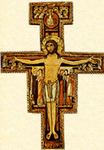
St. Francis composed this simple prayer apparently early on in conversion experience. He would pray this before the Crucifix of San Damiano on the hill outside of the city of Assisi. San Damiano was a hostel for pilgrims en route to Rome, but had fallen into disrepair from neglect. It was before this Crucifix that Francis heard the Lord Jesus speak to him and say, "Francis, go repair my Church which you see is falling into ruins!"

Francis initiated his church-rebuilding campaign shortly afterward, thinking originally that it was to this chapel and a couple others that he was called to physically renew and repair. However, it wasn't till later on, as he reviewed his life, that he realized that the Lord had called him to a renewal of the People of God, not just stone and mortar!

Above I used the word "conversion" -- what was that all about? Francis (Giovanni Baptista Bernardone) was reared in a Catholic household, the elder son of the Bernardone family. He was known to be generous to the poor; he was also known to be lavishly generous to his friends for parties! So, you can imagine that he was popular.

But after his excursion into warfare (Assisi v. Perugia -- Perugia won), he became a prisoner of war in the dungeons of Perugia, where he apparently contracted a form of tuberculosis and nearly died. After being ransomed from the prison by his father, Pietro, Francis returned to Assisi a changed man. He tried another venture in warfare, but turned back after a disturbing dream. He began to reconsider the direction of his life. That is when we began going to San Damiano to pray before the Crucifix, alone in a lonely place -- to confront his inner self and to meet the Lord. Such is the stuff of discernment.

It was out of this interior struggle and encounter that eventually led Francis to renounce the world and to become the poor man, the poverello of Assisi, a "fool for Christ", who wanted to live for Jesus alone. And so he embarked on the greatest adventure a human being can do -- to live the Gospel of Jesus Christ!

Crucifix of San Damiano

"Francis, go repair my Church which you see is falling into ruins."

Thursday, February 22, 2007

Beginning Lent 2007


We began Lent yesterday in the Roman Rite of the Catholic Church. Today at our community Mass Fr. Roch Niemier, OFM shared with us that what we hear in the Scriptures today from the Prophet Joel is a call to “turn.” That is the essence of Christian conversion – turning the heart to God. Ascetical practices, then, are only meant to aid is in this direction. Fr. Roch referred to the Lent of 1213 when St. Francis of Assisi had someone row him to an uninhabited island in a lake. St. Francis stayed there all Lent to pray and fast. He had some bread and other provisions with him on the island. But Francis so wanted to identify with Jesus in the wilderness for his fast of 40 days (cf. Matthew 4 and Luke 4) that he himself went to pray alone in a wooded wilderness on this remote island. His purpose was to turn his heart intensely to the Lord. It shows us that Francis’ whole life was a constant turning to the Lord – that was the goal of any ascetical practices. And so, for us, said Fr. Roch, any ascetical practices we undertake this Lent (e.g. avoiding candies, smoking, alcohol, etc) are to help us turn to the Lord. What good is it if on Easter Sunday we simply return to the former activities (e.g. smoking) and our hearts have not turned to the Lord?