Showing posts with label Vocation. Show all posts

Friday, April 10, 2009

We adore you, O Christ, and we praise you because by your holy cross you have redeemed the world!

These words echo throughout the Church today on Good Friday. For those accustomed to praying the Stations of the Cross this is how each Station begins.


From the movie, "The Passion of the Christ" by Mel Gibson -- the Fifth Station -- Simon of Cyrene is pressed into service to help Jesus carry his cross to Calvary.


We proclaim that Jesus dies on the cross on Golgatha for the salvation of the whole human race. It is "Good" Friday because of the great good that God accomplished through Jesus' obedience even unto death, death on a cross (cf. Phil. 2:5-11). It is not in spite of the cross but actually through the cross that we have salvation.


St. Paul writes in 1 Corinthians chapter 1 that "for the Jewish people the cross is a scandal and for the Greeks (Gentiles) the cross is foolishness, but to those on the way of salvation -- Jew and Gentile alike -- Christ the power and wisdom of God!"


For St. Francis of Assisi, and for successive Franciscan friars, Sisters, nuns and lay people, the Cross of the Lord has always been an invitation to repentance and to joyful (yes, joyful) penance by seeking the Lord in all things and encountering him in every circumstance of life.


From the Crucifix of San Damiano when Francis was a young man, to the design of what would become the habit in the shape of the cross, to the sign of the Tau (T) at Lateran Council IV (1215) as a mark of renewal to the great episode on Monte LaVerna toward the end of his life when he received the sacred stigmata, the cross of the Lord Jesus always impressed upon St. Francis the great condescension of God toward humanity. Such great love of such a great God!


Undeserving sinners that we are, God has never given up on us nor has God turned his back on us. St. Paul reminds us of this in Romans chapter 5 where he writes, "While we were still in our sins Christ died for us."

As we contemplate the Lord Jesus' Passion, death and burial today -- whether Roman Rite, Byzantine Rite or another Eastern Rite of the Catholic Church -- let us consider this great love of God toward us today.

It transformed the lives of the Mother of God, the Apostles and disciples of the Lord, it transformed Francis' and Clare's lives and the lives of countless saints before us.

May this Good Friday be a powerful blessing for you and may your prayer today lead you ever closer to the Lord Jesus who gave his life for us that we might have life, and have it abundantly (Jn. 10:10).

That is our Christian vocation, after all. And this is the Franciscan vocation as well. We bless you, Lord Jesus for by your very cross you have redeemed the world. We believe this, Lord, we believe. Amen.

Thursday, April 9, 2009

Lord, do you intend to wash my feet, too?

This question posed by St. Peter at the Last Supper according to the Gospel of John (chapter 13) really can be a focus for us, especially in the West.


Icon of Jesus washing the discples' feet at the Last Supper

Will we allow the Lord Jesus to wash our feet? According to Middle Eastern tradition it was the role of the slave or servant to undertake this seemingly distasteful task. Jesus the Master become Jesus the Servant. And then later on in the Last Supper discourse (chapter 14) he tells his disciples that he considers them to be his friends and no longer slaves.

We have become familiar with the symbolic use of feet in the Middle East, especially since the US military involvement in Iraq. Perhaps this takes on even a more profound meaning for us. Whether it was beating the fallen statue of Sadaam Hussein with the soles of shoes, or the angry Iraqi people insulting US soldiers by showing the bottoms of their feet or the reporter throwing both of his shoes at former President Bush in Baghdad, the Middle Eastern attitude toward displaying feet is understood as a negative act.

Jesus willingly takes on a distateful ritual reserved to the lowest members of the household in preparation for undergoing the ignominious "ritual" of Roman crucifixion. And he teaches his disciples to do the same!


Tonight at the Roman Rite Mass of the Lord's Supper the priest will wash the feet of members of the congregation. It seems that whenever folks are asked to have their feet washed in this solemn ceremony they are quite reluctant to do so. There is an unease, an embarrassment about this public display of humility and even affection.


Franciscan priest kissing a parishioner's foot after having washed it


And perhaps that is exactly where we need to be -- just a bit uncomfortable! Peter was aghast that his Lord and Master would literally stoop to this act. It was, quite frankly, shocking. And then to be instructed that this is how the disciples are to relate to one another -- washing one another's feet! Not just as a ritual act but as a symbol of loving one another as Jesus has himself loved us.


As Franciscan friars we see this as our life, our vocation. It is not only in imitation of the Lord Jesus. Even more so, it is allowing Jesus Christ, risen from the dead, to animate us to live, act and behave in his name. From the time of St. Francis of Assisi's remarkable humilty in caring for lepers and also for his brothers, the Franciscans have attempted to undertake this task in cheerful love, especially among the poor, the forgotten, the isolated and the marginalized.


The Mass of the Lord's Supper, which concludes with the solemn transfer of the Holy Eucharist to the Altar of Repose, leads us to prepare for the Lord's Passion. I would like to encourage any who read this blog to take the time, whether at your parish church or at home, and continue the Gospel of John from the conclusion of the this evening's Gospel (John 13:1-15), beginning with verse 16 and continuing slowly through the following chapters of the Gospel -- 14, 15, 16 and 17 -- often called the Last Supper Discourse (that is, teaching) of Jesus.


Powerful messages for us as we enter into this Sacred Triduum -- loving one another as Jesus loves us, the promise of the outpouring of the Holy Spirit, the encouragement for perseverence under trial and the famous prayer of Jesus for the unity of his disciples. And more, of course.


The Agony of the Lord Jesus in the Garden of Gesthemani


Jesus washing the discples' feet leads to his own feet being crucified on Good Friday. He does this for you and for me, indeed, for the whole world.


His washing eventually transforms his disciples. If you will, it is a kind of "baptism" in which they are changed by their Master. It leads us to have the attitude of Jesus (cf. Phil. 2:1-11). The same love and compassion, the same strength and grace, the same trust in his Abba, Father (see Rom. 8:14-17).


He wants to wash your feet. Today. Now. Will you let him?


Come, Lord, and wash my feet, too. Deliver me from sin and from my own selfishness. Change my heart that I may trust you with all things in every circumstance in my life. Bring salvation, Lord Jesus, as you wash my feet even now. Lead me through these holy days of the Triduum into the victory (yes, victory!) of your Cross and Resurrection. Lord, by your Cross and Resurrection you have set me free -- you have set us free -- you are the Savior of the world. Thank you. Amen.

Monday, March 30, 2009

How's Your Lent?

A lot of times folks who are serious about engaging Lent find themselves in a real struggle. If they thought that the works of prayer, fasting and almsgiving would be easy, or, if they thought that it might be a good opportunity to practice some kind of pious "diet", I find they are often very mistaken!


Judean wilderness, between Jerusalem and Jericho, near where the Gospels (Matthew & Luke) report Jesus fasting and praying for forty days and having been tempted by the devil.

Lent is a REAL struggle! And it is supposed to be! That's the blessing, though. Not that we are fasting more or praying more or even more generous in our almsgiving. No, rather, that we are allowing the Spirit of God to move through us and to change us more and more into the glorioius image of Jesus Christ!


That is why, on the first Sunday of Lent, in each of the cycles of readings (A, B and C), we find Jesus, just after having had the exhilirating experience of his Baptism in the River Jordan, going up into the desert to pray and to fast, and to struggle.


We know that the desert is the primoridal image in the Old Testament. The Book of Exodus tells us stories of the Israelites fleeing the Egyptians which then leads them into the Sinai Desert where they wander for forty years. It is where God gives Israel the Torah at the hands of Moses the Lawgiver. The Prophet Hosea depicts God affectionately recalling the desert for the People of God as the holy place of their formation as a people belonging uniquely to God!

Like the desert of the first covenant, the desert of our Lent is a crucible in which we are re-formed as God's holy People. We prayerfully accompany those who are preparing for the Sacraments of Christian Initiation (Baptism, Confirmation and Holy Eucharist). We stand together in solidarity with all penitents as we celebrate the Sacrament of Reconicilation, especially favorable during Lent.

The Prophet Moses bringing the Tablets of the Commandments to the Children of Israel from Mount Sinai.
As Franciscan friars, we have donned the "habit of penance", as our holy founder, St. Francis of Assisi, called it. We do so not out of a sense of guilt but rather in the spirit of confident assurance of God's Word which extends mercy "for ever" and "to the thousandth generation to those who fear the LORD."
Our vocation, first as Christians and lived out as friars minor ("lesser brothers") is one of trust in the Lord Jesus. We seek to be in the fire of the crucible of the Lent to be transformed by the hot fire of God's grace into the image of his glorious Son (cf. 2 Corinthians 3:18).
Perhaps the challenges of Lent 2009 have involved famiily disputes, or loss of employment or some other significant financial loss, or the loss of a friendship, or the visit of death to a loved ones. All these can be such difficult situations for us and for those whom we love and care.
Maybe it's time, then, to take stock of our Lent. Have we been looking at our Lenten penance superficially or more deeply as growing into Jesus. Maybe standing in prayer with and for those who are struggling -- in Darfur, in the Middle East, in central Africa, in our own cities and towns -- and who are suffering -- maybe this is the kind of penance (or, better, conversion!) the Lord is calling us to as our Lenten journey is drawing to a close next week. Maybe we can review the First Reading from the Friday after Ash Wednesday, Isaiah 58:1-9 and do a "check-in" with the Lord as to how we are responding to this "great season of grace" (Preface II of Lent).

Thursday, February 26, 2009

Inner Conversion -- Outer Works


St. Paul emphatically teaches that one is saved not by observance of the Law of Moses but by faith in Jesus Christ (cf. Gal. 2:16). Still, the Gospel of Matthew has Jesus teaching the crowds that not only has he come to fulfill the Law and the Prophets, not to abolish them (cf. Mt. 5:17), but also warns his followers that it is not enough to call him "Lord, Lord", but also do the will of the heavenly Father (cf. Mt. 7:21). And First John exhorts us that if we claim to love God whom we cannot see and fail to love the brother (or sister) whom we can, then we are liars! (cf. 1 Jn. 4:20).


In various places in the New Testament, both in the Gospels and in some of the Epistles, we are advised that the fulfillment of the Old Testament is to loved our neighbor as ourself (cf. Lv. 19:18b).

Conversion, or metanoia from the Greek meaning a "change of mind" (so, Mk. 1:15; Mt. 3:2 [John the Baptist] and 4:17 [Jesus]), is the universal call to think and do differently. Yesterday, for those Catholics of the Roman Rite, we heard the injunction to either "Turn from sin and believe the Gospel" or the reminder echoing the Book of Genesis, "You are dust and unto dust you shall return." (cf. Gen. 3:19c).


St. Paul reminds us we who are baptized must have a change of mind (cf. Rom. 12:2) and that, in fact, we have the mind [psyche] of Christ (cf. 1 Cor. 2:16b). And yesterday we were also reminded that "today is the acceptable time" (cf. 2 Cor. 6:2-3).


So, being a Christian -- as we all know -- is more than saying words; it is a lifetime of practice and working. We yield to God's Holy Spirit and allow the Spirit of the Living God to transform us -- our ways of thinking, our attitudes, our bad habits, our speech, our behaviors, our actions -- so that they more readily and clearly reflect the image [ikon] of Jesus Christ (cf. 2 Cor. 3:18).


Our Christian vocation is ongoing converstion into Jesus Christ. For us members of the Franciscan family, friars, Sisters, nuns and laypeople alike -- our life is one of penance in joyful response to the Lord's call. Not only to follow Jesus Christ, but to live in him and him live in us, thus following the lead from our holy founder, St. Francis of Assisi.

St. Francis of Assisi embracing the leper, through whom he encountered the Lord Jesus Christ.

Wednesday, February 25, 2009

Giving Up? Giving Over!

Perhaps something for us to consider this Ash Wednesday 2009 is what we are handing over to the Lord. As Catholics, we have been well-trained (I hope!) to think about "giving up" as a means to penance. Chocolate, ice cream, alcohol, pastries, desserts . . . renouncing all of these can help us to be aware of the luxuries of life and to help increase our awareness of Lent.

We certainly fast during Lent from the Gloria and the Alleluia during our liturgical celebrations and prayer. But all the giving up, as it were, the abstaining from meat (i.e. poultry, beef, veal, pork products) on all Fridays of Lent is meant to be a signpost to us of our need to convert. And to point us to what -- that is WHO -- is really important. The Lord Jesus Christ and his Holy Gospel!


Something that is ancient, that is biblical, that is primordial in the human-divine relationship is giving over. This handing over, not as a passive resignation but an active trust into Someone else's safekeeping, this is really what we are called to. It is the basis, interestingly enough, of the Latin root for our English word tradition (in Latin, traditio). In his first Letter to the Corinthians, in both chapters 11 and 15, St. Paul writes to the Christian Church there, "I hand on to you what I myself received, namely . . ." (1 Cor. 11:23; 15:3). He hands over, in trust and safekeeping, to the Corinthian Christians from whom he has been absent, the deposit of faith and the right practice of that faith.

Handing over is actually a choice for life. Jesus does so continually during his ministry, culminating in the Agony in the Garden and his death on the Cross -- for the life of the world, for our salvation. The Eucharist is our frequent celebration of this handing over.


Our handing ourselves over to the Lord is not some kind of "human sacrifice." Although it is, indeed, a sacrifice, it is us allowing the Lord to be Lord, to be Savior, to be who Jesus says he is in our lives. And it's allowing the promise of our Baptism to be once again renewed and fulfilled in us!

We see St. Francis of Assisi and St. Clare of Assisi do this frequently in their lives, both in imitation of Jesus and even moreso in response to his call. It is the vocation of every Christian to hand ourselves over to the Lord. Our Franciscan vocation impels us to do this, to be a people of penance, so that we are not only giving up what is unnecessary, but giving over in hope and trust to the One who has saved us and who never gives up loving us.


Wednesday, January 14, 2009

Week of Prayer for Vocations -- 2009

St. Francis of Assisi praying before the Cross of San Damiano about his vocation
Giotto, 13th cent. Basilica of San Francesco in Assisi

This week is the annual time of prayer for vocations to the religious life and ordained ministry in the Catholic Church.

Vocation comes from the Latin word "vocare", meaning "to call." There are several Scriptural references telling us about God calling individuals. Abraham, Moses, Naomi, Samuel, Mary, the Twelve Apostles, St. Mary Magdelene, St. Paul (Saul) the Apostle. These are but some names (one could think of Samson, Esther and St. John the Baptist, too).
God continues to call men and women to the consecrated life within the Church. Even from the earliest times in the history of the Church God has been selecting individuals for himself. Most are called to the married life and to be consecrated to the Lord within his Church through this vocation.
At the same time, God has faithfully been calling certain others to the prophetic way of life. People are not called for themselves, however. Looking at the Sacred Scriptures and the lives of the Saints, it becomes very obvious that God calls people to himself for the life of the world. The ancients and the moderns both had to learn that God calls us for others, for his Church.
Abraham is called to be a blessing (cf. Gen 12); Moses is called to lead Israel from slavery (cf. Ex 3); Mary of Nazareth, is called to be the Mother of God and to bring the Word of God incarnate into the world (cf. Lk 1); St. Mary Magdalene is called to be the "apostle to the apostles" (cf. Jn 21; Pope John Paul II); St. Paul is called to be the Apostle to the Gentiles (cf. Acts 9).
St. Francis of Assisi and St. Clare of Assisi were each called to be a force of renewal in the Medieval Church. The Franciscan family continues to try to respond to God's call to proclaim God's grace in our broken and wounded world. Each generation needs the saving and healing power of Jesus Christ because the human reality remains the same although it may take a different form from generation to generation.
In the midst of human suffering we Franciscans are still being called to be bearers of Jesus' Good News and to proclaim his peace and good to a cynical generation, to be men and women who help to repair the Lord's house -- his People!
How is God calling you? What is his "vocare" for your life? Are you willing to listen? Like St. Francis and St. Clare, will you ask him, "Lord, what do you want for my life?" If you do, don't worry, your life will change -- it will be the adventure of faith -- for good!

Tuesday, January 13, 2009

Franciscan Friars Gather to Prepare for the Order's 800th Anniversary


The Franciscan family around the world is gearing up to celebrate the 800th anniversary of the Rule of St. Francis of Assisi this coming 16 April 2009. That's the traditional date given for the vows of our holy founder in 1209 before Pope Innocent III at the St. John Lateran Cathedral in Rome.


San Damiano outside the walls of the city of Assisi where St. Francis heard the Lord Jesus call him to repair his home.


Members of the various American provinces of the Order of Friars Minor have gathered in Las Cruces, NM at Holy Cross Retreat Center for a week-long retreat being given by Fr. Michael Blastic, OFM of Holy Name Province in New York City.


The US provinces represented are Our Lady of Guadalupe (Albuquerque, NM), the hosting province, Sacred Heart (St. Louis, MO), Holy Name Province (as above), the Commissariat of the Holy Land (Washington, DC), St. John the Baptist Province (Cincinnati, OH), St. Barbara Province (Oakland, CA) and my province of the Assumption of the Blessed Virgin Mary (Franklin, WI). There's also a friar from the St. Mary of the Angels Province in Krakow, Poland who is studying in Washington, DC!


It's a good refresher for all of us Franciscan friars, both young and old, veterans and newly professed friars to consider their respective vocations as friars minor ("lesser brothers"). Fr. Michael Blastic recommended and provided gratis for the friars a relatively small book called, A Study of the Rule of 1223: History, Exegesis and Reflection. It is published by the Holy Name Province of Franciscan Friars.


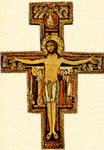
The San Damiano Cross (now housed in the Basilica of Santa Chiara within the City of Assisi), about six feet tall, which spoke to St. Francis of Assisi calling him to repair his house.

It's been a good reflection, as I stated above, to consider our vocation -- our call from the Lord to be lesser brothers in a viiolent world fraught with greed. Fr. Michael has been juxtaposing the reality of 13th century Assisi with our own reality of early 21st century USA. Lots of similarities! Human life deals with the same or at least similar realities and challenges.

Tuesday, December 16, 2008

Advent Swiftly Passing -- What's My Attitude?

Some musings of a Franciscan friar in a Midwestern winter:


Here in southeastern Wisconsin we are getting both frigid weather and new snow fall. Last week when we were preparing to celebrate the Feast of Our Lady of Guadalupe it was quite cold! This past weekend the temps went up into the 40s F, and then they plunged into the single digits. Wow! What a contrast.


For me in the northern part of the Midwest it seems to take more time to adjust to the fluctuations of weather. When it's cold and stays cold I seem to be fine; when it's warmer and stays warmer I'm OK, too. But when it goes up and down my body seems to get rather confused!


Maybe that's just how our lives are -- adjusting to the fluctuations that happen beyond our control. Economic downturn, violence both near and far, insecurity at work, a loved one's illness. I don't think it means we're "powerless", at least not completely so.


As Advent is quickly moving toward the great celebration of Christmas next week, it might be an opportunity for us to consider how we respond to the changes in our lives, the changes about which we have very little, if any, say.


Yes, there are many things in life that we do have control over -- what we put into our bodies, what we watch on TV and in the movies, the people we call friends and with whom we associate outside of work and school.


But, taking a look at this past Sunday's Second Reading (1 Thess. 5:16-24) from the Roman Rite, it speaks a lot about our attitude in life. "Rejoice always;" "pray without ceasing;" "give thanks in all circumstances, for this is the will of God for you in Christ Jesus."


We might be tempted to think this is sweet religiosity or pious prattle until we confront that our life in conversion really is becoming more and more like Jesus Christ! As we yield to the operation of the Holy Spirit in our lives we begin to notice a change. We are becoming more like the Lord in our attitudes. Just take a look at what St. Paul writes about the fruit of the Holy Spirit (BTW, it's singular "fruit") in his Letter to the Galatians 5:22-23.


That's our attitude in the face of uncontrollable events. Not a sense of desperation. Not cynicism. Not even resentment. But an atttiude that God is greater than whatever happens, though for now, at least, it might seem overwhelming. The Christian vocation sees God at the center, at the periphery and throughout the experience.


Advent swiftly passes; tempus fugit as the Latin proverb states (i.e. "time flies"). Still, what's my attitude this Third Week of Advent?

Wednesday, November 26, 2008

Thanksgiving Day is more than "Turkey Day"! Give Thanks to the LORD for He is Good!


Rejoice always. Pray without ceasing. Give thanks in all circumstances, for this is the will of God for you in Christ Jesus." 1 Thessalonians 5:16-18


The word "thanks" in New Testament Greek is the basis for the word we have for "eucharist". During the Mass or the Divine Liturgy at the Preface Dialog beginning the Eucharistic Prayer/Anaphora, the priest says, "Let us give thanks to the Lord our God", and we respond, "It is right to give him thanks and praise", or, "It is just and right." In effect the priest is addressing us as congregation and saying, "Let us do the eucharist!"

Thanksgiving is deeply ingrained in the entire Scriptures, both Old and New Testaments. It is simply what we as Christians do! We give thanks to God.


Fr.Joachim Studwell, OFM at the Great Entrance of the Divine Liturgy


Fr. Patrick Gawrylewski, OFM (right) and Fr. Brendan Wroblewski, OFM during the Eucharistic Prayer at the chapel of Assumption BVM Parish


Thanksgiving Day is far more than its nickname, "Turkey Day!" It is about an attitude of life. Giving thanks and forgiving someone are both might antidotes to bitterness in human life. Not just the proverbial "counting the blessings", as good as that might be. Just giving thanks!


It takes our attention off ourselves and focuses us on Another, in this case God. Hopefully we have been reared to be grateful -- grateful for presents, sending thank-you cards, showing appreciation to people in our family, at work or in school.


Giving thanks just makes plain sense -- and it's good for mental health, besides. Grateful people are happy people. They notice small things about people and take notice of them in a positive way. People of thanksgiving notice the details of life and express gratitude. As the 12 Step Program calls it cultivating the Attitude of Gratitude!


And so it is with the Lord. Maybe we can look at the New Testament reading (above) again, where St. Paul the Apostle deliberately writes that we are to give thanks in ALL circumstances (please note, not for all circumstances, but in all circumstances)! That means we acknowledge God is supreme and greater than any and all circumstances in which we find ourselves.


I'm grateful for Him, first of all! And for my Franciscan brothers, my family and my friends, for the many who have trusted me and allowed me into their lives through ministry, for all the good things that the Lord has lavished upon me. And I am grateful for my vocation as a Franciscan friar and priest.


What are YOU grateful to the Lord for this Thanksgiving Day?

Wednesday, August 27, 2008

Giving One's Life for Others

Bro. Jason Welle, OFM professed solemn vows as a Friar Minor on the Solemnity of the Assumption of Mary, 15 August 2008. A previous article on this blog went into some details about that event.

What I'd like to invite you to consider is how God calls you -- and me -- to give our lives over, like Jesus, for others.

Bro. Jason Welle, OFM kneeling after the Litany of the Saints at the Solemn Vow ceremony (Photo courtesy of Fr. Brendan Wroblewski, OFM)


Simply put, a Christian vocation teaches us that our lives are not our own! It's all about the Lord Jesus. When we Franciscan Friars profess our vows, according to the Rule of St. Francis of Assisi, we are giving ourselves over to the Lord and to the operation of the Holy Spirit. St. Francis taught his friars that the Holy Spirit is the General Minister of the Order of Friars Minor.

Bro. Jason Welle, OFM professing solemn vows into the hands of our Provincial Minister, Fr. Leslie Hoppe, OFM


Professing vows like this hearkens us back to our baptismal commitment, from which all other Christian vows come. It is in the name of the Lord Jesus, believing that he has called us to this path as Friars Minor that we place our trust in God the Father and the work of the Holy Spirit.


Bro. Jason Welle, OFM's Dad and Mom at the celebration of solemn vows.

This is an act of faith. We put our faith in the Lord and his call to live the holy Gospel in the footsteps of St. Francis of Assisi. It is an adventure to give our lives for others -- the Lord, our brothers, the Church and the poor. And all for Jesus!

Tuesday, August 26, 2008

New Franciscan Outreach in Milwaukee

Fr. Joachim (Kim) Studwell, OFM and Fr. James (Jim) Gannon, OFM
at the Franciscan Pilgrimage Program tent
at Fiesta Italiana in Milwaukee, Wi in July 2008
(Photo courtesy of Don Rosen)

Thanks to the Franciscan Pilgrimage Office (FPP) housed in the same building as the administration of the Assumption BVM Province (SS. Francis & Clare Friary) in Franklin, WI, the Franciscan Friars were able to be present at two of the several ethnic festivals in Milwaukee.


Fr. John Cella, OFM, the executive director of FPP and the pilgrimage staff had the foresight to promote their programs at Festa Italiana and Irish Fest, the first held in July and the second in August of this past summer. The FPP focuses most of its attention on the Franciscan holy sites in Italy (particularly Rome and Assisi). They are also beginning a pilgrimage to Ireland and have had several to the California missions founded by Bl. Junipero Serra, OFM and other Spanish Franciscan friars as well as the Holy Land where the Franciscan friars have been serving since the 14th century.


Fr. Paul Reczek, OFM is a graphic artist and works also for the pilgrimage program. He put together a few banners advertising both the pilgrimage program and the vocation office. (Some of his work can be seen in the photo above.) Which leads me to how this became -- at least partially -- a vocation event!


I was asked by Fr. John to helps staff the FPP tent at Maier Festival Park on Milwaukee's South Side adjacent to Lake Michigan for these two ethnic events. One reason was to help our vocation promotion efforts. Fr. James Gannon, OFM, who works for Cardinal Stritch University (CSU) in Milwaukee in administration and pastoral care also volunteered. He was able to have CSU materials and I was able to have vocation materials available for folks to peruse. Three Secular Franciscan women also helped staff the booths the separate weekends -- thanks, Bonnie, Laurel and Suzanne!


Fr. Jim and I wore our habits and several people favorably commented to us about how important it was for them to see a Franciscan witness. Although the festivals were different in their "feel", many people stopped by our tent to engage in conversation -- some wondered if we were in costume or if we were "for real"; others expressed curiosity about who the Franciscans are; still others asked the difference between a tour and a pilgrimage; some were intrigued by the notion of "Secular Franciscan" and requested information. And some people recognized friars' pictures on the banners and the Vocation Office display board whom they knew from ministries in the greater Milwaukee and Chicago areas!


Fr. Kim being interviewed on Sunday afternoon at Festa Italiana in Milwaukee on the radio program. (Photo courtesy of Don Rosen)

A curious thing happened during Festa Italiana -- our tent was adjacent to a tent housing a few radio stations' tent (each day a different radio station occupied the same tent). The announcer for one, which emitted from Racine, WI asked to interview me -- live! So, we did. In a brief amount of time he asked me the difference between a tour and a pilgrimage and then he asked what I did as Vocation Director. At the end of his broadcasting shift he made a special plug for the Franciscan friars! On Sunday, a radio station from Kenosha, WI was broadcasting their weekly Italian-language afternoon show, and also asked if I could say a few words about the Franciscan pilgrimages and vocations. Great exposure for the Franciscans, no?


Fr. Jim and I both thought that these experiences were positive and offered us ample opportunities for evangelization. Fr. Jim even heard a few people's confessions! It was also a good opportunity for some catechesis. And Fr. Jim had an opportunity to speak with a curious young man from northern Illinois who asked about the Franciscan friars and who we are.
It was a great opportunity for young and old alike to meet the Franciscan friars and for us to be in the mix of people, many of whom never expected to see or meet the friars at these festivals!

Monday, August 25, 2008

Bro. Jason Welle, OFM Professes Solemn Vows

Congratulations, Bro. Jason! Welcome to our brotherhood!


Bro. Jason Welle, OFM, prostrate befor e the Lord's altar, during the Litany of the Saints prior to profession his solemn vows
Assumption BVM Parish Church, Pulaski, WI
(Photo courtesy of Jose Martinez)

Bro. Jason Welle, OFM professed his solemn vows as a friar minor in the hands of our Provincial Minister, Fr. Leslie Hoppe, OFM on Friday, 15 August 2008 at Assumption BVM Parish in Pulaski, WI.


His mother and father, his brother and other relatives from his hometown of Albany, MN along with long-time friends from his college days (St. Olaf in Minnesota and the University of Notre Dame in Indiana) joined the Franciscan Friars of the Assumption BVM Province (plus some other Franciscan Friars from the provinces of St. Barbara in CA, Sacred Heart in St. Louis, MO, Our Lady of Guadalupe in Albuquerque, NM and St. John the Baptist in Cincinnati, OH).


Bro. Jason Welle, OFM with the "Li'l Bros" club from St. Stanislaus Parish in Cleveland, OH at Assumption BVM Parish Church in Pulaski, WI (Photo courtesy of Jose Martinez)


The friars who joined in the festivities included our men from throughout the Midwest, from as far away as Cleveland, OH, Cedar Lake, IN, Chicago, IL, Franklin and Milwaukee, WI. His Vocation Director, Fr. Linus Kopczewski, OFM and his Novice Director, Fr. Edward Tlucek, OFM we gathered with the other friars to see this part of Jason's vocation story brought to completion.


The Solemnity of Mary's Assumption, body and soul, into heaven is not only a Holy Day of Obligation among Catholics, it is also the patronal feastday of our Franciscan province! So, it was with great joy that we joined our brother and welcomed him with great warmth and genuine affection to full membership in our provincial brotherhood as Franciscan friars.


Bro. Jason Welle, OFM, newly solemnly professed Franciscan in the Order of Friars Minor (OFM) signs the sheet of his vow formula (wrtiten by his own hand) in the presence of our Provincial Minister, Fr. Leslie Hoppe, OFM (left) and the Secretary of Formation, Fr. Bernard Kennedy, OFM (right) who is also his Post-Novitiate Formation Director (Photo courtesy of Jose Martinez)


It was quite a diverse event -- friars who were originally from Mexico and Vietnam, as well as US-born Franciscan friars, Roman and Byzantine Catholic Rite, parishioners from St. Stanislaus Parish in Cleveland, OH and Sacred Heart Parish in McAllen, TX (both of which hosted Bro. Jason during his post-novitiate formation), plus his family and friends from Minnesota and other parts of the USA -- all joined to celebrate what God has accomplished in the life of our brother -- so far! There is more to come.

Friday, August 22, 2008

Eleven Friars Make Solemn Vow Retreat


From Bro. Jason Welle, OFM


From June 27th to July 27th, I was blessed to spend a month in the mountains of Colorado on retreat with ten other Franciscan friars preparing to make their solemn vows. Our group was a snapshot of the Church around the world, with friars hailing from Vietnam, Mexico, Syria, and Palestine, as well as the United States. All of these friars had discerned a permanent commitment to the Franciscan way of life, and sharing prayer, input, recreation, and fraternity together, for thirty days enabled us all to deepen this commitment.

Road to Bear Lake, Rocky Mountain National Forest


Our group resided at St. Malo’s Retreat Center an hour and a half north of Denver. When John Paul II came to Denver for World Youth Day, he took some personal time for hiking and prayer at St. Malo’s and we were very conscious of his presence among us; we spent many hours hiking the trail now named for the Holy Father, in addition to many other trails in Rocky Mountain National Park.


Amid this breathtaking scenery, Fr. Francis Di Spigno, OFM, and the rest of the retreat committee organized several complementary components to help us explore the meaning and gift of our Franciscan vocation. Fr. Tom Hartle, OFM, the guardian of the retreat, provided a stable and supportive presence for the month, which began with Fr. Bill Beaudin, OFM, preaching a week of conferences on the prayers and writings of St. Francis.


The second week, facilitated by Fr. Jerry Bleem, OFM, focused on Christianity and the Arts. Fr. Jerry led us in both imaginative activities like sketching and painting and repetitive activities like calligraphy and crochet.


These helped us touch our more creative sides, opening channels for the week-long directed retreat with Fr. Tom and Sr. Doris Gerke, OSC. These directors met with each retreatant for an individual conference each day, with the rest of each day free for silent prayer and reflection.


St. Catherine of Siena Chapel, St. MaloRretreat Center


Three special wisdom figures provided the input for the final week. Fr. Nicholas Lohkamp, OFM, reflected on his life as a moral theologian; Fr. Daniel Barica, OFM, on his ministry as pastor of California parishes and missions; and Fr. Mark Soehner, OFM, on his work in psychology and parish ministry.


Listening to these three very different friars comment on the blessings and challenges of their Franciscan vocations and their hopes for the community’s future rounded out our thirty days of prayer and growth in fraternity.


When the retreat ended, we scattered to return to our home provinces, conscious that even though we would profess our solemn vows in different places this fall, we are deeply united in our common vocation to the Order of Friars Minor.


Bro. Jason Welle, OFM, on his way to his Solemn Vows at Assumption BVM Church in Pulaski, WI!

Saturday, February 2, 2008

World Day of Prayer for Consecrated Life


Tomorrow, Sunday 3 February 2008, is the annual World Day of Prayer for Consecrated Life. This usually falls on the Sunday closes to the Feast of the Presentation of the Lord in the Temple (which is today, Saturday 2 Feburary). And, tomrrow happily coincides with the (optional) memorial of the Armenian holy bishop Blase of Sebaste -- the traditional blessing of throats!

Contemporary image of Saints Clare and Francis of Assisi surrounded by men and women Franciscans and Sisters Moon and the Stars and Brother Sun, from Francis' Canticle of the Creatures

All Christians are "consecrated" to the Lord through the Sacrament of Baptism, so what does this mean, "consecrated life"?

The term "consecrated life" became a popular term for religious life during the pontificate of the late Pope John Paul II, when he wrote a treatise called Vita Consecrata (consecrated life in Latin) in the early 1990s.

Yes, all Christians are consecrated to the Lord in baptism -- the various passages in the New Testament (especially the letters of St. Paul the Apostle) testify to this truth. We are told we are a "temple of the Holy Spirit", "heirs of God and co-heirs with Christ", "born again", "a new creation", "a royal priesthood, a holy nation and a people which belongs uniquely to the Lord" and "the People of God".

But since the very beginning centuries of the Church, particularly in the Christian East, there has been a continual movement of certain men and women who discerned they were called by the Lord to a different sense of "vocation" than their peers. We have some evidence of this prior to the fourth century, but the two classical personages of this movement were St. Paul the Hermit and St. Anthony of the Desert (also called "the Abbot" and "the Great") of Egypt.

Originally they went into the desert to "escape the world". This meant that they wanted to consecrate their entire lives to the Lord through prayer, silence, mortifications, penances and work. They believed that living "in the world" was a great distraction and so they wanted to be free of all distractions, following the example of the Lord Jesus who, after his baptism, went into the desert for forty days and nights.

Many did so for the purpose of leading a penitential life. Perhaps they had committed grevious sins and determined that their only hope for salvation in the Lord was to avoid all possible contact with their former lives and begin an entirely new life away from the world. Others simply wanted to live for the Lord Jesus alone -- in prayer and with work.

The movement would eventualy spread throughout the Christian world -- Persia, Greece, Italy, Ireland. Great saints emerge from this movement, countless saints. Over the course of centuries, Western monasticism would develop into what we know as religiious life in our day and age. Rather than stay in monasteries, many men and women discerned their vocation to serve among the poor, to educate, to assist the sick and the dying, to preach, to go among non-believers as missionaries or to preach among the baptized, calling them to deeper relationshiop with the Lord and to conversion.

Our own Franciscan movement, begun with Sts. Francis and Clare in the early 13th century helped change religious life from the monastery to the city and beyond. All of these are examples of "consecrated life."
Bro. Mario Nagy, OFM, of the Assumption BVM Province, on mission in Siberia, Russia, receiving the first (simple) profession of a Russian Franciscan novice

Quite simply, it is discerning the Lord's call in our lives to deepen our baptismal consecration. This disceernment into religious life includes looking critically at our world (not to be negative but to see it as it really is, from the Lord's perspective, through prayer and familiarity with Holy Tradition [including Sacred Scripture]).

The Vita Consecrata takes many forms in the Catholic Church. As Franciscan friars, we seek to serve the Lord and his Church by striving to live and proclaim the Gospel of Jesus Christ like St. Francis of Assisi, our founder, and his early band of "Penitents of Assisi". These he would name, "friars minor", or lesser brothers.
By responding to the Lord's call in faith, that is, a Franciscan vocation, we trust the God is calling us to live in fraternity as brothers, to pray together according to the norms of the Catholic Church (Roman and Byzantine [Ruthenian] Rites), to grow in our relationship with the Lord through personal prayer, days of recollection, spiritual direction and retreats and to become appropriately educated and trained so that we may adequately serve in various capacities. All of this is encompassed with the desire to identify with the Lord Jesus who "became poor for our sake so that we could become rich in the mercy of God". This is what both Sts. Francis and Clare of Assisi desired with all their hearts.

They listened to the Gospels and responded to them, even imperfectly, because of their love for Jesus and his People, the Church. That is what imples us, like St. Paul wrote the Galatian Christians in the New Testament. The love of Jesus Christ impels us to seek him as our greatest good in consecrated life as vowed religious. This we believe is fulfilling our baptismal vows and consecration to the Lord -- to God's glory and for the life of his People.

Monday, December 31, 2007

So, What's New for You in 2008?


Let's look beyond "resolutions" for the New Year. They have their place. They can be great motivators. I must admit, though, as I get older I find fewer and fewer of them come to fruition. Not just for me, mind you! But for others, too.

How about decision we need to make this coming year? Decisions we may have delayed or ignored. Maybe we have dawdled with choosing something very important.

Perhaps a good question for this New Year of the Lord 2008 is: How is God calling YOU to live in 2008? What is God telling your heart?

This is a good time to take stock of your own vocation! How did God call you this past year, in your daily life, in your work, your study, your relationships, your family? How did you respond to the Lord this past year 2007?

There's a lot out there reviewing 2007, isn't there? Major political and historical events, celebrity events, sports events, personages who have passed away. We can actually become saturated about "them".

But what about YOU? How are you either willing to respond favorably to the Lord Jesus or avoid him this coming year? Will you say "yes" to his call this new year? His call may simply be to be attentive to the poor and the needy around you. God rarely calls us to high drama! It's usually pretty normal fare.
But you just might want to take a few minutes before the festivities begin and the New Year gets undeway to consider what Jesus is saying to your heart.

God grant you peace and every good from the Franciscan Friars of the Assumption BVM Province!

Saturday, December 29, 2007

Witness in the Cathedral during the Christmas Octave!

As you probably know we are in the Octave of Christmas (eight days of Christmas Day). So great is the festival of the Incarnation of the Eternal Word of God that we celebrate the single event for eight days.


During these eight days of Christmas we have celebrated St. Stephen the Proto-Martyr and Deacon ("first born" into heaven after the Resurrection through martyrdom), St. John the Apostle and Evangelist ("beloved disciple" of the Lord, according to the Gospel of John), the Holy Innocents ("first witnesses" who unwittingly shed their blood for the Lord during his life) and today, a commemoration, in honor of St. Thomas Becket, martyred Archbishop of Canterbury), 1118-1170.


I would like to comment on St. Thomas Becket. There was a film made in the early 1960s called "Becket" starring the late Richard Burton in the title role and Peter O'Toole as his nemesis, King Henry II. It's a good film, but rather condensed as far as history is concerned. There are many sites on the Internet you can look up for historical details.

For the purpose of this Blog, I would like to reflect on Thomas' own conversion from being a rather arrogant man to learning humility and courage by his willingness to take on the yoke of archiepiscopal office.

St. Thomas Becket, 1182-1170
Martyred Archbishop of Canterbury

Please note that he was killed before the birth of St. Francis of Assisi (1182), and so this has nothing immediately to do with the Franciscan movement. Rather, it seems that Thomas was more influenced by the Benedictine tradition of monasticism, although he never professed religious vows.

Thomas underwent an ongoing conversion. First, he reluctantly accepted the archiepiscopal office and see from his friend King Henry. Apparently the election was "irregular", which Thomas later would confess to Pope Alexander.

Initially Henry thought he could control his new primate of England, but as matters between Church and State, and Thomas and Henry, became increasingly sticky and hostile, the king regretted having made his one-time friend and former Chancellor of England to be Archbishop or Canterbury.

When Thomas did meet with the pope in Rome to appeal his case and confessed the apparent irregularity, he thereupon resigned his office as archbishop. At first the pope accepted his resignation, but later on changed his mind and reinstated Thomas by returning him his bishop's ring and telling him that he was to do God's work back in England.

After a lengthy interval, Thomas and Henry made some peace and Thomas received permission to return to England to serve as archbishop. While Henry was in France, though, his advisers informed him that he would have no peace and only rivalry for authority as long as Thomas was left alive. Then the king made his infamously historical statement, which his barons took as both rebuke and directive, "Will no one rid me of this meddlesome priest?"

The barons understood this as a royal edict and proceeded to murder Thomas in Our Lady's transept of Canterbury Cathedral as Vespers were underway and darkness covered the land. He was canonized two years later, and Henry also did penance for his implication in the archbishop's death.

Contemporary depticion of the Martyrdom of St. Thomas Becket


Our Christian vocation, which we receive from baptism, is to give witness to our faith in our daily lives, whether convenient or inconvenient.

Our vocation is to live and proclaim the truth in love (cf. Eph. 4:15), and that truth is a person, Jesus Christ!


Even during Christmastime, this requires a conversion on our part, doesn't it? From what to what?

More than a preparation for new year's resolutions, it seems to be an opportunity to call upon the Lord, like Thomas Becket did, and ask the Lord where he wants us to change! Christian life is ongoing conversion; our common Christian vocation is ongoing conversion.

Thomas allowed God's Word, the Holy Scritpures, to take root in his heart and to change his life, his attitude, his perspective and his very lifestyle!

I encourage us to take this to the Lord in prayer and let him show us. Do we need more courage in the face possible unpopularity? Do we need more compassion in the face of poverty or other people's disabilities? Do we need to work through forgiveness of someone who has betrayed us?

Let's ask the Lord for the courage of St. Thomas Becket, to let the Incarnate Son of God change us so that our lives may more fully reflect his life in us!

Thursday, December 20, 2007

Christmas Countdown, Part 3

Yesterday’s Advent "O” Antiphon was “O Root of Jesse” and today’s is “O Key of David”. As you can see, these are Old Testament designations of the Messiah, the Anointed of God.


Fr. Camillus Janas, OFM and Fr. Michael Surufka, OFM praying and anointing infirm parishioners at St. Stanislaus Parish, Cleveland, OH

From early times the Christian community has understood Jesus of Nazareth to be the Christ (Messiah) and Lord whom God sent for our salvation (see Acts 2:36).

Over and over again in the Gospels, especially Matthew and Luke, we have references to the prophets of Israel being fulfilled in the person, life, ministry and paschal mystery of Jesus Christ.

We profess in the Nicene Creed every Sunday and Holy Day of Obligation, “We believe in one Lord, Jesus Christ, the only Son of God . . . On the third day he arose again in fulfillment of the Scriptures . . .”

Today’s Gospel, though, focuses on Mary’s call – her vocation – to be the Theotokos (the one who bears God, from the Third Ecumenical Council, at Ephesus in AD 431). This is her unique role, her unique ministry in the history of the human race. No one before or since has been called to be Theotokos!

The First Reading today is from Isaiah 7:10-14, in which the Prophet is instructed by the LORD to speak to King Ahaz of Judea to seek a sign from the Most High. The king balks, and the LORD reprimands him. He then provides a sign – a young woman (in Greek, virgin) will conceive and give birth to a son, who shall be named Immanuel (God is with us; literally, “with us is God” in Hebrew).

An ancient Christian icon of Mary as Mother of God (Theotokos) is Our Lady of the Sign, in which Immanuel is shown in her womb.


Greek Icon of Our Lady of the Sign


St. Francis of Assisi called upon all believers to practice penance and produce worthy fruits of penance; that is, to live holy lives in accordance with the Scriptures and the very life of the Lord Jesus Christ. He teaches us Franciscan friars, all members of the Franciscan family (religious and lay people alike),


Oh, how happy and blessed are these men and women when the Spirit of the Lord will rest upon them (cf. Isa. 11:2) and He will make His home and dwelling among them (cf. Jn. 14:23). They are children of the heavenly Father (cf. Mat 5:45) whose works they do, and they are spouses, brothers, sisters, and mother of our Lord Jesus Christ (cf. Mat 12:40) . . . [We are] mothers when we carry Him in our heart and body (cf. 1 Cor. 6:20) through divine love and pure and sincere conscience and [when] we give birth to Him through [His] holy manner of working, which should shine before others as an example (cf. Mat. 5:16).” (First Version of the Letter to the Faithful, 5-7, 10)


Such is the Christian vocation and the Franciscan vocation. In our Assumption BVM Province, way back in 1987 (20 years ago!), we drew up a Mission Statement, part of which reads, “Our mission in the Church is to make visible the presence of Christ in the world.”


Bro. Andrew Brophy, OFM, serving God's People at St. Francis of Assisi Parish, Greenwood, MS


While Mary’s vocation as Theotokos was certainly singular, we are no less called by God through our Savior Jesus Christ to “bear God” in our world. And we make him visible through holy lives, as St. Francis exhorted and St. Clare of Assisi affirmed.


What are some ways that God is calling you (and me!) to “give birth” to Jesus Christ realistically in our world today? What are the penances and the fruits of penance in which the presence of the Lord Jesus is made visible in and through our lives?


O Root of Jesse, you stand for ensign of humankind; before you rulers shall keep silence, and to you all nations have recourse. Come, save us, and do not delay!


O Key of David and Scepter of the House of Israel: you open and no one closes; you close an no one opens. Come, and deliver from the chains of prison those who sit in darkness and in the shadow of death!

Tuesday, December 18, 2007

Christmas Countdown, Part 2

Today’s “O” Antiphon is “O Lord of Might”, from the Hebrew, Adonai (the respectful name for the LORD in Hebrew).

This is the title that the LORD gave to Moses (cf. Exodus 3) when he called him from shepherding his father-in-law’s flocks in the land of Midian to be the deliverer – and lawgiver – of the Children of Israel.

Two things need to be kept in mind as we continue our Christmas Countdown.

The first is remembering our sacred heritage. Just yesterday at Mass we heard the genealogy of Jesus according to the flesh (so Romans 1:3) from the Gospel of Matthew (1:1-17). And we remember our own sacred heritage -- the one that the Lord has given to us through our family and through his Church (we call this Tradition).

The second is how we respond to God’s call in our own lives, that is, our vocation. This week, in particular, the Gospels refer to a number of calls – Zechariah, Joseph (the Annunciation in Matthew) and Mary, the Blessed Mother of God (the Annunciation in Luke). Look at how each responded to his or her vocation.

They each were perplexed and uncertain. Each chose to believe the message given, even if (with Zechariah) there was some doubt at first. They chose to believe that the God of Israel, who promised and fulfilled the promises from one generation to the next would again fulfill the promise – this time of sending the long-awaited Messiah!


Franciscans prepare for Christmas with particular relish as we set up our Christmas cribs after the example of St. Francis of Assisi at Grecchio way back in the early 1220s. We joyfully celebrate the Incarnation of the Word of God in human history, believing in God’s great love for us and all creation (the whole world) for having sent us his only-begotten Son (see John 3:16).

As Christians we believe that the Law of Moses and the ancient Covenants God established (beginning with Noah, then Abraham, then Moses and again David, concluding with the prophetic hope of a new and eternal covenant [cf. Jeremiah 31]) are fulfilled in the coming of the Lord of Might, Adonai, the one we call Jesus Christ!

He who revealed himself to Moses in the Burning Bush and gave the Law (Torah) to Moses at Mt. Sinai is the same who became incarnate for us and for our salvation.

How do you sense the Lord of Might (Adonai) calling you? How do you respond? Let's re-read the Gospel stories of Joseph’s dream (Matthew 1:18-23), Zechariah’s call (Luke 1:5-25; 57-79) and Mary’s call (Luke 1:26-38). And let's ponder how God is speaking to us as Advent is drawing to a close and Christmas is quickly approaching!

“O Adonai and Ruler of the House of Israel,
you appeared to Moses in the fire of the burning bush
and on Mount Sinai gave him your Law.
Come, and with an outstretched arm redeem us!”

Monday, December 17, 2007

Christmas Countdown

T:he Lord Jesus Christ, the Wisdom of God -- "O Sapientia!"


We are quickly approaching Christmas Day! Liturgically, we “count down” to Christmas from 17-23 December each year. We use the “O” Antiphons.


Perhaps the hymn that is most associated with Advent is “O Come, O Come, Emmanuel”. It is based on a 9th century Gregorian chant. It was used by Benedictine monks originally and was initially intended only for the final days of Advent. However, as it became more popularly used in the modern era, it also became extended throughout the Advent Season.


Today is the first of the “O” Antiphons – O, Wisdom! O Sapientia! These antiphons are used as the opening and closing antiphon for the Gospel canticle for Evening Prayer (Vespers), called the Canticle of Mary, or by its Latin name, Magnificat.


In considering one’s vocation in life, it is always important to seek the Lord’s wisdom. The Book of Wisdom from the Old Testament acclaims God’s wisdom. Like the Book of Proverbs, Wisdom is personified. The early Church saw Jesus Christ as the Wisdom of God and used this book as a reference to the Lord Jesus (esp. Wis. 2:12-21). In the Scriptures, wisdom is a hallmark of the person devoted to God; it is a gift from on high (see Isa. 11:2; 1 Cor. 12:8 and Jas. 1:5). And the person who chooses the path of the Lord chooses wisdom; God's Word is wisdom (see Psalm 119) and they who seek it, follow it and live it are wise! Jesus uses this motif when preaching (cf. Matt. 7:24-27).


The quality of wisdom is opposed to folly; that is, wisdom vs. foolishness. Seeking a vocation is basically seeking God’s wisdom in life. “Lord, what do you want me to do?” as opposed to, “Lord, help me do what I want to do!” Such a prayer is by no means passive. Rather, it is an act of trust in the day-to-day happenings of our lives.


As Franciscan friars we seek God’s wisdom for our decisions. But even at a deeper level, like St. Francis of Assisi before the Cross of San Damiano, “Lord, what you have me do?” In his famous Prayer Before the Crucifix, St. Francis asked the Lord for the grace needed (". . . true faith, certain hope and perfect charity, sense and knowledge . . .") to lead a wise life in following the Lord and living for him alone.


We all need to seek God’s wisdom in order to truly live the Gospel of Jesus Christ in a manner that is pleasing to the Father and relying on the power and gifts of the Holy Spirit.


“O Wisdom, you came from the mouth of the Most High,


and reaching from beginning to end,


you ordered all things mightily and sweetly.


Come, and teach us the way of prudence!"

Wednesday, December 12, 2007

Our Lady of Guadalupe

Image of the Blessed Virgin Mary, Our Lady of Guadalupe, on Juan Diego's tilma ,in the Basilica in Mexico City

La Virgen Morena is the famous celebration of the indigenous peoples of the Americas. She appeared to Juan Diego at Tepeyac, near the former Aztec capital and holy sites, over a series of days in December 1531, about 10 years after Hernán Cortéz and the Spanish conquistadores vanquished the once-proud Aztec people and several the other native peoples of México.

She spoke to Cuauhtlatoatzin, his Nahuatl (Aztec language: “one who speaks like an eagle”) name, in his native tongue, not in Spanish. Similarly, she appeared to him as one of his own, not as a European. She was swarthy, la Virgen morena (the dark-skinned Virgin).

The image of Our Lady of Guadalupe is very rich in symbols. Hers is an “icon”, if you will, not made by hands. Her image was miraculously imprinted on Juan Diego’s tunic, the tilma (a piece of clothing fashioned from the fibers of the maguey plant).

Unbeknownst to Juan Diego, when he displayed his tilma with the freshly picked roses, Bishop Juan Zumárraga, OFM (1st bishop of Mexico and a Franciscan friar and priest) was astonished, as were his friars!

The wonderful result of this heavenly visit was a powerful wave of evangelization. Millions of indigenous peoples, Aztec and beyond, professed faith in Jesus Christ and embraced the Catholic faith through the proclamation of the Gospel and were baptized. The story of the Blessed Mother’s arrival to their land and her message swept the land around Mexico.

Here was someone with whom the native peoples could identify. And still do to this day! When I am among Mexican Catholics, in their homes, businesses and even cars, I see Mary’s image, la Guadalupana! The story and her image are deeply ingrained in the consciousness of Mexican Catholics. And, December 12th is a national holiday in all of Mexico! Ser mexicano es ser guadalupano (to be Mexican is to be a devotee of Guadalupe!).

As we celebrate her feast day today, let us recall that Mary, the Mother of God, continues to intercede for us (as the position of her hands displays) and especially considers the poor and the downtrodden to be her special children. She is the pregnant Mother (the black sash around her waist) who came to a conquered people, the Aztecs. It was to them, not their conquerors, that she gave her message; to a peasant, not to an aristocrat or friar or bishop; in Nahuatl not Spanish.

To me, at least, it becomes another example of “minority” – the quality which was so dear to St. Francis of Assisi and which he tried to inculcate among his brothers, to whom he gave the name “minors” (friars minor – lesser brothers). The fruit of minority is solidarity. And this is our vocation as Franciscans!

We are preparing to celebrate the great festival of the Incarnation -- Christmas -- when the Word of God takes on human flesh, in solidarity with us. So great is God's love (see John 3:16).
God in Jesus Christ identifies with us! He becomes flesh of our flesh, bone of our bone, blood of our blood. Is this not true of what we celebrate sacramentally in the Eucharist, when we partake of the Body and Blood of Christ Jesus? The Lord himself feeds us with himself.


We ourselves might be quite surprised how the Lord desires to enter into our lives, to be in solidarity with us. Through the intercession of the Blessed Virgin Mary, our Lady of Guadalupe, may we all come to know the power of God’s grace in our very real human experience.