
Showing posts with label St. Clare of Assisi. Show all posts

Friday, April 10, 2009

We adore you, O Christ, and we praise you because by your holy cross you have redeemed the world!

These words echo throughout the Church today on Good Friday. For those accustomed to praying the Stations of the Cross this is how each Station begins.


From the movie, "The Passion of the Christ" by Mel Gibson -- the Fifth Station -- Simon of Cyrene is pressed into service to help Jesus carry his cross to Calvary.


We proclaim that Jesus dies on the cross on Golgatha for the salvation of the whole human race. It is "Good" Friday because of the great good that God accomplished through Jesus' obedience even unto death, death on a cross (cf. Phil. 2:5-11). It is not in spite of the cross but actually through the cross that we have salvation.


St. Paul writes in 1 Corinthians chapter 1 that "for the Jewish people the cross is a scandal and for the Greeks (Gentiles) the cross is foolishness, but to those on the way of salvation -- Jew and Gentile alike -- Christ the power and wisdom of God!"


For St. Francis of Assisi, and for successive Franciscan friars, Sisters, nuns and lay people, the Cross of the Lord has always been an invitation to repentance and to joyful (yes, joyful) penance by seeking the Lord in all things and encountering him in every circumstance of life.


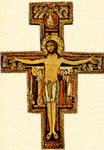
From the Crucifix of San Damiano when Francis was a young man, to the design of what would become the habit in the shape of the cross, to the sign of the Tau (T) at Lateran Council IV (1215) as a mark of renewal to the great episode on Monte LaVerna toward the end of his life when he received the sacred stigmata, the cross of the Lord Jesus always impressed upon St. Francis the great condescension of God toward humanity. Such great love of such a great God!


Undeserving sinners that we are, God has never given up on us nor has God turned his back on us. St. Paul reminds us of this in Romans chapter 5 where he writes, "While we were still in our sins Christ died for us."

As we contemplate the Lord Jesus' Passion, death and burial today -- whether Roman Rite, Byzantine Rite or another Eastern Rite of the Catholic Church -- let us consider this great love of God toward us today.

It transformed the lives of the Mother of God, the Apostles and disciples of the Lord, it transformed Francis' and Clare's lives and the lives of countless saints before us.

May this Good Friday be a powerful blessing for you and may your prayer today lead you ever closer to the Lord Jesus who gave his life for us that we might have life, and have it abundantly (Jn. 10:10).

That is our Christian vocation, after all. And this is the Franciscan vocation as well. We bless you, Lord Jesus for by your very cross you have redeemed the world. We believe this, Lord, we believe. Amen.

Wednesday, February 25, 2009

Giving Up? Giving Over!

Perhaps something for us to consider this Ash Wednesday 2009 is what we are handing over to the Lord. As Catholics, we have been well-trained (I hope!) to think about "giving up" as a means to penance. Chocolate, ice cream, alcohol, pastries, desserts . . . renouncing all of these can help us to be aware of the luxuries of life and to help increase our awareness of Lent.

We certainly fast during Lent from the Gloria and the Alleluia during our liturgical celebrations and prayer. But all the giving up, as it were, the abstaining from meat (i.e. poultry, beef, veal, pork products) on all Fridays of Lent is meant to be a signpost to us of our need to convert. And to point us to what -- that is WHO -- is really important. The Lord Jesus Christ and his Holy Gospel!


Something that is ancient, that is biblical, that is primordial in the human-divine relationship is giving over. This handing over, not as a passive resignation but an active trust into Someone else's safekeeping, this is really what we are called to. It is the basis, interestingly enough, of the Latin root for our English word tradition (in Latin, traditio). In his first Letter to the Corinthians, in both chapters 11 and 15, St. Paul writes to the Christian Church there, "I hand on to you what I myself received, namely . . ." (1 Cor. 11:23; 15:3). He hands over, in trust and safekeeping, to the Corinthian Christians from whom he has been absent, the deposit of faith and the right practice of that faith.

Handing over is actually a choice for life. Jesus does so continually during his ministry, culminating in the Agony in the Garden and his death on the Cross -- for the life of the world, for our salvation. The Eucharist is our frequent celebration of this handing over.


Our handing ourselves over to the Lord is not some kind of "human sacrifice." Although it is, indeed, a sacrifice, it is us allowing the Lord to be Lord, to be Savior, to be who Jesus says he is in our lives. And it's allowing the promise of our Baptism to be once again renewed and fulfilled in us!

We see St. Francis of Assisi and St. Clare of Assisi do this frequently in their lives, both in imitation of Jesus and even moreso in response to his call. It is the vocation of every Christian to hand ourselves over to the Lord. Our Franciscan vocation impels us to do this, to be a people of penance, so that we are not only giving up what is unnecessary, but giving over in hope and trust to the One who has saved us and who never gives up loving us.


Tuesday, February 24, 2009

Beyond Mardi Gras -- Entering Lent 2009

Here we go again! We enter into the Great Fast (so the Eastern Churches) or Lent this new year of 2009.

As Catholics, along with many Orthodox and even several Protestants, we are commemorating the 2000th anniversary of the birth of St. Paul the Apostle (Saul of Tarsus).


What do these two have to do with one another? It's about conversion. In his epistles the Apostle periodically refers to his own conversion, although obliquely so. He does mention that he was a persecutor of the Church until the Lord Jesus himself definitively affected his life.


I remember in high school when my best friend, an evangelical Protestant, asked me a question that both shook me and piqued my curiosity, "Joachim, do you know Jesus Christ?" I answered him, "Well, I go to church on Sundays," to which he replied, "That's now what I asked."


So, I asked myself that question. I think that is one of the aspects of St. Francis of Assisi that really attracted me, and still does. He knew Jesus; not just knew about Jesus! It was later on that I began to appreciate that I, too, could know Jesus Christ. But knowing the Lord is not just about saying the right prayer or practicing some kind of ritual.


No, rather, it's about growing in a relationship with him. And that is ongoing conversion, something that all of us Christians are called by the Lord to do. As Church we have this wonderful opportunity to do this through the ancient biblical practices of prayer, fasting and almsgiving (giving to the poor).


As Franciscan friars, we were originally called the "Penitents of Assisi." Not as self-punishment, but rather, following the inspiration of both St. Francis and St. Clare of Assisi, to seek the Lord as our highest good and to pursue him before all others. Having Jesus first in our lives, that's what penance, repentance and conversion is all about.
Being focused on God's Word -- allowing that Word who became Incarnate for us and for our salvation -- is the "center of gravity" of Christian conversion, knowing the Lord.


For Byzantine Rite Catholics who began the Great Fast this past Sunday night at Forgiveness Vespers or Roman Rite Catholics -- and other Western Christians -- who will begin Lent tomorrow with Ash Wednesday, maybe it is time for us to prayerfully consider if we know the Lord. Do our words show it? Do our actions demonstrate it?


For those being marked with ashes tomorrow on our foreheads, and for those who have already begun the Great Fast, perhaps we can enter into this great season of conversion together toward Easter with renewed purpose and vigor to seek the Lord and come through this holy season knowing Jesus more fully. Just like St. Paul the Apostle and St. Francis of Assisi!

Monday, November 17, 2008

A Young Single Mom, Widow and Saint -- the Franciscan Elizabeth of Hungary

St. Elizabeth of Hungary attending to the poor
She died shy of her 24th birthday; she was rejected by her deceased husband's family and became virtually homeless; she was a widowed Mom of four children; she ardently loved her husband; she gave generously to the poor.

This was a rather dynamic woman, this Elizabeth of Hungary. The universal Church celebrates her festival today, and for Franciscans, friars, nuns, Sisters and Secular Franciscans alike, this is a feast day to celebrate God's goodness manifest through this amazing woman.

She lived contemporaneously with St. Francis and St. Clare of Assisi, although she never met them. She lived north of the Alps while they, of course, lived on the Italian peninsula, south of the Alps.

Elizabeth lived in a violent age, and her mother was apparently murdered while she was a young girl. Having been betrothed at 13 years of age to marry Louis, the landgrave of Thuringia, she willingly did so, as was the custom of filial obedience in those days for a daughter of royalty.
Unlike so many unhappy marriages, which may have been contracted solely for commerce or political alliances, Elizabeth and Louis genuinely loved one another. In the royal palace, during the celebration of the Eucharist, they would gaze upon one another in rapturous love, so deeply convinced in their hearts that indeed the Lord had guided them to the marriage covenant. And their children knew it, too!

Elizabeth was very generous to the poor, with her husband's blessing. Sadly her husband died tragically in the Crusades and subsequently her in-laws, who were not favorable to her for several reasons (among them her generosity to the poor!), evicted her from the palace. Her brother-in-law, having laid claim to the crown, even forbade any of his subjects to take her in!

In the meantime, some men of the newly founded Order of Friars Minor had arrived in the vicinity and were blessed to have Elizabeth as one of their benefactors. Even though she was rejected by her late husband's family, she was loved by the people. She, together with the friars, began a hospital for the poor. Eventually some women joined her in the effort on behalf of the poor and they had a community of sorts.

Inspired by the friars, Elizabeth became a member of the Franciscan family, what used to be called the Third Order and who are now called Secular Franciscans.
In religious art Elizabeth is frequently depicted with roses and bread, due to her love for the poor and her outreach to the marginalized. She herself knew from her own life experiences what it was to be an outcast and, rather than become bitter, she chose to love. Her life of penance and asceticism, even while living in a royal household consisted in her simple clothing, suffering the indignities of her in-laws and her generosity to the poor.
She has become the co-patron of the Secular Franciscan Order, along with St. Louis IX of France (no relationship to her husband, Louis), also a contemporary, although, again, they never knew one another.
What a marvelous model for young adults! This young woman, single mother and widow, lived for the Lord Jesus and for him alone. Eventaully she was to be reconciled with her husband's family, but through it all, she never sought vengeance. She gave herself over to love, especially among the poor. And like her spiritual father, St. Francis of Assisi. she saw in the poor the face of Christ crucified.

Tuesday, October 14, 2008

Synod of Bishops in Rome Focus on the Word of God


Many bishops from around the world have gathered with His Holiness, Pope Benedict XVI in Rome to prayerfully study how to respond to the situations in the world and the Catholic Christian response according to the Word of God. You can find the latest updates on the Vatican Web site, http://www.vatican.va/, including the working document and responses.


The Holy Bible has always been at the heart of the life of the Church since its beginning. The Lord Jesus, the Word of God made flesh (cf. John 1:14) is often depicted in the Gospels as quoting from the Scritpures [Old Testament] -- in combatting the devil (cf. Mt. 4:4; see Dt. 8:3), in addressing the people at his hometown synagogue in Nazareth (cf. Lk. 4:18-19; see Isa. 61:1-2a), and even when hanging upon the Cross, Jesus invokes the Scriptures (cf. Mk. 15:34; see Ps. 22:1).

Pope Benedict XVI, 2008

The Apostles and Evangelists quoted freely from the Sacred Books of the First Covenant of the Jewish people, citing from the ancient texts to indicate that Jesus is the Messiah of Israel and the Savior of the nations. Therefore, he is the fulfillment of the Jewish Bible (Hebrew and Greek texts).

The proclamation of the biblical texts has always been part of our liturgical tradition. Direct Scriptural quotes are found throughout the Roman Mass and other sacramental celebrations. Indirectly, there are multiple allusioins to the Bible. Two examples are the "Holy, Holy, Holy" [Sanctus], which quotes from the Book of the Prophet Isaiah 6:3 and Psalm 118:26b, and the "Lamb of God" [Agnus Dei], which combines the invocation to Christ as the Lamb of God (cf. John 1:36 and Rev. 5:12) with the plea for mercy (cf. Mt. 9:27).

As Franciscan friars we rejoice that Pope Benedict and the bishops from around the world have gathered in the Twelfth Synod to focus on the Word of God. The Bible, being at the heart of the Church, is always at the heart of our Order and our Franciscan tradition.

St. Francis and St. Clare were both inspired to renounce everything for the sake of the Gospel of Jesus Christ, and as our respective Rules state (i.e. that of St. Francis for the Friars Minor and that of St. Clare for the Poor Clare nuns), ". . . to live the Holy Gospel of our Lord Jesus Christ in obedience, without anything of our own and in chastity."

Monday, October 13, 2008

“Brother, Can You Spare a Dime?”

When I was growing up back in the late 1960s I remember older folks commenting about the “Great Depression.” Both of my parents were teenagers during the Depression and recounted experiences of struggle, want and family togetherness. Maybe you remember your parents or grandparents (great-grandparents?!) telling the stories?

Strikers protest for just pay and form unions

And every so often I would hear survivors of the Great Depression remark that they thought such a harrowing experience in the present time might bring people together again in a fractured society like it was back then. That, and it might get them back to church!


To be honest, I don’t know what it was like back in the 1930s. The Great Depression, begun when the stock market crashed in 1929, was not my experience. I only know what I read and what people recounted as they remembered. Problem is, nostalgia can also omit facts. And it probably could resurfac songs of the period that depicted the plight of the poor and unemployed in shantytowns such as the title of this article.


Dust Bowl in the 1930s in Oklahoma


What people frequently recount, though, is the sense of community they remember. People helping people; people, if you will, in solidarity with one another.

Of course, it was also a time of great political turmoil – the Ku Klux Klan had reached its zenith of racial, ethnic and religious intimidation in the 1920s and continued in the 1930s (in the North as well as the South), Jim Crow laws were enforced in the segregated South since after the Civil War and mills and mines in the North were the sites of some rather violent strikes.


Economic refugees from the Great Dust Bowl in Oklahoma were not particularly welcomed to sunny California, as well recounted in John Steinbeck’s famous novel, The Grapes of Wrath. So, not all was “togetherness” or “community”.


To be sure, houses of worship were probably more frequented than in the Roaring Twenties. When disaster strikes, off to God we go!


Train station in South Carolina in the 1930s shows effects of "Jim Crow" segregation laws

In the midst of the current financial downturn, and reality for many of job loses or the threat of job less, we can be faced with the temptation to despair. Many did in the Great Depression. Just as preachers warned their flocks in the past so we are being warned today to not put our faith in the “almighty” dollar, but in God Almighty!


Scripture warns us that the love of money is the root of evil (by the way, not money itself) – see 1 Timothy 6:10, and it follows, “. . . and some people in their desire for it have strayed from the faith and have pierced themselves with many pains.” (NAB Rev).


St. Francis of Assisi and St. Clare of Assisi each renounced fortune and the comforts that their respective parents’ afforded. Not because money in itself was evil, but because they wanted to live for Jesus Christ and him alone. And to love money and seek after it would have defied the Word of God and separated them from the Lord. They each renounced greed, and probably had to renounce it daily in their lives, for there are many forms of greed! They found their hope and their source of strength in the Lord, not in their families’ wealth or social status. And in this they found great freedom.


St. Francis of Assisi as a youth encountering the leper outside of Assisi.
In this meeting Francis found Jesus Christ, which helped lead him to radically change his life.

While the economic forecasters and experts are struggling with what to do next for hope of an economic upturn, all seem to agree that we are not headed for something similar to the Great Depression of the 1930s. Let’s hope so!


At the same time, this may be a graced opportunity to get our focus right and our proverbial “store in order” as we consider our lives and our futures. Yes, we want what is good for us and for those whom we love – affordable health care, just and living wage, honest work for honest pay. These are important. But our faith in what is eternal is even MORE important.


Like St. Francis and St. Clare, it would seem to behoove us to guard against the temptation to greed. As Franciscan Friars it is our sincere hope that we can offer this insecure world the hope of God’s security!

Saturday, February 9, 2008

Embarking on the Great Fast

Did you receive ashes this past Wednesday? Lots of people here in southeastern Wisconsin did not due to the huge snowstorm from Tuesday evening through Wednesday night! However, that shouldn't stop us from entering Lent.


As the People of God we embark upon a Sacred Journey each year. A Holy Retreat, as Pope Benedict XVI reminded the Catholics in Rome at St. Sabina Church this Ash Wednesday night. (He receives ashes, too, by the way!).

In the Eastern Churches it is called the "Great Fast" (in Poland, a Western Slavic country, it is called "Wielki Post" -- great fast, also). This is the time we as a community undertake the traditional penitential practices of prayer, fasting and almsgiving (giving to the poor). These ancient biblical traditions (which are also echoed in Islam, especially during Ramadan) call us as Catholic Christians to renew our baptism. We purposely abstain from certain things so that we may avail ourselves to God and grow more closely in the likeness of Christ Jesus (cf. 2 Cor. 3:18).


We the baptized receive the ashes on our forehead (or sprinkled atop our heads, as according to local custom) being signed to call us to deeper repentance, to grow deeper with those who are preparing for the Sacraments of Christian Initiation. To grow deeper in our relationship with the Lord; to grow deeper in our love of God and neighbor. Especially the poor. Especially to be reconciled with our enemies.


We heard in yesterday's First Reading from Isaiah 58 the call to the "true fast" -- not just abstaining from foods and delights as though we were trying to please God merely by our penitential practicies or try to curry favor with God. Rather, true penance is a change of life; that is, to live justly and conduct ourselves as a redeemed people. To live lives of integrity that corresond to our baptism. That is the Great Fast -- to turn away from sin and to believe the Gospel of Jesus Christ!


As Franciscans we participate in this Great Fast, whether Roman Rite or Byzantine Rite, according to our respective Church customs. We are Men of Penance who wear the habit of penance. Our life is about conversion, daily conversion to the Lord. And both St. Francis of Assisi and St. Clare of Assisi took this Holy Season very seriously in their own ongoing conversion to the Lord and his manner of living.

Please note the following:
In case you are not aware, Catholics of the Roman (Latin) Rite abstain from meat (i.e. beef, chicken, lamb, goat, pork, turkey -- basically any animal with lungs) on ALL Fridays of Lent; and on Ash Wednesday and Good Friday. Likewise, all between the ages of 18-59 are required (unless medically unable to do so) to fast on Ash Wednesday and Good Friday as penitential practices. This means eating only ONE full meal those two days of the year. Byzantine Rite Catholics have different customs, according to their particular laws (i.e. Ruthenians, Melkites, Ukrainians, Romanians) -- to abstain from meat AND dairy products especially on Wednesdays and Fridays of the Great Fast.


Monday, February 4, 2008

Welcome to Lent 2008! It's More than "Giving Up"

"Have mercy on me, O God, according to your goodness; in your abundant compassion blot out my offense." Psalm 51:3 (The "Miserere" Psalm)


How many of us plan to "give things up" for Lent? Maybe we've been thinking about chocolate, or soda pop, or snacks between meals. Maybe we've thought it's a good time to actually fulfill those New Year's resolutions we were so determined to do on 31 December!


However, it seems to me, this misses the point of Lent. Lent is the time the entire Church -- East and West, Protestant, Catholic and Orthodox (although on a different calendar) -- journey together prayerfully toward the great celebration of the Lord Jesus' Paschal Mystery. It all aims toward the Sacred Triduum (Three Days) of the end of Holy Week toward Easter.

The Roman, or Western, Tradition solemnly begins Lent on Ash Wednesday with the marking of ashes on the forehead or sprinkling ashes on the top of the head (as is done in parts of Europe). The Byzantine Tradition begins on the evening of Cheese-Fare Sunday (this past Sunday) with Forgiveness Vespers, a penitential ceremony at the end of which the priest and congregation mutually ask forgiveness of one another and embrace one another in peace.


It is the time of the Great Fast, a time to refrain from regular life and to purposely prepare to deepen one's relationship with the Lord together with the entire Church. What a great retreat -- and we get to do it together with all our brother and sister Christians around the world! Praise God!


But, as I stated above, it's more than "giving up" something. It really is a matter of growing in Christian maturity, letting Jesus Christ genuinely be who he says he is in our lives. He is Lord, he is Savior, he is Master, he is the Good Shepherd, he is Son of God, he is Bread of Life, he is Resurrection and Life, he is the Way, the Truth and the Life -- and the list, of course, goes on.


So Lent is not a matter of taking advantage of a church time to lose weight, or exercise, or other such practices about us. It's about focusing on the Lord Jesus.


This is what St. Francis of Assisi and St. Clare of Assisi both understood intuitvely and practiced. The earliest Franciscans were known as the "Penitents of Assisi". Penance was a popular devotion in the Middle Ages, even into the Modern age. Some of the physical rigors we would consider odd or even bizarre today.

But the overall purpose of the penance that Sts. Francis and Clare practiced was to turn their minds and hearts to the Lord. That's the purpose of Franciscan penance; that is the purpose of Christian penance! It is to deliberately rid ourselves of unnecessary distractions (TV? ipods?), that which can separate us from the Lord, at least for the period of this retreat of forty days. And it is to face the temptations in our lives, by God's grace, and know the victorious power of the Lord's love over them. Even when we fail!

St. Francis of Assisi, as a young man, praying before the San Damiano Crucifix: "Lord, who are you . . .? And, who am I . . .?" His prayer in this run down chapel was pivotal in his conversion to the Lord. This was where he heard the Lord Jesus speak to him from the Cross and say, "Francis, go repair my Church, which you see is falling into ruin!"

As we turn to the Lord we are changed! The fruit of the Spirit (cf. Gal. 5:22-23) become more evident in our lives. The image of the Lord Jesus becomes more manifest and visible in our attitudes, our ways of speaking, our ways of acting and interacting.

This was what was so attractive about St. Francis and the Francisans, both men and women. Although quite imperfect, they were willing to grow in holiness as men and women of penance. It is about becoming conformed to the Lord Jesus.

In a word, we are undergoing conversion! Conversion from our selfishness to the Lord's own selflessness through acts of generosity and almsgiving (outreach to the poor); from self-preocupation to concern about what the Lord wants for us through self-abnegation (fasting); from vanity and self-absorption to deeper love of God and neighbor through prayer.

Saturday, February 2, 2008

World Day of Prayer for Consecrated Life


Tomorrow, Sunday 3 February 2008, is the annual World Day of Prayer for Consecrated Life. This usually falls on the Sunday closes to the Feast of the Presentation of the Lord in the Temple (which is today, Saturday 2 Feburary). And, tomrrow happily coincides with the (optional) memorial of the Armenian holy bishop Blase of Sebaste -- the traditional blessing of throats!

Contemporary image of Saints Clare and Francis of Assisi surrounded by men and women Franciscans and Sisters Moon and the Stars and Brother Sun, from Francis' Canticle of the Creatures

All Christians are "consecrated" to the Lord through the Sacrament of Baptism, so what does this mean, "consecrated life"?

The term "consecrated life" became a popular term for religious life during the pontificate of the late Pope John Paul II, when he wrote a treatise called Vita Consecrata (consecrated life in Latin) in the early 1990s.

Yes, all Christians are consecrated to the Lord in baptism -- the various passages in the New Testament (especially the letters of St. Paul the Apostle) testify to this truth. We are told we are a "temple of the Holy Spirit", "heirs of God and co-heirs with Christ", "born again", "a new creation", "a royal priesthood, a holy nation and a people which belongs uniquely to the Lord" and "the People of God".

But since the very beginning centuries of the Church, particularly in the Christian East, there has been a continual movement of certain men and women who discerned they were called by the Lord to a different sense of "vocation" than their peers. We have some evidence of this prior to the fourth century, but the two classical personages of this movement were St. Paul the Hermit and St. Anthony of the Desert (also called "the Abbot" and "the Great") of Egypt.

Originally they went into the desert to "escape the world". This meant that they wanted to consecrate their entire lives to the Lord through prayer, silence, mortifications, penances and work. They believed that living "in the world" was a great distraction and so they wanted to be free of all distractions, following the example of the Lord Jesus who, after his baptism, went into the desert for forty days and nights.

Many did so for the purpose of leading a penitential life. Perhaps they had committed grevious sins and determined that their only hope for salvation in the Lord was to avoid all possible contact with their former lives and begin an entirely new life away from the world. Others simply wanted to live for the Lord Jesus alone -- in prayer and with work.

The movement would eventualy spread throughout the Christian world -- Persia, Greece, Italy, Ireland. Great saints emerge from this movement, countless saints. Over the course of centuries, Western monasticism would develop into what we know as religiious life in our day and age. Rather than stay in monasteries, many men and women discerned their vocation to serve among the poor, to educate, to assist the sick and the dying, to preach, to go among non-believers as missionaries or to preach among the baptized, calling them to deeper relationshiop with the Lord and to conversion.

Our own Franciscan movement, begun with Sts. Francis and Clare in the early 13th century helped change religious life from the monastery to the city and beyond. All of these are examples of "consecrated life."
Bro. Mario Nagy, OFM, of the Assumption BVM Province, on mission in Siberia, Russia, receiving the first (simple) profession of a Russian Franciscan novice

Quite simply, it is discerning the Lord's call in our lives to deepen our baptismal consecration. This disceernment into religious life includes looking critically at our world (not to be negative but to see it as it really is, from the Lord's perspective, through prayer and familiarity with Holy Tradition [including Sacred Scripture]).

The Vita Consecrata takes many forms in the Catholic Church. As Franciscan friars, we seek to serve the Lord and his Church by striving to live and proclaim the Gospel of Jesus Christ like St. Francis of Assisi, our founder, and his early band of "Penitents of Assisi". These he would name, "friars minor", or lesser brothers.
By responding to the Lord's call in faith, that is, a Franciscan vocation, we trust the God is calling us to live in fraternity as brothers, to pray together according to the norms of the Catholic Church (Roman and Byzantine [Ruthenian] Rites), to grow in our relationship with the Lord through personal prayer, days of recollection, spiritual direction and retreats and to become appropriately educated and trained so that we may adequately serve in various capacities. All of this is encompassed with the desire to identify with the Lord Jesus who "became poor for our sake so that we could become rich in the mercy of God". This is what both Sts. Francis and Clare of Assisi desired with all their hearts.

They listened to the Gospels and responded to them, even imperfectly, because of their love for Jesus and his People, the Church. That is what imples us, like St. Paul wrote the Galatian Christians in the New Testament. The love of Jesus Christ impels us to seek him as our greatest good in consecrated life as vowed religious. This we believe is fulfilling our baptismal vows and consecration to the Lord -- to God's glory and for the life of his People.

Thursday, December 20, 2007

Christmas Countdown, Part 3

Yesterday’s Advent "O” Antiphon was “O Root of Jesse” and today’s is “O Key of David”. As you can see, these are Old Testament designations of the Messiah, the Anointed of God.


Fr. Camillus Janas, OFM and Fr. Michael Surufka, OFM praying and anointing infirm parishioners at St. Stanislaus Parish, Cleveland, OH

From early times the Christian community has understood Jesus of Nazareth to be the Christ (Messiah) and Lord whom God sent for our salvation (see Acts 2:36).

Over and over again in the Gospels, especially Matthew and Luke, we have references to the prophets of Israel being fulfilled in the person, life, ministry and paschal mystery of Jesus Christ.

We profess in the Nicene Creed every Sunday and Holy Day of Obligation, “We believe in one Lord, Jesus Christ, the only Son of God . . . On the third day he arose again in fulfillment of the Scriptures . . .”

Today’s Gospel, though, focuses on Mary’s call – her vocation – to be the Theotokos (the one who bears God, from the Third Ecumenical Council, at Ephesus in AD 431). This is her unique role, her unique ministry in the history of the human race. No one before or since has been called to be Theotokos!

The First Reading today is from Isaiah 7:10-14, in which the Prophet is instructed by the LORD to speak to King Ahaz of Judea to seek a sign from the Most High. The king balks, and the LORD reprimands him. He then provides a sign – a young woman (in Greek, virgin) will conceive and give birth to a son, who shall be named Immanuel (God is with us; literally, “with us is God” in Hebrew).

An ancient Christian icon of Mary as Mother of God (Theotokos) is Our Lady of the Sign, in which Immanuel is shown in her womb.


Greek Icon of Our Lady of the Sign


St. Francis of Assisi called upon all believers to practice penance and produce worthy fruits of penance; that is, to live holy lives in accordance with the Scriptures and the very life of the Lord Jesus Christ. He teaches us Franciscan friars, all members of the Franciscan family (religious and lay people alike),


Oh, how happy and blessed are these men and women when the Spirit of the Lord will rest upon them (cf. Isa. 11:2) and He will make His home and dwelling among them (cf. Jn. 14:23). They are children of the heavenly Father (cf. Mat 5:45) whose works they do, and they are spouses, brothers, sisters, and mother of our Lord Jesus Christ (cf. Mat 12:40) . . . [We are] mothers when we carry Him in our heart and body (cf. 1 Cor. 6:20) through divine love and pure and sincere conscience and [when] we give birth to Him through [His] holy manner of working, which should shine before others as an example (cf. Mat. 5:16).” (First Version of the Letter to the Faithful, 5-7, 10)


Such is the Christian vocation and the Franciscan vocation. In our Assumption BVM Province, way back in 1987 (20 years ago!), we drew up a Mission Statement, part of which reads, “Our mission in the Church is to make visible the presence of Christ in the world.”


Bro. Andrew Brophy, OFM, serving God's People at St. Francis of Assisi Parish, Greenwood, MS


While Mary’s vocation as Theotokos was certainly singular, we are no less called by God through our Savior Jesus Christ to “bear God” in our world. And we make him visible through holy lives, as St. Francis exhorted and St. Clare of Assisi affirmed.


What are some ways that God is calling you (and me!) to “give birth” to Jesus Christ realistically in our world today? What are the penances and the fruits of penance in which the presence of the Lord Jesus is made visible in and through our lives?


O Root of Jesse, you stand for ensign of humankind; before you rulers shall keep silence, and to you all nations have recourse. Come, save us, and do not delay!


O Key of David and Scepter of the House of Israel: you open and no one closes; you close an no one opens. Come, and deliver from the chains of prison those who sit in darkness and in the shadow of death!