
Showing posts with label penance. Show all posts

Monday, March 30, 2009

How's Your Lent?

A lot of times folks who are serious about engaging Lent find themselves in a real struggle. If they thought that the works of prayer, fasting and almsgiving would be easy, or, if they thought that it might be a good opportunity to practice some kind of pious "diet", I find they are often very mistaken!


Judean wilderness, between Jerusalem and Jericho, near where the Gospels (Matthew & Luke) report Jesus fasting and praying for forty days and having been tempted by the devil.

Lent is a REAL struggle! And it is supposed to be! That's the blessing, though. Not that we are fasting more or praying more or even more generous in our almsgiving. No, rather, that we are allowing the Spirit of God to move through us and to change us more and more into the glorioius image of Jesus Christ!


That is why, on the first Sunday of Lent, in each of the cycles of readings (A, B and C), we find Jesus, just after having had the exhilirating experience of his Baptism in the River Jordan, going up into the desert to pray and to fast, and to struggle.


We know that the desert is the primoridal image in the Old Testament. The Book of Exodus tells us stories of the Israelites fleeing the Egyptians which then leads them into the Sinai Desert where they wander for forty years. It is where God gives Israel the Torah at the hands of Moses the Lawgiver. The Prophet Hosea depicts God affectionately recalling the desert for the People of God as the holy place of their formation as a people belonging uniquely to God!

Like the desert of the first covenant, the desert of our Lent is a crucible in which we are re-formed as God's holy People. We prayerfully accompany those who are preparing for the Sacraments of Christian Initiation (Baptism, Confirmation and Holy Eucharist). We stand together in solidarity with all penitents as we celebrate the Sacrament of Reconicilation, especially favorable during Lent.

The Prophet Moses bringing the Tablets of the Commandments to the Children of Israel from Mount Sinai.
As Franciscan friars, we have donned the "habit of penance", as our holy founder, St. Francis of Assisi, called it. We do so not out of a sense of guilt but rather in the spirit of confident assurance of God's Word which extends mercy "for ever" and "to the thousandth generation to those who fear the LORD."
Our vocation, first as Christians and lived out as friars minor ("lesser brothers") is one of trust in the Lord Jesus. We seek to be in the fire of the crucible of the Lent to be transformed by the hot fire of God's grace into the image of his glorious Son (cf. 2 Corinthians 3:18).
Perhaps the challenges of Lent 2009 have involved famiily disputes, or loss of employment or some other significant financial loss, or the loss of a friendship, or the visit of death to a loved ones. All these can be such difficult situations for us and for those whom we love and care.
Maybe it's time, then, to take stock of our Lent. Have we been looking at our Lenten penance superficially or more deeply as growing into Jesus. Maybe standing in prayer with and for those who are struggling -- in Darfur, in the Middle East, in central Africa, in our own cities and towns -- and who are suffering -- maybe this is the kind of penance (or, better, conversion!) the Lord is calling us to as our Lenten journey is drawing to a close next week. Maybe we can review the First Reading from the Friday after Ash Wednesday, Isaiah 58:1-9 and do a "check-in" with the Lord as to how we are responding to this "great season of grace" (Preface II of Lent).

Thursday, February 26, 2009

Inner Conversion -- Outer Works


St. Paul emphatically teaches that one is saved not by observance of the Law of Moses but by faith in Jesus Christ (cf. Gal. 2:16). Still, the Gospel of Matthew has Jesus teaching the crowds that not only has he come to fulfill the Law and the Prophets, not to abolish them (cf. Mt. 5:17), but also warns his followers that it is not enough to call him "Lord, Lord", but also do the will of the heavenly Father (cf. Mt. 7:21). And First John exhorts us that if we claim to love God whom we cannot see and fail to love the brother (or sister) whom we can, then we are liars! (cf. 1 Jn. 4:20).


In various places in the New Testament, both in the Gospels and in some of the Epistles, we are advised that the fulfillment of the Old Testament is to loved our neighbor as ourself (cf. Lv. 19:18b).

Conversion, or metanoia from the Greek meaning a "change of mind" (so, Mk. 1:15; Mt. 3:2 [John the Baptist] and 4:17 [Jesus]), is the universal call to think and do differently. Yesterday, for those Catholics of the Roman Rite, we heard the injunction to either "Turn from sin and believe the Gospel" or the reminder echoing the Book of Genesis, "You are dust and unto dust you shall return." (cf. Gen. 3:19c).


St. Paul reminds us we who are baptized must have a change of mind (cf. Rom. 12:2) and that, in fact, we have the mind [psyche] of Christ (cf. 1 Cor. 2:16b). And yesterday we were also reminded that "today is the acceptable time" (cf. 2 Cor. 6:2-3).


So, being a Christian -- as we all know -- is more than saying words; it is a lifetime of practice and working. We yield to God's Holy Spirit and allow the Spirit of the Living God to transform us -- our ways of thinking, our attitudes, our bad habits, our speech, our behaviors, our actions -- so that they more readily and clearly reflect the image [ikon] of Jesus Christ (cf. 2 Cor. 3:18).


Our Christian vocation is ongoing converstion into Jesus Christ. For us members of the Franciscan family, friars, Sisters, nuns and laypeople alike -- our life is one of penance in joyful response to the Lord's call. Not only to follow Jesus Christ, but to live in him and him live in us, thus following the lead from our holy founder, St. Francis of Assisi.

St. Francis of Assisi embracing the leper, through whom he encountered the Lord Jesus Christ.

Tuesday, February 24, 2009

Beyond Mardi Gras -- Entering Lent 2009

Here we go again! We enter into the Great Fast (so the Eastern Churches) or Lent this new year of 2009.

As Catholics, along with many Orthodox and even several Protestants, we are commemorating the 2000th anniversary of the birth of St. Paul the Apostle (Saul of Tarsus).


What do these two have to do with one another? It's about conversion. In his epistles the Apostle periodically refers to his own conversion, although obliquely so. He does mention that he was a persecutor of the Church until the Lord Jesus himself definitively affected his life.


I remember in high school when my best friend, an evangelical Protestant, asked me a question that both shook me and piqued my curiosity, "Joachim, do you know Jesus Christ?" I answered him, "Well, I go to church on Sundays," to which he replied, "That's now what I asked."


So, I asked myself that question. I think that is one of the aspects of St. Francis of Assisi that really attracted me, and still does. He knew Jesus; not just knew about Jesus! It was later on that I began to appreciate that I, too, could know Jesus Christ. But knowing the Lord is not just about saying the right prayer or practicing some kind of ritual.


No, rather, it's about growing in a relationship with him. And that is ongoing conversion, something that all of us Christians are called by the Lord to do. As Church we have this wonderful opportunity to do this through the ancient biblical practices of prayer, fasting and almsgiving (giving to the poor).


As Franciscan friars, we were originally called the "Penitents of Assisi." Not as self-punishment, but rather, following the inspiration of both St. Francis and St. Clare of Assisi, to seek the Lord as our highest good and to pursue him before all others. Having Jesus first in our lives, that's what penance, repentance and conversion is all about.
Being focused on God's Word -- allowing that Word who became Incarnate for us and for our salvation -- is the "center of gravity" of Christian conversion, knowing the Lord.


For Byzantine Rite Catholics who began the Great Fast this past Sunday night at Forgiveness Vespers or Roman Rite Catholics -- and other Western Christians -- who will begin Lent tomorrow with Ash Wednesday, maybe it is time for us to prayerfully consider if we know the Lord. Do our words show it? Do our actions demonstrate it?


For those being marked with ashes tomorrow on our foreheads, and for those who have already begun the Great Fast, perhaps we can enter into this great season of conversion together toward Easter with renewed purpose and vigor to seek the Lord and come through this holy season knowing Jesus more fully. Just like St. Paul the Apostle and St. Francis of Assisi!

Saturday, February 9, 2008

Embarking on the Great Fast

Did you receive ashes this past Wednesday? Lots of people here in southeastern Wisconsin did not due to the huge snowstorm from Tuesday evening through Wednesday night! However, that shouldn't stop us from entering Lent.


As the People of God we embark upon a Sacred Journey each year. A Holy Retreat, as Pope Benedict XVI reminded the Catholics in Rome at St. Sabina Church this Ash Wednesday night. (He receives ashes, too, by the way!).

In the Eastern Churches it is called the "Great Fast" (in Poland, a Western Slavic country, it is called "Wielki Post" -- great fast, also). This is the time we as a community undertake the traditional penitential practices of prayer, fasting and almsgiving (giving to the poor). These ancient biblical traditions (which are also echoed in Islam, especially during Ramadan) call us as Catholic Christians to renew our baptism. We purposely abstain from certain things so that we may avail ourselves to God and grow more closely in the likeness of Christ Jesus (cf. 2 Cor. 3:18).


We the baptized receive the ashes on our forehead (or sprinkled atop our heads, as according to local custom) being signed to call us to deeper repentance, to grow deeper with those who are preparing for the Sacraments of Christian Initiation. To grow deeper in our relationship with the Lord; to grow deeper in our love of God and neighbor. Especially the poor. Especially to be reconciled with our enemies.


We heard in yesterday's First Reading from Isaiah 58 the call to the "true fast" -- not just abstaining from foods and delights as though we were trying to please God merely by our penitential practicies or try to curry favor with God. Rather, true penance is a change of life; that is, to live justly and conduct ourselves as a redeemed people. To live lives of integrity that corresond to our baptism. That is the Great Fast -- to turn away from sin and to believe the Gospel of Jesus Christ!


As Franciscans we participate in this Great Fast, whether Roman Rite or Byzantine Rite, according to our respective Church customs. We are Men of Penance who wear the habit of penance. Our life is about conversion, daily conversion to the Lord. And both St. Francis of Assisi and St. Clare of Assisi took this Holy Season very seriously in their own ongoing conversion to the Lord and his manner of living.

Please note the following:
In case you are not aware, Catholics of the Roman (Latin) Rite abstain from meat (i.e. beef, chicken, lamb, goat, pork, turkey -- basically any animal with lungs) on ALL Fridays of Lent; and on Ash Wednesday and Good Friday. Likewise, all between the ages of 18-59 are required (unless medically unable to do so) to fast on Ash Wednesday and Good Friday as penitential practices. This means eating only ONE full meal those two days of the year. Byzantine Rite Catholics have different customs, according to their particular laws (i.e. Ruthenians, Melkites, Ukrainians, Romanians) -- to abstain from meat AND dairy products especially on Wednesdays and Fridays of the Great Fast.


Monday, February 4, 2008

Welcome to Lent 2008! It's More than "Giving Up"

"Have mercy on me, O God, according to your goodness; in your abundant compassion blot out my offense." Psalm 51:3 (The "Miserere" Psalm)


How many of us plan to "give things up" for Lent? Maybe we've been thinking about chocolate, or soda pop, or snacks between meals. Maybe we've thought it's a good time to actually fulfill those New Year's resolutions we were so determined to do on 31 December!


However, it seems to me, this misses the point of Lent. Lent is the time the entire Church -- East and West, Protestant, Catholic and Orthodox (although on a different calendar) -- journey together prayerfully toward the great celebration of the Lord Jesus' Paschal Mystery. It all aims toward the Sacred Triduum (Three Days) of the end of Holy Week toward Easter.

The Roman, or Western, Tradition solemnly begins Lent on Ash Wednesday with the marking of ashes on the forehead or sprinkling ashes on the top of the head (as is done in parts of Europe). The Byzantine Tradition begins on the evening of Cheese-Fare Sunday (this past Sunday) with Forgiveness Vespers, a penitential ceremony at the end of which the priest and congregation mutually ask forgiveness of one another and embrace one another in peace.


It is the time of the Great Fast, a time to refrain from regular life and to purposely prepare to deepen one's relationship with the Lord together with the entire Church. What a great retreat -- and we get to do it together with all our brother and sister Christians around the world! Praise God!


But, as I stated above, it's more than "giving up" something. It really is a matter of growing in Christian maturity, letting Jesus Christ genuinely be who he says he is in our lives. He is Lord, he is Savior, he is Master, he is the Good Shepherd, he is Son of God, he is Bread of Life, he is Resurrection and Life, he is the Way, the Truth and the Life -- and the list, of course, goes on.


So Lent is not a matter of taking advantage of a church time to lose weight, or exercise, or other such practices about us. It's about focusing on the Lord Jesus.


This is what St. Francis of Assisi and St. Clare of Assisi both understood intuitvely and practiced. The earliest Franciscans were known as the "Penitents of Assisi". Penance was a popular devotion in the Middle Ages, even into the Modern age. Some of the physical rigors we would consider odd or even bizarre today.

But the overall purpose of the penance that Sts. Francis and Clare practiced was to turn their minds and hearts to the Lord. That's the purpose of Franciscan penance; that is the purpose of Christian penance! It is to deliberately rid ourselves of unnecessary distractions (TV? ipods?), that which can separate us from the Lord, at least for the period of this retreat of forty days. And it is to face the temptations in our lives, by God's grace, and know the victorious power of the Lord's love over them. Even when we fail!

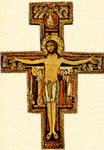
St. Francis of Assisi, as a young man, praying before the San Damiano Crucifix: "Lord, who are you . . .? And, who am I . . .?" His prayer in this run down chapel was pivotal in his conversion to the Lord. This was where he heard the Lord Jesus speak to him from the Cross and say, "Francis, go repair my Church, which you see is falling into ruin!"

As we turn to the Lord we are changed! The fruit of the Spirit (cf. Gal. 5:22-23) become more evident in our lives. The image of the Lord Jesus becomes more manifest and visible in our attitudes, our ways of speaking, our ways of acting and interacting.

This was what was so attractive about St. Francis and the Francisans, both men and women. Although quite imperfect, they were willing to grow in holiness as men and women of penance. It is about becoming conformed to the Lord Jesus.

In a word, we are undergoing conversion! Conversion from our selfishness to the Lord's own selflessness through acts of generosity and almsgiving (outreach to the poor); from self-preocupation to concern about what the Lord wants for us through self-abnegation (fasting); from vanity and self-absorption to deeper love of God and neighbor through prayer.