
Showing posts with label Christian. Show all posts

Saturday, April 11, 2009

The Harrowing of Hell

This icon depicts what an early Christian homily for Holy Saturday describes in text-- Jesus Christ enters into the regions of the dead (Hades in Greek, technically not "hell" as a place of punishment). There the Lord Jesus, having been crucified and buried for all humanity enters into death, having tasted death for us all, and releases the captives held in the grip of death. Jesus has conquered and we can see him grasping our first parents, Adam and Eve, by their hands and lifting them from their tombs.


Byzantine icon of the Resurrecton of the Lord Jesus Christ


In the Roman Rite's Easter Vigil there is a solemn proclamation of the Lord's resurrection at the beginning of the Liturgy called the Exsultet. It uses biblical imagery from the Old Testament to describe the fulfillment of the Exodus of Israel from Egypt and the Passover in the life, passion, death, burial and resurrection of the Lord Jesus on the Third Day. It also delcares that Christ is risen and victorious.


The same early Christian homily referred to above notes that Jesus brings into the regions of the dead the weapon of victory, his own life-giving Cross. While this particular icon does not show the Cross, it does colorfully demonstrate that Jesus stands upon the crossed tombstones of our first parents as he raises them and all the emblems of death are at his feet. Moreover, other figures from the Old Testament, Saints, are shown gathering around this scene of victory -- King David, John the Baptist, the Patriarchs and Matriarchs, the Prophets. All who from the very beginning of time have perished without conscious hope of resurrection are now participating in the Lord's resurrection!


And this is our hope, the hope of all who have lossed loved ones, who wonder aloud to God about the realities we face in this world of violence, of disease, of hunger, of terror; all who long for an end to suffering and death; all who are preparing for the embrace of what St. Francis of Assisi called "our Sister Death."


As we Christians of all the Rites of the Catholic Church, along with our Protestant brothers and sisters, prepare to celebrate the Lord's glorious resurrection (Eastern Orthodox Easter falls on next Sunday, 19 April 2009), let us remember that Jesus has conquered death; he is the victor over sin. There is nothing, absolutely nothing, that is impossible for God! Sacred Scripture declares is, our liturgies celebrate it; the newly baptized profess it and we renew that profession this Easter.


Christ is risen! Indeed he is risen! We Franciscan friars join in extending to you our prayer that you and your lovedones have a very happy and even life-changing Easter.

Friday, April 10, 2009

We adore you, O Christ, and we praise you because by your holy cross you have redeemed the world!

These words echo throughout the Church today on Good Friday. For those accustomed to praying the Stations of the Cross this is how each Station begins.


From the movie, "The Passion of the Christ" by Mel Gibson -- the Fifth Station -- Simon of Cyrene is pressed into service to help Jesus carry his cross to Calvary.


We proclaim that Jesus dies on the cross on Golgatha for the salvation of the whole human race. It is "Good" Friday because of the great good that God accomplished through Jesus' obedience even unto death, death on a cross (cf. Phil. 2:5-11). It is not in spite of the cross but actually through the cross that we have salvation.


St. Paul writes in 1 Corinthians chapter 1 that "for the Jewish people the cross is a scandal and for the Greeks (Gentiles) the cross is foolishness, but to those on the way of salvation -- Jew and Gentile alike -- Christ the power and wisdom of God!"


For St. Francis of Assisi, and for successive Franciscan friars, Sisters, nuns and lay people, the Cross of the Lord has always been an invitation to repentance and to joyful (yes, joyful) penance by seeking the Lord in all things and encountering him in every circumstance of life.


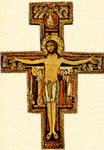
From the Crucifix of San Damiano when Francis was a young man, to the design of what would become the habit in the shape of the cross, to the sign of the Tau (T) at Lateran Council IV (1215) as a mark of renewal to the great episode on Monte LaVerna toward the end of his life when he received the sacred stigmata, the cross of the Lord Jesus always impressed upon St. Francis the great condescension of God toward humanity. Such great love of such a great God!


Undeserving sinners that we are, God has never given up on us nor has God turned his back on us. St. Paul reminds us of this in Romans chapter 5 where he writes, "While we were still in our sins Christ died for us."

As we contemplate the Lord Jesus' Passion, death and burial today -- whether Roman Rite, Byzantine Rite or another Eastern Rite of the Catholic Church -- let us consider this great love of God toward us today.

It transformed the lives of the Mother of God, the Apostles and disciples of the Lord, it transformed Francis' and Clare's lives and the lives of countless saints before us.

May this Good Friday be a powerful blessing for you and may your prayer today lead you ever closer to the Lord Jesus who gave his life for us that we might have life, and have it abundantly (Jn. 10:10).

That is our Christian vocation, after all. And this is the Franciscan vocation as well. We bless you, Lord Jesus for by your very cross you have redeemed the world. We believe this, Lord, we believe. Amen.

Wednesday, April 8, 2009

Passover Seder and the Eucharist

The celebration of Passover by the Jewish community today has its roots in biblical tradition. However, it is not the same celebration as was conducted by Jews at the time of the Roman occupation and the beginnings of Christianity. It reflects more of a Medieval influence.


Nevertheless, the Haggadah (Hebrew -- story) is the same, namely, God delivered the Hebrew slaves from Egyptian bondage and formed them as his Chosen People in the Sinai Desert and gave them the Torah (Hebrew -- law) through the hands of Moses at Mount Sinai.


The celebration of the the Passover is conducted as a supper and there is a seder (Hebrew -- order) to the meal and all that occurs. It is a home liturgy. The basic contents of the celebration are the meal and the story. This is accompanied by the praying of Psalms, especially Psalms 118, 135 and 136 which render thanks to God for his enduring mercy and recount Israel's liberation from slavery.


The Haggadah text on the right (Hebrew letters for Haggadah), and because Hebrew is written from right to left, the book begins from the right end rather than the left.

The traditional principal foods at the time of Jesus would have been the Passover lamb as cental, the unleavened bread, or matzoh and grape wine. The lamb was likely made into a stew to accommodate as many people as possible for the feast.


The Passover lambs were slaughtered by the priests in the Temple in Jerusalem on the day before the feast began, according to custom, and had to be completed before nightfall. In Hebrew usage, the following day begins at sunset.


By the Middle Ages, perhaps before, the Jewish community ceased using lamb for the Passover meal because in the year AD 70, to quell the Jewish Revolt, the Romans destroyed Jerusalem and razed the Temple. The current edifice, the Dome of the Rock -- or Noble Sanctuary -- the third holiest shrine in Islam, is situated on the grounds where the Jewish Temples were once located.


The Old City of Jerusalem as seen from the Mount of Olives with the Dome o f the Rock (or Noble Sanctuary) to the right, where the ancient Jewish Temples once stood. The Russian Orthodox Monastery of St. Mary Magdelene in in the foreground.


The Jewish Passover now uses a chicken in lieu of the lamb -- there is no Temple at which to sacrifice the lambs and there are no priests to conduct the ritual slaughters. It is a tribute of sacred -- and sad -- memory on behalf of the Jewish community to honor these events in such a manner. They maintain the ancient biblical mandate to keep the Passover, but historical realities have caused a reinterpretation by the rabbis as to how it is to be celebrated.


However, the shank bone of the lamb, in honor of the ancient past, is kept on the seder plate as a reminder of how the celebration was once done and is also a reminder of the hope for a renewed celebration of Pesach in the holy city of Jerusalem. Toward the end of the meal the participants cry out, Lashanah haba b'Yerushalayim! Next year in Jersualem!

Jesus, being Jewish and a rabbi, along with his Apostles, disciples and family would have been very famliar with the customs of his day, including the annual ritual slaughter of the Passover lambs in the Temple just prior to the celebration.

Compare the two separate traditions we have in the Gospels -- the Synoptic tradition (Mark, Matthew and Luke) have the Last Supper as their Passover meal while the Johannine tradition has Jesus die on the very day that the Passover lambs were being slaughtered, just before Passover actually begins.

The differences between the traditions are theological. They do not contradict the foundations of Jesus' Passion, death and resurrecton on the Third Day, nor do they deny the Holy Eucharist. John's tradition places this teaching within the Bread of Life discourse in chapter 6 while the Synoptists place it at the Last Supper on the night before Jesus' death.

Byzanitne icon of "The Mystical Supper" of Jesus with the Apostles on Holy Thursday

For us Christians the Eucharist is the New Passover, the universal Passover. What God instituted through Moses for Israel to commemorate annually the great events of the Exodus foreshadowed the deliverance God would accomplish for all humanity through Jesus Christ who was obedient to death, even death on a Cross (cf. Phil. 2:6-11).

The Mass or Divine Liturgy, then, is our seder meal; the Eucharist is our celebration -- not just annually but weekly on Sundays and even daily -- of the saving events that have brought about the gift of salvation for the whole human race. Our haggadah is the institution narrative we hear at every Celebration of the Eucharist when we believe that the simple bread and wine is transformed by the power of God's Spirit through our recounting of the event and words of the Lord Jesus into the very Body and Blood, Soul and Divinity of our Savior.

Jesus himself is our Passover; he is the Paschal Lamb! He is our Pesach. Is this not what we hear in the Roman Rite before approaching the altar for Holy Communion? The priest, addressing the assembly, cries out, "This is the Lamb of God who takes away the sins of the world . . ." to which we respond, "Lord, I am not worthy to receive you, but only say the word and I shall be healed!"

We properly honor our "elder brothers (and sisters)" as Pope John Paul II was wont to call the Jewish community in their annual celebration of God's great saving event in the formation of the House of Israel -- the Exodus. That is part of our heritage as Christians. Let us remember our Jewish brothers and sisters, then, as we celebrate the seder and recount the haggadah of our salvation in Christ this Holy Week and especially the Sacred Triduum, the Great Passover of the Son of the God of Israel.


Thursday, February 26, 2009

Inner Conversion -- Outer Works


St. Paul emphatically teaches that one is saved not by observance of the Law of Moses but by faith in Jesus Christ (cf. Gal. 2:16). Still, the Gospel of Matthew has Jesus teaching the crowds that not only has he come to fulfill the Law and the Prophets, not to abolish them (cf. Mt. 5:17), but also warns his followers that it is not enough to call him "Lord, Lord", but also do the will of the heavenly Father (cf. Mt. 7:21). And First John exhorts us that if we claim to love God whom we cannot see and fail to love the brother (or sister) whom we can, then we are liars! (cf. 1 Jn. 4:20).


In various places in the New Testament, both in the Gospels and in some of the Epistles, we are advised that the fulfillment of the Old Testament is to loved our neighbor as ourself (cf. Lv. 19:18b).

Conversion, or metanoia from the Greek meaning a "change of mind" (so, Mk. 1:15; Mt. 3:2 [John the Baptist] and 4:17 [Jesus]), is the universal call to think and do differently. Yesterday, for those Catholics of the Roman Rite, we heard the injunction to either "Turn from sin and believe the Gospel" or the reminder echoing the Book of Genesis, "You are dust and unto dust you shall return." (cf. Gen. 3:19c).


St. Paul reminds us we who are baptized must have a change of mind (cf. Rom. 12:2) and that, in fact, we have the mind [psyche] of Christ (cf. 1 Cor. 2:16b). And yesterday we were also reminded that "today is the acceptable time" (cf. 2 Cor. 6:2-3).


So, being a Christian -- as we all know -- is more than saying words; it is a lifetime of practice and working. We yield to God's Holy Spirit and allow the Spirit of the Living God to transform us -- our ways of thinking, our attitudes, our bad habits, our speech, our behaviors, our actions -- so that they more readily and clearly reflect the image [ikon] of Jesus Christ (cf. 2 Cor. 3:18).


Our Christian vocation is ongoing converstion into Jesus Christ. For us members of the Franciscan family, friars, Sisters, nuns and laypeople alike -- our life is one of penance in joyful response to the Lord's call. Not only to follow Jesus Christ, but to live in him and him live in us, thus following the lead from our holy founder, St. Francis of Assisi.

St. Francis of Assisi embracing the leper, through whom he encountered the Lord Jesus Christ.

Monday, December 31, 2007

Old Year Out -- New Year In!

Another year of the Lord comes to completion and a new one is about to begin. Why "year of the Lord"? Because that is what A.D. means -- "anno Domini" (year of the Lord). It is a testimony of faith in the Incarnation of the Word of God, the Lord Jesus Christ, who is our salvation.

While an early Medieval monk named Dionysius miscalculated (by 4 or 6 years!) the actual date of the birth of Jesus, we have been using this designation for centuries to describe the passage of time.

Still, not everyone is a Christian believer and so many have found the terminology BC (before Christ) and AD (anno Domini [year of the Lord]) to be objectionable. So, a more acceptable term has been used: BCE ( "before the common era") and CE ("common era").

I think it is a "trans-religious" and "trans-cultural" term that works when we are dealing with folks from other religious traditions or non-religious traditions which do not profess faith in Jesus as Christ (Messiah) or Lord.

Tuesday, December 11, 2007

What’s With All the Killing?

Prayer Service after shooting incident in Omaha, NE


An Amish school near Lancaster, PA in 2006, Virginia Tech this past spring, and now just recently a shopping mall in Omaha, NE and a church and missionary school in Colorado Springs, CO. It seems too frequent now – deliberate shootings at innocent people. It seems there have been increasing numbers of shootings most often random.


What is happening?


Wounded victim being removed from the mall in Omaha, NE


I don’t presume to have an answer, but I’d like offer some thoughts on the matter.


First, it seems that all the assailants are, at the very least, psychologically disturbed. From the evidence I have read, they tend to be loners and disconnected from human interaction.


They seem to have found some kind of weird “connection” with people by killing them!


Perhaps the “connection” is really about power.


The individuals involved in these violent acts also seem to have no concept of how these acts hurt not only their victims, but the families of the victims and their own families!


There doesn’t seem to be any sense of conscience; hence, no remorse.


It seems to be a question of power – power over others whom they perceive at least represent those who have wronged them, excluded them, betrayed them or otherwise ignored them. It appears to be a rage that turns into a vicarious vengeance.


And it also seems to be nihilistic. There seems to be no apparent thought (who can interview someone who has committed suicide after the killings, or who has been slain?) about their future, either temporal or eternal.


There is apparently nothing for them – no hope, no apparent relationships to hold them, no reason to go on. And where, if it exists at all, does faith come into the picture?


The young man who opened fire on the horrified shoppers in Omaha and then killed himself apparently left a suicide note which concluded, “Now I’ll be famous.”


A very touching scene for me, at least, was an image of the prayer service at a local Catholic Church in which people lit candles in memory of the slain, and someone included the assailant’s name among the deceased.


Young people among horrified shoppers at mall in Omaha, NE


In this Season of Advent we read and hear the marvelous Scripture passages, especially from the Prophet Isaiah, which foretell the reign of Messiah, when there will be an end to violence and peace will flourish. But we continue to see the evils of violence all around us!


Name of assailant is included among the names of the nine deceased persons at Prayer Service, Omaha, NE


What is this all about?


We Christians affirm that Jesus of Nazareth is the Messiah and the Lord. We also claim to believe, as we profess in the Lord’s Prayer (Our Father), “thy kingdom come, thy will be done on earth as it is in heaven.”


What we claim is mighty bold – we claim that we believe, in prayer and our celebration of the Sacraments, that God is establishing his kingdom among us, even in the midst of warfare, terror and violence.


We Franciscan friars say to a mad world that seems more and more nihilistic and sees no purpose for existence that life is a gift from God and precious to God, even the life of someone who commits unspeakable violence and affronts common human sensibilities with senseless rage. We struggle to focus on Jesus Christ, even when tempted to surrender to the insanity of violence or the stunning silence of apathy.


Like our founder St. Francis of Assisi, who loved Jesus as the Center of his very life, we believe and proclaim that real power comes not from doing violence against another, whether a vendetta against another or others. Yes, one may have power to take another person’s life. But for what? Death? Then what?


Instead, real power comes from God who is the Author of Life. And this power is to give life, to forgive, to renounce grudges, to seek out those who are oftentimes abandoned by society, who are “benignly neglected” because they are different or odd or just don’t “fit in” to our notions of belonging. Maybe even those who reject society because of mental illness or other affliction.
Would someone’s outreach to these loners have possibly stopped a massacre? I don’t presume to know an answer to that. And I don’t think trying to assign guilt is helpful.


Rather, it seems to me, the Christian vocation – and as a Franciscan friar and priest of the Catholic Church I particularly feel this – our life in Christ is to allow God’s grace, already within us from our baptism and confirmation, and from our reception of the Holy Eucharist, to become visible in our society.


That can readily become healing in our world. To take the Lord at his Word and believe those powerful texts of Sacred Scripture, like St. Francis and St. Clare did, and to believe that God is, indeed, effecting them in our lives – that is the hopeful message of Advent.


How can we respond as Christians to such evil? How do you think God is calling you to respond? How do you think you can bring God's hope into this world?