Friday, April 10, 2009

We adore you, O Christ, and we praise you because by your holy cross you have redeemed the world!

These words echo throughout the Church today on Good Friday. For those accustomed to praying the Stations of the Cross this is how each Station begins.


From the movie, "The Passion of the Christ" by Mel Gibson -- the Fifth Station -- Simon of Cyrene is pressed into service to help Jesus carry his cross to Calvary.


We proclaim that Jesus dies on the cross on Golgatha for the salvation of the whole human race. It is "Good" Friday because of the great good that God accomplished through Jesus' obedience even unto death, death on a cross (cf. Phil. 2:5-11). It is not in spite of the cross but actually through the cross that we have salvation.


St. Paul writes in 1 Corinthians chapter 1 that "for the Jewish people the cross is a scandal and for the Greeks (Gentiles) the cross is foolishness, but to those on the way of salvation -- Jew and Gentile alike -- Christ the power and wisdom of God!"


For St. Francis of Assisi, and for successive Franciscan friars, Sisters, nuns and lay people, the Cross of the Lord has always been an invitation to repentance and to joyful (yes, joyful) penance by seeking the Lord in all things and encountering him in every circumstance of life.


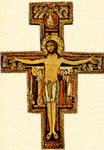
From the Crucifix of San Damiano when Francis was a young man, to the design of what would become the habit in the shape of the cross, to the sign of the Tau (T) at Lateran Council IV (1215) as a mark of renewal to the great episode on Monte LaVerna toward the end of his life when he received the sacred stigmata, the cross of the Lord Jesus always impressed upon St. Francis the great condescension of God toward humanity. Such great love of such a great God!


Undeserving sinners that we are, God has never given up on us nor has God turned his back on us. St. Paul reminds us of this in Romans chapter 5 where he writes, "While we were still in our sins Christ died for us."

As we contemplate the Lord Jesus' Passion, death and burial today -- whether Roman Rite, Byzantine Rite or another Eastern Rite of the Catholic Church -- let us consider this great love of God toward us today.

It transformed the lives of the Mother of God, the Apostles and disciples of the Lord, it transformed Francis' and Clare's lives and the lives of countless saints before us.

May this Good Friday be a powerful blessing for you and may your prayer today lead you ever closer to the Lord Jesus who gave his life for us that we might have life, and have it abundantly (Jn. 10:10).

That is our Christian vocation, after all. And this is the Franciscan vocation as well. We bless you, Lord Jesus for by your very cross you have redeemed the world. We believe this, Lord, we believe. Amen.

Thursday, April 9, 2009

Lord, do you intend to wash my feet, too?

This question posed by St. Peter at the Last Supper according to the Gospel of John (chapter 13) really can be a focus for us, especially in the West.


Icon of Jesus washing the discples' feet at the Last Supper

Will we allow the Lord Jesus to wash our feet? According to Middle Eastern tradition it was the role of the slave or servant to undertake this seemingly distasteful task. Jesus the Master become Jesus the Servant. And then later on in the Last Supper discourse (chapter 14) he tells his disciples that he considers them to be his friends and no longer slaves.

We have become familiar with the symbolic use of feet in the Middle East, especially since the US military involvement in Iraq. Perhaps this takes on even a more profound meaning for us. Whether it was beating the fallen statue of Sadaam Hussein with the soles of shoes, or the angry Iraqi people insulting US soldiers by showing the bottoms of their feet or the reporter throwing both of his shoes at former President Bush in Baghdad, the Middle Eastern attitude toward displaying feet is understood as a negative act.

Jesus willingly takes on a distateful ritual reserved to the lowest members of the household in preparation for undergoing the ignominious "ritual" of Roman crucifixion. And he teaches his disciples to do the same!


Tonight at the Roman Rite Mass of the Lord's Supper the priest will wash the feet of members of the congregation. It seems that whenever folks are asked to have their feet washed in this solemn ceremony they are quite reluctant to do so. There is an unease, an embarrassment about this public display of humility and even affection.


Franciscan priest kissing a parishioner's foot after having washed it


And perhaps that is exactly where we need to be -- just a bit uncomfortable! Peter was aghast that his Lord and Master would literally stoop to this act. It was, quite frankly, shocking. And then to be instructed that this is how the disciples are to relate to one another -- washing one another's feet! Not just as a ritual act but as a symbol of loving one another as Jesus has himself loved us.


As Franciscan friars we see this as our life, our vocation. It is not only in imitation of the Lord Jesus. Even more so, it is allowing Jesus Christ, risen from the dead, to animate us to live, act and behave in his name. From the time of St. Francis of Assisi's remarkable humilty in caring for lepers and also for his brothers, the Franciscans have attempted to undertake this task in cheerful love, especially among the poor, the forgotten, the isolated and the marginalized.


The Mass of the Lord's Supper, which concludes with the solemn transfer of the Holy Eucharist to the Altar of Repose, leads us to prepare for the Lord's Passion. I would like to encourage any who read this blog to take the time, whether at your parish church or at home, and continue the Gospel of John from the conclusion of the this evening's Gospel (John 13:1-15), beginning with verse 16 and continuing slowly through the following chapters of the Gospel -- 14, 15, 16 and 17 -- often called the Last Supper Discourse (that is, teaching) of Jesus.


Powerful messages for us as we enter into this Sacred Triduum -- loving one another as Jesus loves us, the promise of the outpouring of the Holy Spirit, the encouragement for perseverence under trial and the famous prayer of Jesus for the unity of his disciples. And more, of course.


The Agony of the Lord Jesus in the Garden of Gesthemani


Jesus washing the discples' feet leads to his own feet being crucified on Good Friday. He does this for you and for me, indeed, for the whole world.


His washing eventually transforms his disciples. If you will, it is a kind of "baptism" in which they are changed by their Master. It leads us to have the attitude of Jesus (cf. Phil. 2:1-11). The same love and compassion, the same strength and grace, the same trust in his Abba, Father (see Rom. 8:14-17).


He wants to wash your feet. Today. Now. Will you let him?


Come, Lord, and wash my feet, too. Deliver me from sin and from my own selfishness. Change my heart that I may trust you with all things in every circumstance in my life. Bring salvation, Lord Jesus, as you wash my feet even now. Lead me through these holy days of the Triduum into the victory (yes, victory!) of your Cross and Resurrection. Lord, by your Cross and Resurrection you have set me free -- you have set us free -- you are the Savior of the world. Thank you. Amen.

Wednesday, April 8, 2009

Passover Seder and the Eucharist

The celebration of Passover by the Jewish community today has its roots in biblical tradition. However, it is not the same celebration as was conducted by Jews at the time of the Roman occupation and the beginnings of Christianity. It reflects more of a Medieval influence.


Nevertheless, the Haggadah (Hebrew -- story) is the same, namely, God delivered the Hebrew slaves from Egyptian bondage and formed them as his Chosen People in the Sinai Desert and gave them the Torah (Hebrew -- law) through the hands of Moses at Mount Sinai.


The celebration of the the Passover is conducted as a supper and there is a seder (Hebrew -- order) to the meal and all that occurs. It is a home liturgy. The basic contents of the celebration are the meal and the story. This is accompanied by the praying of Psalms, especially Psalms 118, 135 and 136 which render thanks to God for his enduring mercy and recount Israel's liberation from slavery.


The Haggadah text on the right (Hebrew letters for Haggadah), and because Hebrew is written from right to left, the book begins from the right end rather than the left.

The traditional principal foods at the time of Jesus would have been the Passover lamb as cental, the unleavened bread, or matzoh and grape wine. The lamb was likely made into a stew to accommodate as many people as possible for the feast.


The Passover lambs were slaughtered by the priests in the Temple in Jerusalem on the day before the feast began, according to custom, and had to be completed before nightfall. In Hebrew usage, the following day begins at sunset.


By the Middle Ages, perhaps before, the Jewish community ceased using lamb for the Passover meal because in the year AD 70, to quell the Jewish Revolt, the Romans destroyed Jerusalem and razed the Temple. The current edifice, the Dome of the Rock -- or Noble Sanctuary -- the third holiest shrine in Islam, is situated on the grounds where the Jewish Temples were once located.


The Old City of Jerusalem as seen from the Mount of Olives with the Dome o f the Rock (or Noble Sanctuary) to the right, where the ancient Jewish Temples once stood. The Russian Orthodox Monastery of St. Mary Magdelene in in the foreground.


The Jewish Passover now uses a chicken in lieu of the lamb -- there is no Temple at which to sacrifice the lambs and there are no priests to conduct the ritual slaughters. It is a tribute of sacred -- and sad -- memory on behalf of the Jewish community to honor these events in such a manner. They maintain the ancient biblical mandate to keep the Passover, but historical realities have caused a reinterpretation by the rabbis as to how it is to be celebrated.


However, the shank bone of the lamb, in honor of the ancient past, is kept on the seder plate as a reminder of how the celebration was once done and is also a reminder of the hope for a renewed celebration of Pesach in the holy city of Jerusalem. Toward the end of the meal the participants cry out, Lashanah haba b'Yerushalayim! Next year in Jersualem!

Jesus, being Jewish and a rabbi, along with his Apostles, disciples and family would have been very famliar with the customs of his day, including the annual ritual slaughter of the Passover lambs in the Temple just prior to the celebration.

Compare the two separate traditions we have in the Gospels -- the Synoptic tradition (Mark, Matthew and Luke) have the Last Supper as their Passover meal while the Johannine tradition has Jesus die on the very day that the Passover lambs were being slaughtered, just before Passover actually begins.

The differences between the traditions are theological. They do not contradict the foundations of Jesus' Passion, death and resurrecton on the Third Day, nor do they deny the Holy Eucharist. John's tradition places this teaching within the Bread of Life discourse in chapter 6 while the Synoptists place it at the Last Supper on the night before Jesus' death.

Byzanitne icon of "The Mystical Supper" of Jesus with the Apostles on Holy Thursday

For us Christians the Eucharist is the New Passover, the universal Passover. What God instituted through Moses for Israel to commemorate annually the great events of the Exodus foreshadowed the deliverance God would accomplish for all humanity through Jesus Christ who was obedient to death, even death on a Cross (cf. Phil. 2:6-11).

The Mass or Divine Liturgy, then, is our seder meal; the Eucharist is our celebration -- not just annually but weekly on Sundays and even daily -- of the saving events that have brought about the gift of salvation for the whole human race. Our haggadah is the institution narrative we hear at every Celebration of the Eucharist when we believe that the simple bread and wine is transformed by the power of God's Spirit through our recounting of the event and words of the Lord Jesus into the very Body and Blood, Soul and Divinity of our Savior.

Jesus himself is our Passover; he is the Paschal Lamb! He is our Pesach. Is this not what we hear in the Roman Rite before approaching the altar for Holy Communion? The priest, addressing the assembly, cries out, "This is the Lamb of God who takes away the sins of the world . . ." to which we respond, "Lord, I am not worthy to receive you, but only say the word and I shall be healed!"

We properly honor our "elder brothers (and sisters)" as Pope John Paul II was wont to call the Jewish community in their annual celebration of God's great saving event in the formation of the House of Israel -- the Exodus. That is part of our heritage as Christians. Let us remember our Jewish brothers and sisters, then, as we celebrate the seder and recount the haggadah of our salvation in Christ this Holy Week and especially the Sacred Triduum, the Great Passover of the Son of the God of Israel.